Welcome to the fourth lesson in our module on the fundamentals of financial accounting. In our last session, we established the core principle that every business transaction has a dual effect, always keeping the accounting equation, , in balance. We visualized this using a tabular analysis, which was a great conceptual tool.
Today, we transition from that conceptual framework to the practical, formal system that accountants use worldwide: double-entry bookkeeping. We will learn how to translate the "dual effect" into a language of debits and credits, recording transactions in individual ledger accounts. This lesson is all about the mechanics of how financial data is systematically captured, forming the bedrock upon which all financial statements are built.
1. From Columns to Accounts: The Ledger
In the previous lesson, we used a table with columns for Cash, Equipment, Liabilities, and Capital. In a real accounting system, each of these items has its own dedicated record, called a ledger account. For visual and educational purposes, these are often represented as a 'T' shape, which is why you'll frequently hear them called T-accounts.
A T-account has a title (e.g., "Cash") and two sides:
- The left-hand side is called the debit side (abbreviated Dr).
- The right-hand side is called the credit side (abbreviated Cr).
The core idea of double-entry is that for every transaction, the total debits must equal the total credits. This ensures the accounting equation remains balanced at all times. The key is to know which account to debit and which to credit for any given transaction.
2. The Rules of the Game: PEARLS
The decision to debit or credit an account depends on two things:
- What type of account is it (Asset, Liability, Equity, Income, or Expense)?
- Is the account increasing or decreasing?
There is a standard set of rules that governs this process. A very helpful way to remember these rules is the mnemonic PEARLS.
Ledger Accounting and DoubleEntry Bookkeeping
This chapter from a Kaplan study text provides a clear and structured introduction to the rules of double-entry bookkeeping.
First, read the section on "Ledger accounts, debits and credits" to understand the basic format. Focus on the table that summarises the rules for debit and credit entries. You can find it by looking for the heading 4 Ledger accounts, debits and credits. Next, read the section "Summary of bookkeeping entries" which introduces the PEARLS mnemonic. Find the table under the heading 9 Summary of bookkeeping entries.
As the text explains, the rules can be summarised as follows:
| PEARLS Mnemonic | To INCREASE the account | To DECREASE the account |
|---|---|---|
| Purchases | Debit | Credit |
| Expenses | Debit | Credit |
| Assets | Debit | Credit |
| Revenue (Income) | Credit | Debit |
| Liabilities | Credit | Debit |
| Shareholders' Equity (Capital) | Credit | Debit |
Notice the pattern: all the accounts on the left side of the accounting equation (Assets) and items that decrease equity (Expenses, Drawings/Purchases) are increased by debits. All the accounts on the right side of the equation (Liabilities, Equity) and items that increase equity (Revenue/Income) are increased by credits.
Another popular mnemonic you might encounter is DEALER (Dividends, Expenses, Assets increase with debits; Liabilities, Equity, Revenue increase with credits). Both serve the same purpose. The key is to internalise this logic.
3. Applying the Rules: A Step-by-Step Example
With the rules established, let's see them in action. The following video provides an excellent, detailed walkthrough of recording a series of transactions for a new business, starting from scratch. The presenter initially refers to "opposite pages" in a book, which is the origin of the debit/credit concept, before adopting the formal terminology.
Double Entry Bookkeeping (part a) - ACCA Financial Accounting (FA) lectures
This lecture from OpenTuition, "Double Entry Bookkeeping", is a fantastic, practical demonstration that aligns perfectly with your preference for worked examples.
Watch the video from the beginning until the end of the examples. Pay close attention to how the instructor analyzes each transaction to decide which two accounts are affected and then applies the "opposite pages" (debit/credit) rule. Here are the key transactions demonstrated: Owner's capital injection: Debit Cash (Asset increases), Credit Capital (Equity increases). Cash purchase of a car (asset): Debit Car (Asset increases), Credit Cash (Asset decreases). Purchase of goods: Both for cash and on credit. Notice the debit to a "Purchases" account (an expense-like account) and the credit to either Cash or Payables (a liability). Payment of an expense (rent): Debit Rent Expense (Expense increases), Credit Cash (Asset decreases). Sale of goods: Both for cash and on credit. Notice the credit to a "Sales" account (Revenue) and the debit to either Cash or Receivables (an asset). Cash movements with payables/receivables: Paying a supplier and receiving cash from a customer. Owner's withdrawal (drawings): Debit Drawings (Equity decreases), Credit Cash (Asset decreases).
4. Formalising the Record: The Journal Entry
While T-accounts are great for visualizing the balances of individual accounts, the first place a transaction is formally recorded is in a journal. The journal is a chronological list of all transactions, like a business diary. The process of recording in a journal is called journalizing. Once recorded in the journal, the amounts are then transferred, or posted, to the individual ledger accounts (the T-accounts we've been using).
A standard journal entry has a specific format.
3.5 Use Journal Entries to Record Transactions and Post to ...
This article from OpenStax clearly explains the purpose of a journal and the formatting rules for creating journal entries.
Please read the first two sections, starting from the beginning down to the end of the formatting rules. Focus on the structure: date, debits first, credits indented, and a brief description.
The image below shows a clean, modern example of how these journal entries might look in a spreadsheet. Each transaction is a self-contained block where debits equal credits.
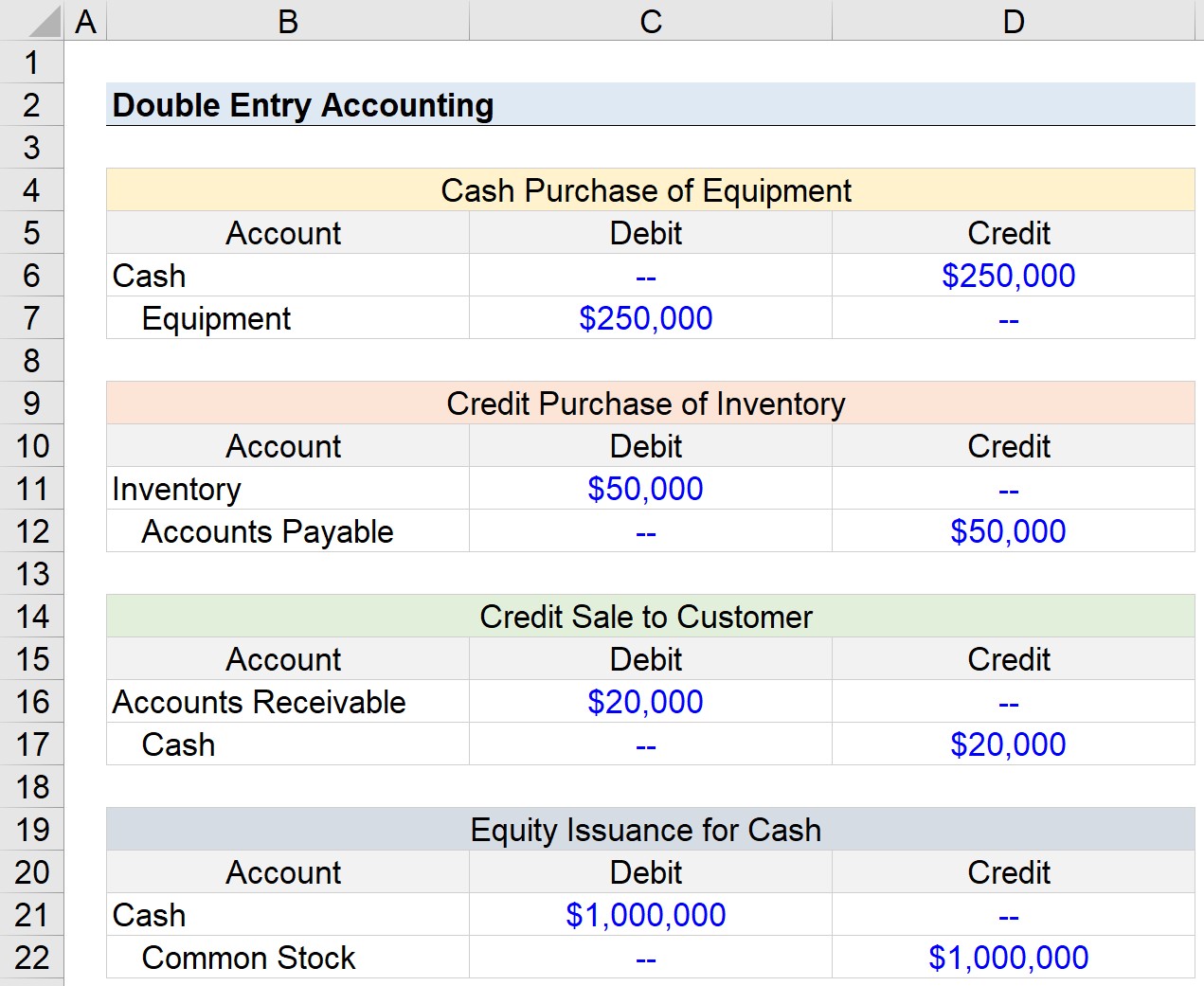
You have now seen the complete flow:
- A transaction occurs.
- It is analyzed to determine which accounts are affected.
- The rules of debit and credit (PEARLS) are applied.
- A journal entry is created to formally record the transaction.
- The debit and credit amounts are posted from the journal to the respective ledger T-accounts.
5. Practice Makes Perfect
The best way to become proficient with double-entry is through practice. The Kaplan study text contains an excellent exercise with a series of transactions for a new business. I strongly encourage you to work through it.
In the resource Ledger Accounting and Double-Entry Bookkeeping (ID: LINK), navigate to Illustration 2 near the end of the chapter (page 130). You will find a list of 15 transactions for a new business started by "BR". Your task is to prepare the ledger account (T-account) entries for each one. A helpful tip provided in the text is to first create a table identifying the accounts involved, their type, and whether they are being debited or credited.
The full solution is provided in the "Test your understanding answers" section at the very end of the PDF, allowing you to check your work. This exercise is the perfect way to apply what you've learned today.
Conclusion
In this lesson, we have built the mechanical foundation of accounting. We have moved beyond the conceptual accounting equation to the practical system of double-entry bookkeeping that brings it to life.
Key Takeaways:
- Double-entry bookkeeping records the dual effect of every transaction using equal debits and credits.
- Ledger accounts (T-accounts) track the balance of individual items like cash or sales. The left side is for debits, the right for credits.
- The PEARLS mnemonic is a powerful tool to remember the rules: increases in Purchases, Expenses, and Assets are Debits; increases in Revenue, Liabilities, and Shareholders' Equity are Credits.
- Transactions are first recorded chronologically in a journal and then posted to the ledger accounts.
In our next lesson, we will refine our recording skills by focusing on an important classification decision: distinguishing between capital expenditure (e.g., buying a machine) and revenue expenditure (e.g., paying for electricity). The choice of which account to debit has a significant impact on a company's assets and its reported profit for the period.