Welcome to the next lesson in our journey through the fundamentals of financial accounting. In our previous session, we explored the core accounting concepts that act as the 'rules of the game' for financial reporting. We saw how principles like accruals and prudence have a direct numerical impact on a company's reported figures.
Today, we shift our focus from the rules to the players themselves: the five fundamental elements of financial statements. We will define assets, liabilities, equity, income, and expenses. Most importantly, we will introduce the accounting equation—the foundational mathematical relationship that governs all of accounting—and apply it to a series of practical business transactions. This lesson will serve as a crucial bridge, connecting the 'why' of accounting concepts to the 'how' of bookkeeping mechanics, which we will tackle next.
1. The Elements of Financial Position
At any given moment, a company's financial standing can be summarised by three core elements. These are presented in a key financial statement called the Statement of Financial Position, often referred to as the Balance Sheet.
Let's start by defining these three elements.
The accounting equation | Student Accountant
This article from ACCA Global provides clear and concise definitions for the core elements of the accounting equation.
Please read the first part of the article, from the beginning down to the initial definition. Then, continue reading the explanations for Capital, Assets, and Liabilities until you reach the heading What about drawings.
As the article explains:
- Assets are economic resources controlled by the business as a result of past events, from which future economic benefits are expected to flow. Think of assets as what the business owns. Examples include cash in the bank, machinery, buildings, and money owed to the business by customers (receivables).
- Liabilities are present obligations of the business arising from past events, the settlement of which is expected to result in an outflow of resources. Think of liabilities as what the business owes to others. Examples include bank loans and money owed to suppliers (payables).
- Equity (also called Capital for a sole trader) is the residual interest in the assets of the business after deducting all its liabilities. This represents the owner's claim on the net assets of the business. It's what would be left over for the owner if all assets were sold and all liabilities were paid off.
These three elements are bound together by the fundamental accounting equation:
This equation must always hold true. It presents two perspectives of the business that must be in balance: the resources it controls (Assets) and the claims on those resources (from lenders/creditors as Liabilities, and from owners as Equity).
2. The Elements of Financial Performance
While the balance sheet gives a snapshot in time, we also need to measure performance over a period. This is done using two other elements, which are reported on the Statement of Profit or Loss (also known as the Income Statement).
- Income (or Revenue): These are increases in economic benefits during the accounting period, such as inflows of cash or other assets, that result in an increase in equity. Simply put, it's what a business earns from its activities, like sales of goods or fees for services.
- Expenses: These are decreases in economic benefits during the accounting period, such as outflows of cash or the using up of assets, that result in a decrease in equity. Simply put, these are the costs incurred to generate income, like salaries, rent, and electricity.
The net effect of income and expenses is the profit or loss for the period (). This profit (or loss) directly impacts equity. Profit increases the owner's claim on the business, while a loss decreases it.
We can now create an expanded accounting equation that incorporates these elements, along with Drawings (when an owner takes money out of the business for personal use):
This expanded version beautifully illustrates how the performance during a period (Income - Expenses) connects to the financial position.
3. Applying the Accounting Equation: A Practical Walkthrough
The best way to understand the accounting equation is to see it in action. Every single transaction a business undertakes has a dual effect that keeps the equation in balance.
The following video provides an excellent, detailed walkthrough of ten different business transactions, showing precisely how each one affects the components of the accounting equation. Your task is to see how the logic we've just discussed is applied numerically.
Accounting Equation - Problem 1 - By Saheb Academy
This video, "Accounting Equation - Problem 1" from Saheb Academy, meticulously analyses a series of transactions and plots their impact on a tabular analysis sheet. It's a perfect example of the practical application you prefer.
First, watch the analysis of the following key transactions to understand their dual impact: Initial capital investment: An increase in Cash (Asset) and an increase in Capital (Equity). Credit purchase of goods: An increase in Stock (Asset) and an increase in Creditors (Liability). Cash purchase of goods: An increase in one asset (Stock) and a decrease in another (Cash). Sale of goods for profit: Note the three effects here—Cash (Asset) increases, Stock (Asset) decreases, and Capital (Equity) increases by the profit. Cash withdrawal by owner: A decrease in Cash (Asset) and a decrease in Capital (Equity). Paying a creditor with a discount: This is a great example. Cash (Asset) decreases, the Creditor (Liability) is fully removed, and the discount received is Income, which increases Capital (Equity). Depreciation of an asset: A non-cash expense that decreases an Asset (Furniture) and decreases Capital (Equity). After understanding the logic, watch the full solution from this section to see how all these transactions are compiled into a final table, with the equation balancing after every single entry.
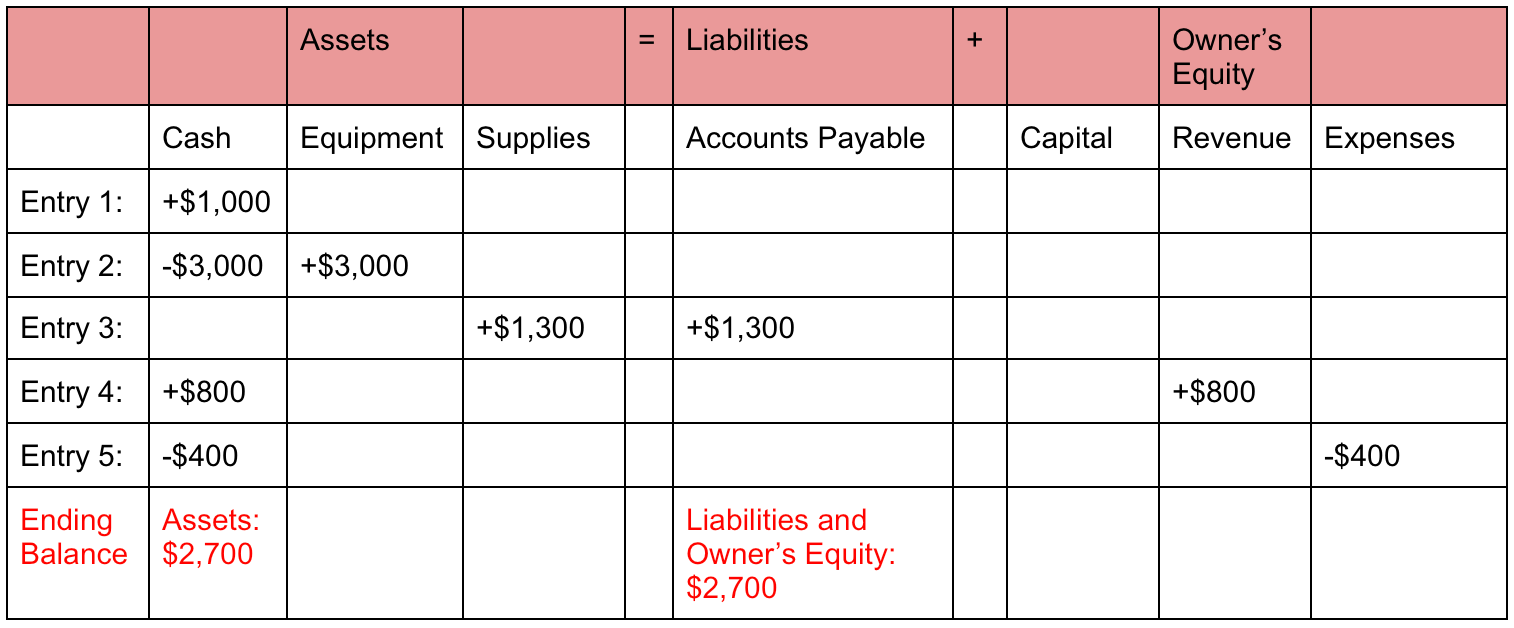
The tabular analysis shown in the video is a powerful way to visualize the dual effect of transactions. Below is a summary table, similar to the one in the video, illustrating five simple transactions and how the equation always balances.
4. From the Equation to the Balance Sheet
The ultimate goal of this process is to produce the financial statements. The balances you see at the end of the tabular analysis are the exact numbers that will be used to construct the Balance Sheet.
Let's solidify this with another comprehensive example. The following resource walks through eight transactions for a new business, showing not only the effect on the accounting equation but also how the Balance Sheet looks after each step.
Accounting Equation | Explanation | AccountingCoach
This in-depth explanation from AccountingCoach.com provides an excellent, step-by-step demonstration of how transactions are recorded and how they build up the financial statements.
Please read through the sections covering Transactions #1 through #8, starting from this point. For each of the eight transactions, pay close attention to: The explanation of the transaction's effect on the accounting equation. The resulting Balance Sheet presented after the transaction. See how the statement evolves with each entry.
After working through all eight transactions in the article, you will arrive at a final financial position. The Balance Sheet for Accounting Software, Inc. as of December 8, 2025, shown below, is the final output of that entire process.

Conclusion
In this lesson, we have defined the five essential elements of financial statements and demonstrated their unbreakable relationship through the accounting equation. You have seen, through detailed numerical examples, how every business event has a dual impact that is captured by this framework.
Key Takeaways:
- The five elements are Assets, Liabilities, Equity, Income, and Expenses.
- The fundamental accounting equation is Assets = Liabilities + Equity.
- The expanded equation incorporates income and expenses, showing how a company's performance over a period affects its financial position: .
- Every transaction has a dual effect, ensuring the equation always remains in balance. This might be a change in an asset and a liability, two different assets, or an asset and an equity account.
We have analysed transactions using a tabular format, which is a great conceptual tool. However, it is not how real-world accounting is done. In our next lesson, we will take the final step into practical bookkeeping by learning the double-entry system, which uses debits and credits to formally record these dual effects in accounts.