Welcome to the final lesson in our module on alternative financing. In our last session, we explored securitisation, a complex process that transforms illiquid assets into tradable securities. We saw how financial engineering could create different risk and return profiles from a single pool of debt.
Today, we'll examine two of the most modern forms of alternative finance: crowdfunding and peer-to-peer (P2P) lending. These technology-driven models have democratised both investing and borrowing. Our goal is to compare crowdfunding and peer-to-peer lending with traditional financing using cost and return analysis. This will involve digging into the numbers to understand the trade-offs for both the businesses seeking funds and the individuals providing them.
1. The Crowdfunding and P2P Lending Model
At its heart, crowdfunding is about sourcing small amounts of money from a large number of people (the "crowd"), typically via an online platform. This model bypasses traditional financial intermediaries like banks. While P2P lending is often used interchangeably with crowdfunding, it is technically a specific type of it.
Let's clarify the main forms:
- Donation- and Reward-based: Backers contribute to a project in exchange for a sense of altruism or a non-financial reward (e.g., the product being developed). Websites like Kickstarter are famous for this.
- Equity-based: Investors receive shares in the company in exchange for their capital. This is an alternative to seeking venture capital.
- Debt-based (P2P Lending): This is our main focus. Individuals or institutions lend money to businesses or other individuals in exchange for interest payments and the eventual return of principal. Platforms like Lending Club, Prosper, and Funding Circle facilitate these loans.
The key mechanism is the online platform, which performs several functions that a traditional bank would, such as verifying identity, assessing credit quality, and processing payments. To understand this model better, let's start with a foundational reading.
Peer-to-peer lending to small businesses - Federal Reserve
This paper from the Federal Reserve provides an excellent introduction to crowdfunding and how peer-to-peer (P2P) lending fits within this framework.
Please read the section titled Crowdfunding. Focus on how the article distinguishes between donation/reward, equity, and debt-based (P2P) models. Pay attention to the role of the SEC's classification of P2P loans as securities, which was a pivotal moment for the industry.
2. The Borrower's Perspective: Cost Analysis
For a small business, the most common traditional financing option is a bank loan. How do P2P loans compare in terms of cost?
While P2P lending can offer faster and more accessible funding, especially for those who might be declined by a bank, this often comes at a higher price. Research on P2P platforms has shown that the interest rates charged can be significantly higher than those for traditional small business loans.
A study using data from Lending Club, a major US P2P platform, provides a clear numerical comparison.
Peer-to-peer lending to small businesses - Federal Reserve
This section of the Federal Reserve paper dives into a direct cost comparison.
Please read the first part of the section Interest Rate Paid. Pay close attention to Table 7, which compares the average interest rates for Lending Club small business loans with those for traditional small business loans reported by the National Federation of Independent Business (NFIB). The visual in Figure 5 also powerfully illustrates this difference. Note the substantial margin between the P2P rates and traditional bank rates.
The data you just reviewed shows P2P loan rates for small businesses averaging over 12%, while traditional bank loans for similar firms averaged around 7%.
Given your background in statistics, you'll find the regression analysis in the same paper particularly insightful. After controlling for borrower quality (FICO scores, employment duration, etc.), the study found that P2P loans for small businesses were charged an interest rate nearly a full percentage point higher than loans for other purposes on the same platform. This premium suggests that the platform prices in a higher perceived risk for business ventures.
3. The Investor's Perspective: Return Analysis
If borrowers are paying more, investors must be earning more. P2P lending offers individuals the chance to act like a bank and earn returns from lending. These returns are significantly higher than those from a traditional bank savings account but must be weighed against the risk.
Let's analyse the returns investors have actually achieved, net of fees and defaults.
[PDF] The economics of peer-to-peer lending | Oxera
The Oxera report provides a detailed analysis of investor returns in the UK P2P market.
Please read the subsection Investor returns. Focus on Figures 3.3 and 3.4, which show the net returns for investors in consumer and business P2P loans. Then, examine Figure 3.5, which benchmarks these returns against the yields of corporate bonds of varying credit ratings (AA, A, BBB, etc.).
As the report shows, net investor returns have been in the range of 4-8%. The comparison in Figure 3.5 is crucial: P2P lending returns are "broadly consistent with the typical yields of high-yield corporate bonds with ratings of BB or B." This places P2P lending firmly in the category of a medium-to-high risk investment, not a savings product. It offers a higher return to compensate for the higher risk of borrower default compared to, say, a government bond or a savings deposit.
4. A Key Calculation: Effective Annual Rate (EAR)
When comparing costs, simply looking at the advertised "nominal" interest rate can be misleading. A 15% rate compounded annually is different from a 15% rate compounded monthly. To make a true "apples-to-apples" comparison between a traditional loan and a P2P loan, we must calculate the Effective Annual Rate (EAR).
The EAR is the true rate of return or cost of borrowing, taking the effect of compounding into account. The formula is:
where:
- = the nominal annual interest rate
- = the number of compounding periods per year

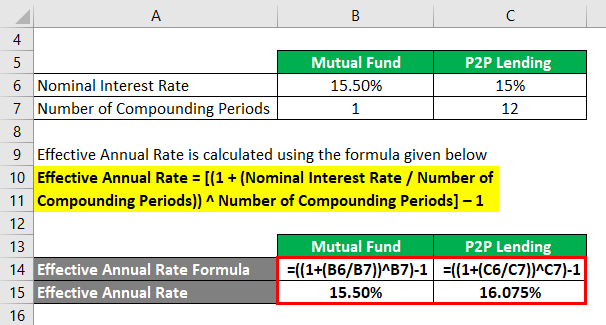
Let's consider a simple example. A business is choosing between two loan options:
- Traditional Bank Loan: 15% nominal rate, compounded annually ().
- P2P Loan: 15% nominal rate, compounded monthly ().
For the bank loan, the EAR is straightforward:
For the P2P loan, the monthly compounding increases the effective cost:
Even though both loans have the same nominal rate, the P2P loan is slightly more expensive for the borrower (and more lucrative for the investor) due to the more frequent compounding.
The following image shows this exact calculation performed in a spreadsheet, a common tool for financial analysis.
5. The Risk Behind the Return
Higher returns for investors invariably mean higher risks. The main risk in P2P lending is borrower default. The Federal Reserve paper you read earlier provides a stark statistical confirmation of this.
In its analysis of loan performance, after controlling for borrower and loan characteristics, the study found that P2P loans for small businesses were more than 2.5 times more likely to perform poorly (i.e., become delinquent or be charged off) than loans for other purposes. This higher default risk is precisely why lenders demand a higher interest rate and why investors can earn higher returns. It's the compensation for taking on that elevated probability of loss.
Platforms attempt to manage this risk for investors through several mechanisms:
- Credit Assessment: Sophisticated models to screen borrowers.
- Diversification: Tools that automatically spread an investor's funds across hundreds or thousands of different loans.
- Buffer Funds: Some platforms maintain a reserve fund (paid for by a portion of borrower fees) to cover expected losses, smoothing returns for investors. However, these funds are not guaranteed and could be depleted in a severe economic downturn.
- Secondary Markets: Platforms may offer a way for investors to sell their loans to other investors before maturity, providing some liquidity, though this is not guaranteed.
Conclusion
Today we've seen that P2P lending and crowdfunding present a clear set of trade-offs when compared to traditional financing.
Key Takeaways:
- For Borrowers: P2P lending offers greater accessibility and speed but often at a higher cost (higher effective interest rates) than traditional bank loans.
- For Investors: P2P lending provides higher returns than traditional savings accounts, comparable to high-yield corporate bonds. This higher return is direct compensation for taking on significant borrower default risk.
- Cost Comparison: To accurately compare loan costs, you must calculate the Effective Annual Rate (EAR) to account for differences in compounding frequency.
- Risk Profile: P2P lending transforms a traditional bank loan into a new asset class for investors, one with a specific and relatively high risk-return profile. The risk is not just theoretical; data shows significantly higher default rates for P2P business loans.
This lesson concludes our module on alternative financing. We have journeyed from private equity and securitisation to the modern world of P2P lending. In our next session, we will pivot to a completely new area of the CB1 syllabus: the fundamentals of financial accounting. We will begin by learning why financial statements are prepared and who uses them.