Welcome to your next lesson. In our previous session, we analysed the world of private equity and venture capital, focusing on how they differ from traditional financing methods like bank loans. We saw that these alternatives provide specialised capital for companies at transformational stages, from high-growth startups to mature firms undergoing major restructuring.
Today, we continue our journey through alternative financing by examining a powerful and complex technique: securitisation. This process was at the heart of the 2008 financial crisis, but it remains a fundamental tool in modern finance. Our goal is to illustrate the mechanics of securitisation using a numerical example of cash flow transformation. You will learn how a pool of illiquid assets, like car loans or mortgages, can be bundled together and converted into new, tradable securities with diverse risk and return profiles. This process of financial engineering is a fascinating application of risk redistribution.
1. The Securitisation Process: Creating Value from Pools of Debt
At its core, securitisation is the process of taking an illiquid asset, or group of assets, and through financial engineering, transforming them into a security. A typical example involves a bank that has issued thousands of car loans. These loans are assets for the bank, generating steady cash flows, but they are not easily tradable. The bank cannot sell a single car loan to an investor on a stock exchange. Securitisation solves this problem.
The process involves a few key players and steps:
- The Originator: This is the institution that originally created the assets, such as the bank that made the car loans.
- The Asset Pool: The originator bundles these individual assets (e.g., thousands of car loans) into a large, diversified portfolio.
- The Special Purpose Vehicle (SPV): The originator sells this asset pool to a new, legally separate entity called a Special Purpose Vehicle (or Special Purpose Entity, SPE). This is a critical step. Because the SPV is a separate company, its assets (the loan pool) are protected even if the originator goes bankrupt. This is known as being bankruptcy-remote.
- Issuance of Asset-Backed Securities (ABS): The SPV raises the money to buy the asset pool by issuing new, tradable securities to investors. These securities are "asset-backed" because their value and cash flows come directly from the underlying pool of loans. The cash—interest and principal payments from the original borrowers—flows from the asset pool, through the SPV, and out to the investors who bought the ABS.
To see this process explained, let's watch a section of the following video.
Asset-Backed Securities (ABS) Explained | CFA Level 1 Fixed Income | Complete Concept | Simple Terms
The video "Asset-Backed Securities (ABS) Explained" provides a clear, step-by-step walkthrough of the securitisation process.
Please watch from the beginning of the main explanation. Focus on understanding the roles of the originator and the SPV, and why separating the assets from the originator's balance sheet is so important for protecting investors. The speaker clearly illustrates how the cash flows from the original borrowers are used to pay the new ABS investors.
2. Tranching: The Art of Slicing Risk
Here is where the real transformation happens. The SPV doesn't just issue one uniform type of security. Instead, it slices the claims on the asset pool's cash flows into different classes, or tranches, each with a distinct level of risk and reward. This is the key to broadening the appeal of the investment to different types of investors, from the very risk-averse to those seeking high returns.
The most common structure involves three tiers:
- Senior Tranche: The safest tranche. It has the first claim on the cash flows from the asset pool. It also has the lowest risk of default and, consequently, offers the lowest return. These are often rated AAA.
- Mezzanine Tranche: The middle tier. It gets paid after the Senior tranche is fully paid. It carries more risk than the senior tranche but offers a higher return to compensate.
- Equity Tranche (or Junior Tranche): The riskiest tranche. It has the last claim on cash flows and is the first to absorb any losses from defaults in the asset pool. It's often unrated and may not be publicly traded. In exchange for taking on this high risk, equity tranche investors have the potential for the highest returns, receiving whatever cash is left after the senior and mezzanine tranches are paid.
This hierarchical structure is often referred to as a waterfall.
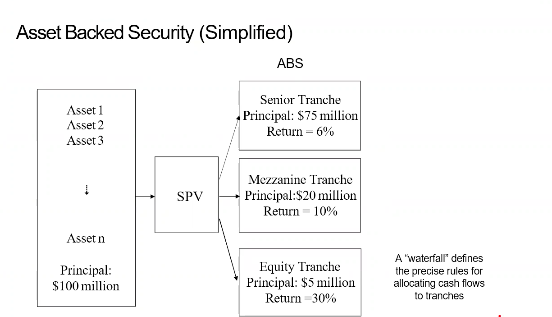
The waterfall has two sides:
- Cash Flow Distribution: Interest and principal payments from the asset pool flow down the waterfall. The Senior tranche gets paid first, then the Mezzanine, and finally the Equity tranche gets the residual.
- Loss Allocation: If borrowers in the asset pool default, the losses flow up the waterfall. The Equity tranche absorbs the first losses. Only after the Equity tranche is completely wiped out does the Mezzanine tranche begin to take losses. The Senior tranche is only affected if losses are so catastrophic that they wipe out both the Equity and Mezzanine tranches.
Given your background in probability theory, you can think of tranching as a method for partitioning the risk of the underlying asset pool. The equity tranche absorbs the initial, more probable losses, while the senior tranche is designed to be affected only by extreme, low-probability "tail" events.
To solidify these concepts, the following article explains the structure and the waterfall mechanism in more detail.
Securitisation and tranching | P4 Advanced Financial Management
This article from ACCA Global provides a concise and clear explanation of securitisation, CDOs, and the tranching structure.
Please read the first two main sections of the article. Start at the beginning to get an overview. Then, focus carefully on the section The structure of CDOs, which explains the different tranches and the waterfall analogy for cash and loss distribution.
3. A Numerical Example of Cash Flow Transformation
Now, let's put this all together with a numerical example, which is the core of today's learning outcome. We will use the scenario from the ACCA article you just reviewed to see exactly how the cash flows are transformed.
The Scenario:
- Originator: A bank.
- Asset Pool: A mortgage book with a total value of $350 million.
- Cash Inflow: The mortgages generate a net income of 7% per year.
- SPV Action: The bank securitises 85% of the mortgage pool. The securities issued by the SPV have the following structure:
- Senior Tranche: 75% of the collateral value, paying investors 6% per year.
- Mezzanine Tranche: 15% of the collateral value, paying investors 11% per year.
- Equity Tranche: 10% of the collateral value, receiving the residual cash flow.
Let's work through the cash flow transformation step-by-step.
Step 1: Calculate the total annual cash inflow from the asset pool.
This is the money generated by the underlying mortgages that will be paid to the SPV.
Step 2: Calculate the value of the collateral backing the new securities.
The bank is only securitising 85% of the pool.
Step 3: Calculate the principal value of each tranche.
These values represent the amount of securities sold to each class of investor.
- Senior Tranche Principal:
- Mezzanine Tranche Principal:
- Equity Tranche Principal:
Step 4: Calculate the annual cash outflow to the Senior and Mezzanine tranches.
This is the interest the SPV is committed to paying these investors.
- Payment to Senior Tranche:
- Payment to Mezzanine Tranche:
- Total Committed Payments:
Step 5: Calculate the residual cash flow available for the Equity tranche.
This is what's left of the total inflow after the senior and mezzanine investors have been paid.
Step 6: Calculate the return on the Equity tranche.
This shows the high potential return for the riskiest investors.
This calculation perfectly illustrates the cash flow transformation. The securitisation process has taken a simple pool of mortgages yielding 7% and re-engineered it into three distinct products:
- A low-risk security yielding 6%.
- A medium-risk security yielding 11%.
- A high-risk, high-return security yielding nearly 21%.
This allows investors to choose the risk-return profile that best suits their appetite.
Now, please review the worked example in the article to reinforce your understanding.
Securitisation and tranching | P4 Advanced Financial Management
This section of the article provides the numerical example we just walked through.
Read the section titled Example. Compare the calculations and figures with the steps we just completed. Note how the article arrives at the same 20.8% return for the high-risk investment.
4. Credit Enhancement
To ensure the tranches have their intended risk profiles, securitisation structures use credit enhancements. The primary method is the subordination we've already discussed (i.e., the waterfall structure). Two other common internal credit enhancements are:
- Overcollateralization: The total value of the assets in the pool is greater than the total face value of the securities issued. For example, the SPV might issue $95 million in ABS against a $100 million asset pool. The extra $5 million in assets provides a buffer against losses.
- Excess Spread: The interest rate earned on the underlying assets is higher than the average interest rate paid to the ABS holders. In our numerical example, the asset pool yielded 7%, while the weighted average interest on the senior and mezzanine tranches was about 7.2%. After accounting for all tranches, there's a significant surplus. This difference, the "excess spread," can be held in a reserve account to cover any unexpected shortfalls before they affect the payments to investors.
The following resource provides a clear definition of these concepts.
Structured Credit Risk | FRM Part II Study Notes - AnalystPrep
This article from AnalystPrep provides detailed definitions of the components of a securitisation.
Please read the sections Tranching and Distribution and Waterfall Structure. Pay special attention to the definitions of subordination, over-collateralization, and excess spread.
Conclusion
In this lesson, we dissected the process of securitisation, seeing how it transforms simple, illiquid debt into a range of tradable securities. This mechanism is a cornerstone of modern finance, enabling risk to be managed, redistributed, and sold to those best able to bear it.
Key Takeaways:
- Securitisation involves an originator selling a pool of assets to a bankruptcy-remote Special Purpose Vehicle (SPV).
- The SPV finances this purchase by issuing Asset-Backed Securities (ABS) to investors.
- The core mechanic is tranching, which slices the cash flows from the asset pool into different risk/return profiles (e.g., Senior, Mezzanine, Equity).
- The waterfall structure dictates that cash flows are distributed top-down (Senior first), while losses are absorbed bottom-up (Equity first).
- Through a numerical example, we saw how a 7% yielding asset pool was transformed into securities offering 6%, 11%, and 20.8%, catering to different investor appetites.
We have now covered several key forms of alternative finance. In our next and final lesson in this module, we will explore the more recent innovations of crowdfunding and peer-to-peer lending, comparing them to the traditional financing models we've studied.