Welcome to our third lesson on short-term and alternative financing. In our previous lesson, we analyzed trade credit and calculated the high effective annual cost of forgoing an early payment discount. This highlighted how seemingly simple financing choices can have significant hidden costs.
Today, we move from financing inventory to financing the use of long-term assets, such as equipment, vehicles, or buildings. We will explore two common methods for this: leasing and hire purchase. These options allow a company to use an asset without the large initial cash payment required for an outright purchase.
Our focus for this lesson is to fulfill the learning outcome: Describe the mechanics of leasing and hire purchase, identifying the relevant after-tax cash flows. We will break down the financial components of both leasing and buying an asset, laying the essential groundwork for the next lesson, where we will use this information to perform a full quantitative analysis to decide which option is cheaper.
1. Understanding Leasing
At its core, a lease is a contractual agreement where one party, the lessor (the owner of the asset), grants another party, the lessee (the user of the asset), the right to use the asset for a specified period in exchange for periodic payments.
It is useful to distinguish between two main categories of leases, as they have different financial characteristics. Think of it like the difference between renting an apartment for a year versus taking out a 30-year mortgage to buy a house. Both provide you with a place to live, but the nature of the commitment, responsibility, and financial structure are vastly different.
The following reading provides a formal introduction to these concepts.
[PDF] LEASE FINANCING AND BUSINESS VALUATION
This excerpt from a textbook on Healthcare Finance offers a clear and comprehensive introduction to the fundamentals of leasing. It defines the key parties involved and distinguishes between the two primary types of leases.
Please read the first part of this chapter, focusing on the sections titled Leasing Basics, Operating Leases, and Financial Leases. Pay attention to the key differences in terms of duration, maintenance responsibility, and how the payments relate to the asset's cost.
As you read, you'll see the two main types are:
- Operating Leases: These are more like a simple rental agreement. They are typically short-term, not covering the asset's full economic life. The lessor is often responsible for maintenance, and the lease may include a cancellation clause. The payments are treated as a straightforward operating expense.
- Financial (or Capital) Leases: These are long-term arrangements that are more akin to a financing transaction to purchase the asset. They are non-cancellable and cover most of the asset's useful life. The lessee is usually responsible for maintenance, and the total payments are sufficient to cover the lessor's cost for the asset plus a return on their investment.
2. Leasing vs. Hire Purchase
A hire purchase agreement is another popular way to finance an asset. It is structurally similar to a financial lease, but with a crucial distinction regarding ownership. In a hire purchase contract, the user (the "hirer") makes regular payments for a specified period. At the end of this period, the hirer typically has the option to purchase the asset for a nominal sum, and ownership is then transferred.
The table below provides a concise comparison of the key differences between lease financing and hire purchase.
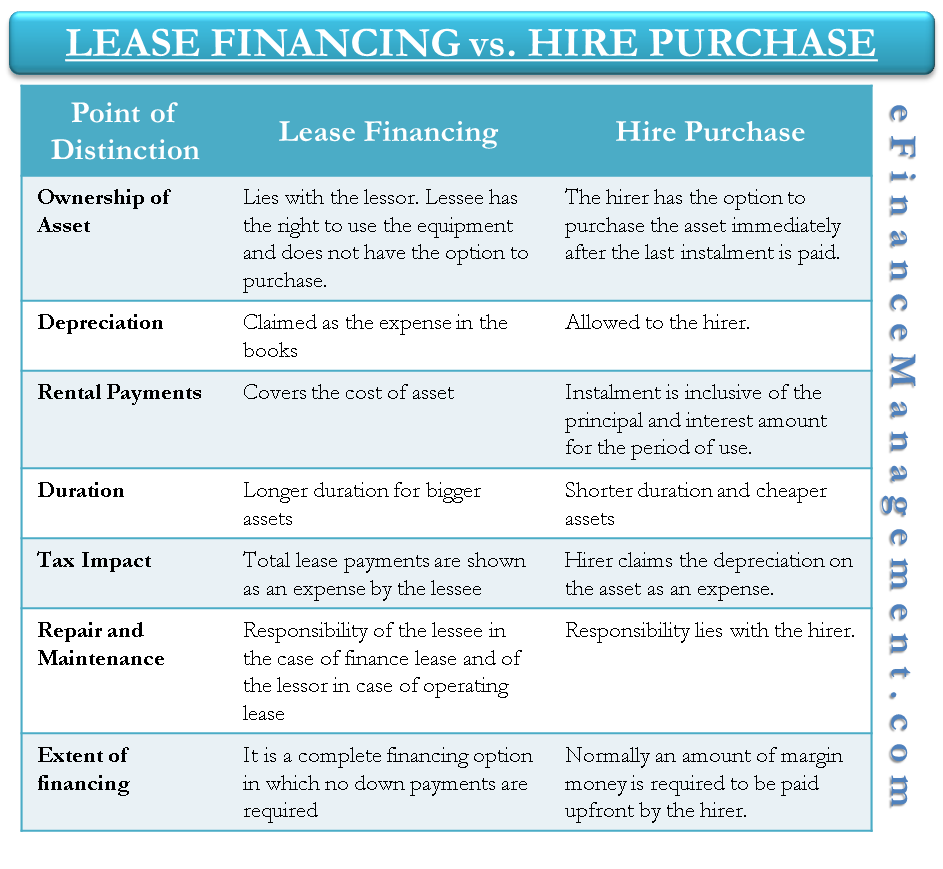
The most critical difference for our purposes is how ownership and depreciation are treated, as this directly affects the after-tax cash flows, which we will explore next.
3. Identifying the Relevant After-Tax Cash Flows
To decide whether leasing or buying is the better financial option, a company must compare the cash flows associated with each choice. The decision isn't simply about comparing the lease payment to a loan payment. We must consider all relevant cash flows, especially the tax implications, which can be substantial. As a statistician, you know that the quality of any model's output depends entirely on the quality of its inputs; here, our inputs are the correctly identified cash flows.
Let's break down the cash flows for each alternative.
Alternative 1: Leasing the Asset
The cash flows associated with leasing are relatively straightforward:
- Lease Payments: These are the regular payments made to the lessor. They are a cash outflow. It's important to note their timing (e.g., paid at the start or end of each period).
- Tax Savings on Lease Payments: Because lease payments are generally considered an operating expense, they are tax-deductible. This means they reduce the company's taxable profit, which in turn reduces its tax bill. This tax reduction is a cash inflow.
- Calculation: Tax Saving = Lease Payment × Corporation Tax Rate
Alternative 2: Buying the Asset
The cash flows for buying are more complex. This option is usually financed with a loan.
- Purchase Cost: The initial price of the asset. This is a large cash outflow at the beginning of the project (Time 0).
- Maintenance Costs: Unless included in a service contract, the owner is responsible for maintenance. These are cash outflows. These costs are also tax-deductible, creating a tax saving (a cash inflow).
- Tax Savings from Capital Allowances (Depreciation): This is a crucial, non-obvious cash flow. When a company buys an asset, it cannot deduct the full cost as an expense in year one. Instead, tax rules (in the UK, "capital allowances") allow the company to deduct a portion of the asset's cost from its profits each year over the asset's life. This deduction is not a cash flow itself, but like any expense, it reduces the tax bill. This tax saving is a cash inflow.
- Calculation: Tax Saving = Capital Allowance for the year × Corporation Tax Rate
- Scrap or Residual Value: At the end of the asset's useful life, the company can sell it. The cash received from the sale is a cash inflow. There may also be a final tax impact at this stage, depending on the difference between the sale price and the asset's remaining value for tax purposes.
4. A Practical Walkthrough
Identifying these flows is best understood through a worked example. The following video from OpenTuition, a well-regarded source for professional accounting exams, provides an excellent step-by-step calculation of the cash flows for a typical lease-versus-buy problem.
While the video proceeds to discount these cash flows to make a final decision (the topic of our next lesson), your focus here should be on how each cash flow is identified and calculated.
Discounted Cash Flow Further Aspects, Lease versus Buy - ACCA Financial Management (FM)
This video provides a detailed walkthrough of a lease versus buy analysis problem. It clearly sets out the relevant financial data and then systematically calculates the after-tax cash flows for both the leasing and buying options.
Please watch the following segments, paying close attention to the construction of the cash flow tables. Problem Setup: Watch from the beginning to understand the scenario. Note the key figures given for both options. Leasing Cash Flows: Watch the section on lease payments, and then the section on the corresponding tax savings. Observe how the lease payment is an outflow and how the tax saving is calculated and timed as an inflow. Buying Cash Flows: Watch the setup of the initial purchase and scrap values. Then, watch the detailed calculation of the tax savings from capital allowances. This is the most complex part, so pay close attention to how the annual depreciation is calculated and how that translates into a tax saving in a subsequent period.
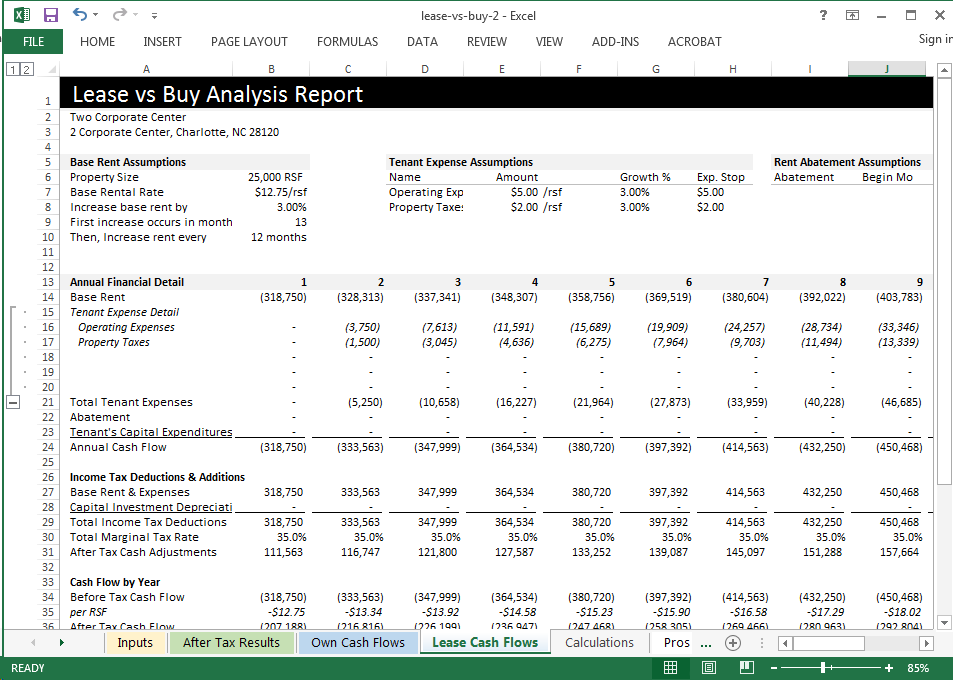
After watching the video, you can see how the different components we discussed are laid out over time. The final analysis will look something like the report in the image below, with separate streams of cash flows for each option.
Conclusion
In this lesson, we have laid the foundation for one of the most common capital investment decisions a firm has to make. We've defined leasing and hire purchase and, most importantly, identified the specific after-tax cash flows that must be considered when comparing leasing an asset to buying it.
Key Takeaways:
- Leasing allows a company to use an asset without owning it. Operating leases are like short-term rentals, while financial leases are more like long-term financing arrangements.
- Hire purchase is similar to a financial lease but includes an option to take ownership at the end of the term.
- The cash flows for leasing primarily involve the lease payment (outflow) and the tax saving from that payment (inflow).
- The cash flows for buying are more complex, involving the initial purchase price (outflow), maintenance costs (outflow), tax savings from capital allowances (inflow), and the final scrap value (inflow).
- The timing of these cash flows, particularly the tax effects, is critical for a correct analysis.
In our next lesson, we will take the logical next step. We will apply the discounted cash flow (DCF) techniques you've learned previously to these streams of cash flows to calculate the net present value of the cost for each option, allowing us to make a clear, data-driven decision: is it cheaper to lease or to buy?