Welcome to our second lesson on short-term financing. In our previous discussion, we contrasted bank-provided funding like overdrafts and term loans, focusing on how their different structures lead to different costs. A key takeaway was the importance of the Annual Percentage Rate (APR) in understanding the true cost of borrowing, which accounts for fees and interest schedules.
Today, we'll shift our focus from banks to suppliers. We will explore trade credit, one of the most common and significant sources of short-term finance for any business. Our goal is to address the learning outcome: calculate the effective annual cost of forgoing early payment discounts in trade credit. You'll see how a seemingly small discount can translate into a surprisingly high interest rate, making this calculation a crucial tool for financial decision-making. The concept of an effective rate, which we touched upon with APR, is central to today's lesson.
1. Understanding Trade Credit
When a business buys goods or services from a supplier, it is often not required to pay immediately. The supplier provides a short period during which the payment is due. This is known as trade credit. It's essentially an interest-free loan from the supplier for a brief period.
To encourage faster payment and improve their own cash flow, suppliers often offer an early payment discount. This is typically expressed in a standardized format. For example, you might see terms like "2/10, net 30". This means:
- A 2% discount on the invoice amount can be taken if the payment is made within 10 days.
- Otherwise, the full (net) invoice amount is due within 30 days.
This creates a clear choice for the purchasing company: pay early and save money, or hold onto the cash for longer and pay the full amount.
To familiarise yourself with this concept, please watch the beginning of the following video.
CFA® Level I Corporate Finance - Cost of Trade Credit
This video from PrepNuggets provides a clear introduction to trade credit and the dilemma of whether to take an early payment discount.
Please watch the first part of the video, which explains the basics of trade credit and defines terms like "2/10 net 60". Pay close attention to the financial decision this presents to a company. You can stop at this point.
2. The Cost of Forgoing the Discount
At first glance, a 2% discount might seem small. However, by forgoing it, the company is effectively choosing to pay an extra 2% for the privilege of using the money for an additional period (in the "2/10, net 30" case, for an extra 20 days). This can be viewed as taking out a loan from the supplier. Our task is to find the effective annual interest rate of this implicit loan.
The Periodic Rate
Let's think about the "2/10, net 30" example. If an invoice is for £100:
- Pay within 10 days: The cost is £98.
- Pay after 10 days (e.g., on day 30): The cost is £100.
By choosing to pay on day 30, the company gets to use £98 for an extra 20 days, but at a cost of £2. The interest rate for this 20-day period is:
In general terms, using d for the discount percentage:
This 2.04% is the interest rate for a 20-day period. To make a meaningful comparison with other sources of finance, like a bank loan with an annual rate, we must annualize it.
From Periodic Rate to Effective Annual Rate (EAR)
A simple approach would be to multiply the periodic rate by the number of 20-day periods in a year (365 / 20 ≈ 18.25). This gives a nominal annual rate. However, this ignores the effect of compounding.
As a statistician familiar with probabilistic processes over time, you'll appreciate that the true cost must account for compounding, just as we saw with APR in the last lesson. If this 20-day "loan" is effectively rolled over throughout the year, the interest earned in one period would itself earn interest in the next. The Effective Annual Rate (EAR) captures this compounding effect.
The infographic below illustrates the difference between a nominal rate (simple interest) and an effective rate (which includes compounding).
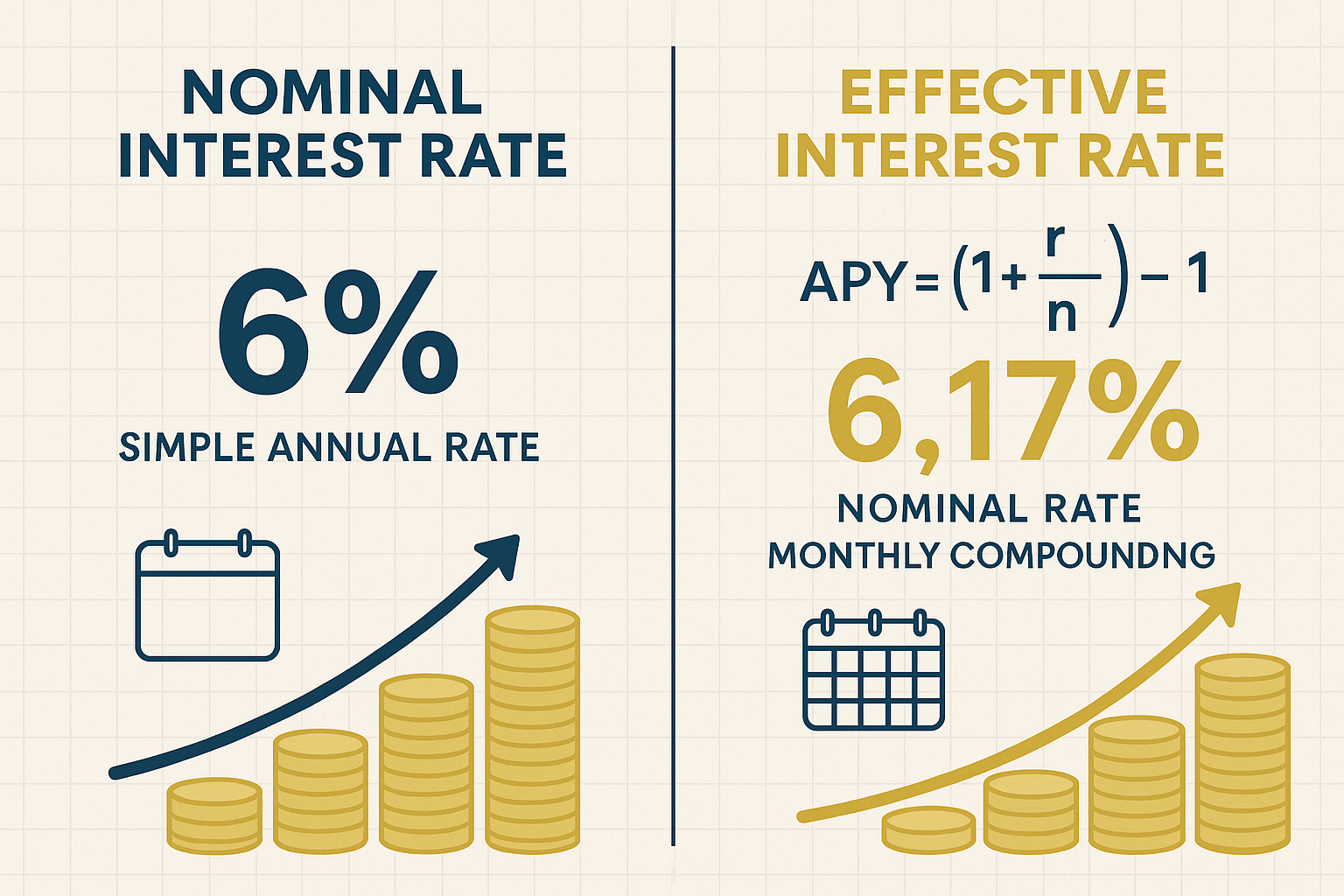
The formula to convert our periodic rate into an EAR is:
Substituting our specific terms:
This is the central formula for this lesson. It accurately calculates the true annual cost of forgoing a trade credit discount. The following reading from Plan Projections provides an excellent step-by-step derivation and explanation.
Cost of Trade Credit | Plan Projections
This article clearly explains the logic behind calculating the cost of trade credit, building up from the periodic rate to the nominal rate and finally to the correct Effective Annual Rate (EAR).
Please read from the beginning of the article down to the end of the section on the "Cost of Trade Credit Formula". Focus on these key parts: The calculation of the periodic interest rate. The section on Effective Annual Rate, which explains why compounding matters. The final formula, which consolidates the entire calculation.
The final formula presented in the article is the one we will use. It's often visualized in spreadsheets for quick calculations.

3. Worked Example and Decision Rule
Now, let's apply this to our "2/10, net 30" scenario to solidify your understanding.
Problem: A company receives an invoice with terms 2/10, net 30. Calculate the effective annual cost of forgoing the discount.
Solution:
- Discount (
d): 0.02 - Discount Period: 10 days
- Credit Period (Net Period): 30 days
- Additional days of credit: 30 - 10 = 20 days
Using the formula:
\text{EAR} \approx 1.4459 - 1 = 0.4459 \quad \text{or} \quad \textbf{44.59%}Forgoing a simple 2% discount is equivalent to taking a loan with a staggering 44.59% annual interest rate! This is why the calculation is so important.
The Decision Rule
The calculation's practical use is in deciding whether to take the discount. The rule is simple:
Compare the EAR of the trade credit with the interest rate of other available short-term financing (e.g., a bank overdraft).
- If EAR of trade credit > Cost of other finance, the company should borrow from the cheaper source and take the discount.
- If EAR of trade credit < Cost of other finance, the company should forgo the discount and use the trade credit as a source of financing.
The following video provides an excellent practice problem that applies this decision rule.
CFA® Level I Corporate Finance - Cost of Trade Credit
This video segment presents a self-test problem where you calculate the cost of trade credit and use it to make a financing decision.
Please watch the final example in the video starting from this point. Pause the video as instructed at 03:59 to perform the calculation yourself, then watch the solution to check your work.
In the video's example, the cost of trade credit was 16.1%, which was less than the alternative financing cost of 18%. Therefore, the correct decision was to forgo the discount and use the (cheaper) trade credit.
Conclusion
In this lesson, we have demystified the "hidden" cost within trade credit terms. By forgoing an early payment discount, a company is effectively borrowing from its supplier, often at a very high implicit interest rate.
Key Takeaways:
- Trade credit terms like "d/t, net T" offer a discount
dfor paying withintdays, with the full amount due inTdays. - Forgoing this discount is a form of short-term financing, but its cost can be substantial.
- The true cost is found by calculating the Effective Annual Rate (EAR), which accounts for the compounding effect of rolling over this implicit loan throughout the year.
- The formula for this is: .
- The decision to take the discount should be based on comparing the EAR of the trade credit to the cost of other available financing, such as a bank overdraft.
We have now added another crucial tool to our short-term financing toolkit. In our next lesson, we will continue exploring non-bank financing by examining leasing and hire purchase, common methods for acquiring the use of assets without the large upfront cash outlay of purchasing them.