Welcome to the first lesson in our new module, "Short-Term and Alternative Financing." In the previous module, we covered the various ways companies raise capital for the long term, culminating in our discussion of warrants. We now shift our focus from multi-year strategic funding to the day-to-day financial lifeblood of a business: managing short-term cash needs.
Today, we will address the learning outcome: compare the costs and features of bank overdrafts and term loans using numerical examples. These are two of the most fundamental and common sources of short-term funding available to a business. Your background as a statistician will be particularly helpful here, as we will ground our comparison in the practical calculation of costs, allowing for a clear, quantitative decision-making framework.
1. Defining the Instruments: A Revolving Door vs. a One-Way Street
Before we compare them, it's essential to understand the distinct nature of bank overdrafts and term loans. Think of a term loan as a one-way street for a specific journey, while an overdraft is more like a revolving door for daily entries and exits.
A term loan provides a business with a single lump sum of cash upfront. This is then repaid in regular, scheduled instalments over a fixed period (e.g., 1-5 years). These loans are typically used for planned, significant expenditures, such as purchasing a new piece of equipment or financing a specific project.
An overdraft facility, by contrast, is a revolving line of credit attached to a business's current account. It allows the business to withdraw more money than its account balance holds, up to a pre-agreed limit. It's designed for flexibility, to cover temporary cash flow shortages or unexpected expenses.
To solidify these definitions, let's turn to a clear explanation from Fi.Money.
Overdraft vs Personal Loan: Which is Better? - Fi.Money
This article provides precise definitions and simple examples for both overdrafts and personal loans (which function like business term loans in this context).
First, read the section defining an overdraft. Pay attention to the example of buying a TV to understand how it works in practice. Next, read the section that defines a personal loan, noting the key characteristics of a lump-sum disbursement and repayment through Equated Monthly Instalments (EMIs).
The image below offers a concise summary of the key distinctions we will explore in more detail.

2. A Detailed Feature Comparison
Now that we have the basic definitions, we can perform a more systematic comparison across several key features. The choice between these two financing options depends entirely on the specific needs of the business.
Let's break down their differences feature by feature.
| Feature | Term Loan | Bank Overdraft |
|---|---|---|
| Purpose | Specific, planned, long-term investments | Short-term cash flow management, emergencies |
| Nature of Credit | One-time lump sum disbursement | Revolving credit line, used as needed |
| Repayment | Fixed, regular instalments (EMIs) | Flexible; repay whenever funds are available |
| Interest Charged | On the entire principal loan amount | Only on the negative balance (amount used) |
| Tenure | Fixed period (e.g., 1-5 years) | Typically ongoing, reviewed annually by the bank |
| Access to Funds | Disbursed once after a formal approval process | Immediate access up to the pre-approved limit |
The following infographic, though focused on a "loan against property," illustrates these differences well, especially concerning cash flow and fees.
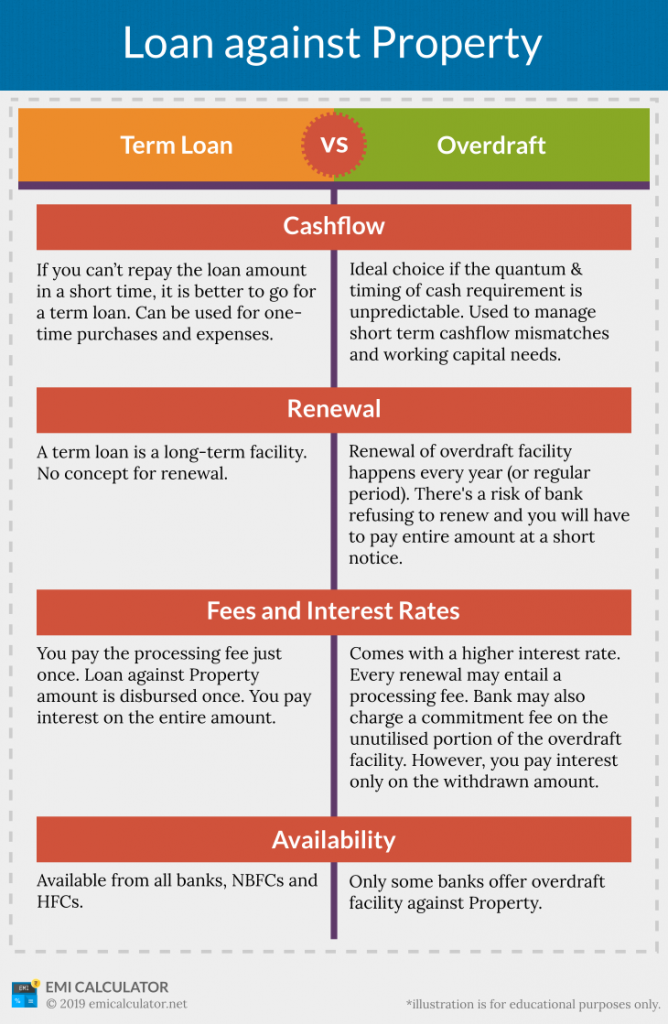
To dive deeper into these distinctions, the comparison table in the Fi.Money article is an excellent resource.
Overdraft vs Personal Loan: Which is Better? - Fi.Money
This resource offers a comprehensive table comparing the two credit facilities.
Please review the table under the heading "Overdraft vs Personal Loan". As you read, notice how each feature aligns with the core purpose of either predictable, planned funding (loan) or flexible, short-term liquidity (overdraft).
3. Comparing the Costs: A Numerical Deep Dive
This is where your quantitative skills come into play. The most significant difference in cost comes from how interest is calculated.
- With a term loan, interest accrues on the entire loan amount from the moment it is disbursed.
- With an overdraft, interest is calculated daily only on the actual amount overdrawn.
This fundamental difference means that an overdraft can be significantly cheaper for very short-term needs, even if its headline interest rate is higher.
Example 1: The Cost of Short-Term Need
Let's use the example from the Fi.Money article to illustrate this point.
Overdraft vs Personal Loan: Which is Better? - Fi.Money
This section provides a clear, numerical example of an overdraft interest calculation.
Read the section on interest rates, focusing on the calculation shown for "Overdraft Interest".
As the article demonstrates, if a business has an overdraft facility and uses £200,000 of it for just 10 days at an annual interest rate of 12%, the interest cost is calculated as:
If the business had instead taken a £200,000 term loan to cover this temporary shortfall, it would begin paying interest on the full £200,000 for the entire loan term, making it a far more expensive solution for a 10-day need.
Example 2: The True Cost of a Loan (APR)
The nominal interest rate doesn't tell the whole story. Loans and overdrafts often come with additional fees:
- Term Loans: Origination fees, processing fees.
- Overdrafts: Arrangement fees, annual renewal fees, non-utilisation fees.
To make a true "apples-to-apples" comparison, we must use the Annual Percentage Rate (APR), which represents the total cost of borrowing, including fees, expressed as an annual rate.
Annual Percentage Rate (APR) | Formula + Calculator
This article from Wall Street Prep explains what APR is and why it's a crucial metric for comparing loan products.
Read the sections "What is APR?" and "How to Calculate APR" to understand the concept. Then, examine the formula provided under the heading "Annual Percentage Rate Formula".
Let's apply this to a term loan scenario. Suppose a business takes a £50,000 term loan for 3 years at a stated nominal interest rate of 8% per annum. The bank also charges a £750 origination fee.
-
Calculate the Monthly Payment (EMI): The EMI is based on the full loan amount of £50,000. The formula for the EMI is:
Where , the monthly interest rate , and the number of months . This gives an EMI of approximately £1,566.82.
-
Account for the Fee: The business only receives £50,000 - £750 = £49,250 in cash. However, it still has to make repayments based on the full £50,000.
-
Calculate the APR: We need to find the interest rate that equates the net cash received (£49,250) with the present value of the 36 monthly payments of £1,566.82. This is an internal rate of return (IRR) calculation. Solving this gives a monthly rate of approximately 0.738%.
The nominal APR is this monthly rate multiplied by 12:
\text{Nominal APR} \approx 0.738\% \times 12 \approx \textbf{8.86%}
The true cost of the loan (APR) is 8.86%, not the stated 8%, because of the origination fee. This demonstrates why it is crucial to look beyond the headline interest rate when comparing financing costs.
4. Making the Right Choice
The decision between an overdraft and a term loan boils down to the intended use of the funds.
Choose a term loan when:
- You need a specific, large sum for a planned expense (e.g., buying an asset).
- You prefer the discipline and predictability of fixed monthly repayments for budgeting.
- You are financing a long-term investment and need funding for several years.
Choose an overdraft facility when:
- You need to manage short-term, fluctuating cash flow mismatches.
- You are unsure of the exact amount or timing of your funding need.
- You want the flexibility to draw and repay funds as needed and pay interest only on what you use.
- You need quick access to emergency funds.
Conclusion
In this lesson, we have launched our exploration of short-term finance by comparing two foundational instruments: bank overdrafts and term loans. We established their distinct features and, crucially, quantified the differences in their cost structures.
Key Takeaways:
- A term loan provides a fixed lump sum for a specific purpose, repaid via regular instalments, with interest charged on the full amount.
- An overdraft offers a flexible, revolving credit line for managing short-term cash flow, with interest charged only on the amount used.
- Overdrafts are ideal for uncertain, short-term needs due to their flexibility and interest calculation method.
- Term loans are suited for large, planned investments where predictable repayments are beneficial.
- The Annual Percentage Rate (APR) is the most accurate measure for comparing the true cost of borrowing, as it incorporates both interest and associated fees.
We have now laid the groundwork for understanding how businesses manage their short-term liquidity. In our next lesson, we will examine another ubiquitous form of short-term finance: trade credit. We will see how this credit, extended by suppliers rather than banks, has its own unique—and often hidden—costs, which we will learn to calculate.