In our last lesson, we focused on identifying the components of a lease-versus-buy decision, meticulously cataloging the various after-tax cash flows associated with each path. We saw how to calculate tax savings from lease payments and, for the buying option, the more complex tax shields generated by capital allowances.
Now, we will put that foundational work into action. This lesson directly addresses the learning outcome: Perform a discounted cash flow analysis to decide between leasing and buying an asset. We will take the streams of cash flows we learned to construct and apply the net present value (NPV) techniques you've already mastered. By the end of this lesson, you will be able to make a clear, financially justified recommendation on whether a company should lease or buy an asset.
1. The Decision Framework: Net Advantage to Leasing (NAL)
The lease-versus-buy problem is a classic example of comparing two mutually exclusive financing alternatives. The goal is to determine which method of financing the use of an asset—leasing or borrowing to buy—is cheaper. Since the cash flows occur at different points in time, we must compare their present values. We will calculate the present value of the costs for each option and select the one with the lower PV of cost.
The standard method for this is to calculate the Net Advantage to Leasing (NAL). The NAL consolidates the comparison into a single number. It is the Net Present Value of the incremental cash flows that result from choosing to lease instead of buy.
The incremental cash flow for any given year is calculated as:
The NAL is then the NPV of this incremental stream of cash flows.
- If NAL > 0, leasing is cheaper (more advantageous) than buying.
- If NAL < 0, buying is cheaper than leasing.
This process transforms the decision into a standard NPV problem, a method you are already familiar with. The result is a clear financial metric: a positive NAL of, say, $1,370 means the company is better off by that amount in present value terms if it chooses to lease.
2. The Correct Discount Rate
A critical parameter in any DCF analysis is the discount rate. For a standard capital project appraisal, we often use the Weighted Average Cost of Capital (WACC), which reflects the risk of the project's operating cash flows. However, the cash flows in a lease-versus-buy analysis are different. They are primarily financing flows (lease payments, tax shields) which are often set by contract or tax law. Their risk is much lower than that of a typical project's revenues and operating costs.
Therefore, the appropriate discount rate is one that reflects this lower risk. The convention is to use the company's after-tax cost of debt. This rate represents the effective cost of borrowing after accounting for the tax-deductibility of interest payments.
The formula is:
For example, if a company can borrow at 10% and its tax rate is 30%, its after-tax cost of debt is . This is the rate we will use to discount the cash flows in our analysis.
3. A Step-by-Step Numerical Analysis
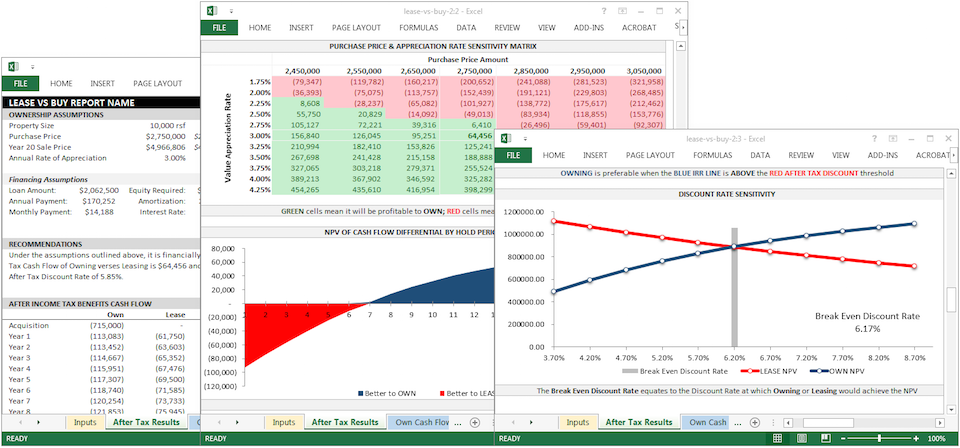
Let's walk through a complete numerical example. This exercise will combine the cash flow identification from the last lesson with the NAL framework we've just discussed. The output of such an analysis often looks like the spreadsheets in the image below, with detailed breakdowns of cash flows and sensitivities.
The following reading provides a clear, step-by-step guide to building the analysis.
[PDF] LEASE FINANCING AND BUSINESS VALUATION
This part of the textbook chapter walks through a detailed, practical example of a lease-versus-buy analysis. It clearly lays out the cash flows for both owning and leasing, and then calculates the Net Advantage to Leasing (NAL). This aligns perfectly with your preference for numerical examples.
Please study the section that begins with the heading Dollar Cost Analysis. Follow the construction of the cash flows in Exhibit 18.2. Pay close attention to: Part I: Cost of Owning: How each line item (maintenance, depreciation tax savings, residual value) is calculated. Part II: Cost of Leasing: The simpler structure of lease payments and their tax savings. Part III: Cost Comparison: How the Net Advantage to Leasing (NAL) is calculated by comparing the Present Values of the two options. The discount rate used is the after-tax cost of debt (6%). Next, read the section Percentage Cost Analysis. This presents the same problem from a slightly different angle, by first calculating the incremental cash flows (Leasing - Owning) and then finding the IRR of that stream. This is a powerful method. Focus on how the incremental cash flow stream in Exhibit 18.3 is derived from Exhibit 18.2.
As you saw in the reading, the analysis involves three main steps:
- Calculate the PV of Owning: Systematically list all cash outflows (purchase price, maintenance) and inflows (tax shields, residual value) over the asset's life. Discount the resulting net cash flow stream at the after-tax cost of debt.
- Calculate the PV of Leasing: List the lease payments (outflow) and their corresponding tax shields (inflow). Discount this net cash flow stream at the same after-tax cost of debt.
- Compare and Decide: Calculate the NAL by finding the NPV of the incremental cash flows (Leasing CFs - Owning CFs). A positive NAL indicates that leasing is the preferred option.
4. Break-Even Analysis
While the NAL gives a definitive "lease" or "buy" answer based on a given set of assumptions, it can also be useful to find the indifference point. For example, what is the maximum lease payment a company would be willing to pay before buying becomes the cheaper option? This is a form of break-even analysis.
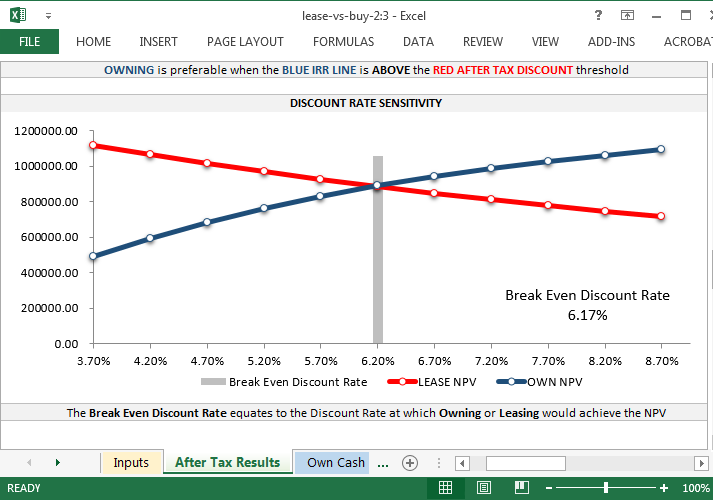
We can also ask: what is the discount rate at which the NPVs of both options are equal? This is the break-even discount rate. If the company's actual after-tax cost of debt is lower than this break-even rate, one option will be better; if it's higher, the other will be. The break-even discount rate is simply the Internal Rate of Return (IRR) of the incremental cash flow stream.
The chart below visualizes this concept. The point where the NPV lines for leasing and owning cross is the break-even discount rate.
The following video demonstrates how to perform a lease-buy analysis in Excel and, importantly, how to use tools like "Goal Seek" to find break-even points, such as the break-even lease payment.
This video provides a comprehensive walkthrough of a lease-buy analysis using a detailed Excel spreadsheet. It reinforces the concepts from the previous reading and introduces the practical application of break-even analysis.
Please watch the following segments: Cash Flow Analysis: Watch the segments covering the analysis for the 'buy' option and the analysis for the 'lease' option. Notice how the structure is very similar to the textbook example, but with different figures. The key is to see the pattern of identifying costs and tax shields. Decision and Break-Even: The most important part for this section is the demonstration of comparing the NPVs and finding the break-even lease payment. Observe how the presenter uses Excel's Goal Seek function to find the lease payment that makes the Net Advantage to Leasing equal to zero. This is a very useful technique in practice.
Conclusion
Today, we have built a complete quantitative framework for making the lease-versus-buy decision. By combining the after-tax cash flows identified in the previous lesson with standard discounted cash flow techniques, we can arrive at a clear, value-based conclusion. Your background in statistics will help you appreciate that this analysis, like any model, is sensitive to its inputs—the tax rate, the cost of debt, and particularly the estimate of the asset's residual value. The break-even analysis we explored provides a powerful way to understand these sensitivities.
Key Takeaways:
- The lease-versus-buy decision is resolved by comparing the Net Present Value of the costs of each financing option.
- The correct discount rate to use is the firm's after-tax cost of debt, which reflects the low-risk nature of the financing cash flows.
- The Net Advantage to Leasing (NAL) is the NPV of the incremental cash flow stream (Leasing CF - Owning CF). A positive NAL means leasing is the cheaper option.
- The IRR of the incremental cash flow stream is the break-even discount rate, representing the point of indifference between the two options.
In our next lesson, we will continue exploring alternative financing sources by turning our attention to methods for managing working capital. We will examine factoring and invoice discounting, and, in line with your preference for numerical application, we will calculate their effective costs.