Welcome back to your course on Business Finance. In our last session, we mastered the skill of calculating a bond's market price by discounting its future cash flows using a given market interest rate. This involved starting with a known rate and finding the price.
In this lesson, we will invert that problem. We'll start with a bond's market price—which is observable in the real world—and work backwards to determine the implied rate of return an investor would earn if they held the bond until it matures. This crucial metric is known as the Yield to Maturity (YTM). Your objective for this lesson is to calculate the yield to maturity (YTM) of a bond given its market price. This is a fundamental skill for the CB1 exam and for comparing different bond investments. Given your background in statistics, you'll appreciate that solving for this unknown rate is a non-trivial exercise that often requires approximation or computational tools.
What is Yield to Maturity (YTM)?
Yield to Maturity is the total return an investor can expect to receive if they buy a bond and hold it until its maturity date. It accounts for all future coupon payments plus the repayment of the face value. Conceptually, YTM is the specific interest rate (or discount rate) that makes the present value of all a bond's future cash flows exactly equal to its current market price. It is also known as the bond's internal rate of return (IRR).
To understand the definition and the underlying formula, let's start with a foundational reading.
Yield to Maturity on Calculator: A Step-by-Step Guide - Bondfish
This article from Bondfish provides a concise definition of YTM and outlines the key components needed for its calculation.
Please read the first two main sections of the article. Focus on the definition under "What Is YTM?" to grasp the core concept. Then, review the section "Key Concepts" to ensure you are comfortable with the terminology (Face Value, Coupon Rate, etc.).
As the article explains, the formula for a bond's price is:
In our previous lesson, the 'Price' was the unknown. Now, the 'Price' is known, and the 'YTM' is the unknown we need to solve for.
The Challenge: Solving for YTM
As you can see from the formula, YTM appears in the denominator of every term. Isolating YTM algebraically is difficult and, for bonds with more than two periods, generally impossible. It's similar to finding the roots of a high-order polynomial. This is why we rely on other methods.
We will explore two primary approaches:
- An approximation formula, which is quick, easy to use in an exam, and provides a reasonably accurate estimate.
- Using financial tools (like a financial calculator or spreadsheet), which perform an iterative "trial and error" process to find the exact YTM.
Method 1: The YTM Approximation Formula
A widely used and examinable method for estimating YTM is the approximation formula. It provides a surprisingly accurate result in most cases. The formula is:
Where:
- C = Annual coupon payment in dollars
- F = Face value (or Par Value) of the bond
- P = Current market price of the bond
- n = Number of years to maturity
Let's break this down intuitively:
- The numerator, , represents the average annual return. It's the annual coupon interest plus the annualized capital gain or loss (the difference between face value and price, spread over the bond's life).
- The denominator, , represents the average investment value over the bond's life.
The following video provides an excellent walkthrough of this concept and demonstrates how to apply the formula in different scenarios.
How to Calculate Yield To Maturity of a Bond -What is YTM and How to Use the Approximation Formula
This video, "How to Calculate Yield To Maturity of a Bond," offers a clear explanation of YTM and its approximation formula.
Please watch from the beginning up to the end of the discount bond example. The video will cover: The intuition behind YTM for bonds bought at par, a premium, and a discount. The introduction of the approximation formula. Worked examples for a bond bought at par, at a premium (higher price), and at a discount (lower price). Pay close attention to how the signs change in the numerator.
As you saw, the calculation is straightforward once you plug in the numbers. Let's work through one of the video's examples to solidify the process.
Example: A Bond Trading at a Discount
- Face Value (F) = $1,000
- Price (P) = $900
- Annual Coupon Rate = 5% (so, C = $50)
- Years to Maturity (n) = 5
Plugging these into the formula:
Because the bond was purchased at a discount ($900), the YTM (7.37%) is higher than the coupon rate (5%), which makes perfect sense—the investor earns the coupon payments plus a capital gain at maturity.
It's important to note, as the video mentions, that this is an approximation. For bonds trading at a very deep discount or high premium, the approximation becomes less accurate.

Method 2: Calculating the Exact YTM with Financial Tools
To find the precise YTM, we need tools that can solve the bond pricing equation iteratively. For your exam, you won't need to perform the iteration yourself, but you must understand the inputs required for a financial calculator or a spreadsheet function.
Using a Financial Calculator
A financial calculator uses five main keys for time value of money calculations. To find YTM, you provide four of them and compute the fifth.
- N: Number of periods. (For semi-annual bonds, this is years × 2)
- PV: Present Value, which is the bond's current market price. Crucially, this is entered as a negative value to represent the cash outflow of buying the bond.
- PMT: The periodic coupon payment. (For semi-annual bonds, this is the annual coupon / 2)
- FV: Future Value, which is the bond's face value.
- I/Y: The interest rate per period, which is the YTM you compute. (For semi-annual bonds, you must multiply the result by 2 to annualize it).
The following resource provides clear, step-by-step instructions.
10.3: Bond Valuation - Business LibreTexts
This textbook excerpt provides excellent, table-based examples of how to use a financial calculator to find YTM for both semi-annual and annual bonds.
Read the two sections titled "Determining Bond Yield Using a Calculator" and the next example. Follow the tables that show the calculator inputs for each step. Notice how for the semi-annual Coca-Cola bond, the final I/Y result is multiplied by 2.
Using a Spreadsheet (e.g., Excel)
In a professional setting, and often for exam purposes, spreadsheet functions are the most common tool. In Excel, the YIELD function is specifically designed for this.
=YIELD(settlement, maturity, rate, pr, redemption, frequency)
- settlement: The date the bond is purchased.
- maturity: The bond's maturity date.
- rate: The annual coupon rate.
- pr: The price per $100 of face value.
- redemption: The redemption value per $100 of face value.
- frequency: The number of coupon payments per year (1 for annual, 2 for semi-annual).
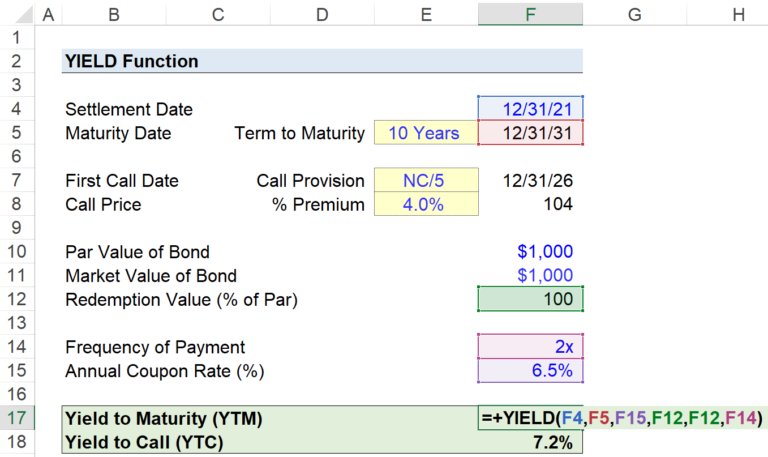
While you won't have Excel in the CB1 exam, understanding that such functions exist and what inputs they require reinforces the core concepts of what defines a bond's return.
Conclusion
In this lesson, we have explored how to determine a bond's yield to maturity, which is the most comprehensive measure of its return. We've seen that while the underlying equation is complex, we have practical methods to find the YTM.
Key Takeaways:
- Yield to Maturity (YTM) is the internal rate of return of a bond, representing the total annualized return if held to maturity.
- A bond's YTM will be higher than its coupon rate if it trades at a discount, and lower if it trades at a premium.
- The approximation formula provides a quick and useful estimate for YTM, especially for exams: .
- For an exact YTM, financial calculators or spreadsheet functions are used. This involves inputting the bond's key characteristics (N, PV, PMT, FV) to solve for the interest rate (I/Y).
We have now covered the two fundamental calculations for fixed-interest bonds: finding the price given a rate, and finding the rate given a price. This completes our core analysis of simple debt instruments.
In the next lesson, we will shift our focus from debt financing to equity financing. We'll begin by examining how a private company raises large-scale capital from the public for the first time through an Initial Public Offering (IPO), analysing its costs and financial implications.