Welcome back. In our previous lesson, we concluded our study of long-term debt financing by learning how to calculate a bond's yield to maturity. This involved determining the rate of return implied by a bond's market price.
Today, we transition from debt to equity, exploring one of the most significant events in a company's life: the Initial Public Offering (IPO). This is the process through which a private company first offers its shares to the public, transforming itself into a public entity. Your objective for this lesson is to analyse the costs and financial implications of an initial public offering (IPO) for the issuing company. We will focus on the numerical aspects, breaking down where the money comes from, where it goes, and the various costs—both obvious and hidden—that the company incurs.
What is an IPO and Why Do Companies Do It?
An Initial Public Offering is a pivotal moment for a business, marking its entry into the public financial markets. While there are several reasons for a company to go public, the primary motivation is almost always financial: to raise a significant amount of capital to fund growth, pay down debt, or allow original owners to cash out some of their investment.
To begin, let's get a high-level overview of the IPO process and the key players involved.
This video from The Plain Bagel, "The IPO Process," provides an excellent introduction to what an IPO is, why it's done, and the role of the investment banker.
Please watch from the introduction to understand the fundamental purpose of an IPO and the role of the investment banker. Then, watch the segment on setting the price and finally the section explaining why IPOs can be expensive from the company's viewpoint. Pay attention to the primary objective: raising capital.
As the video explains, the company works with an investment bank (the underwriter) to manage the process, with the goal of raising as much money as possible. This brings us to the core financial mechanics of the IPO.
The Financial Mechanics of an IPO
The financial implications of an IPO are centered on the flow of money from new investors to the company. However, the amount the company ultimately receives is not the same as the total amount investors pay. Let's break down the key figures.
-
Gross Proceeds (Total Money Raised): This is the total amount of money raised from selling shares to the public. It's calculated simply as:
-
Underwriting Spread (or Discount): The investment bank does not provide its services for free. Its main compensation is the "spread," which is the difference between the price it pays the company for the shares and the price it sells them to the public (the offer price). This is typically expressed as a percentage of the gross proceeds.
-
Net Proceeds: This is the amount of capital the company actually gets to keep after paying the underwriters.
The Indirect Cost: Underpricing
A fascinating and common phenomenon in IPOs is "underpricing." This occurs when the stock's price on the first day of trading closes significantly above the initial offer price set by the company and its underwriters.
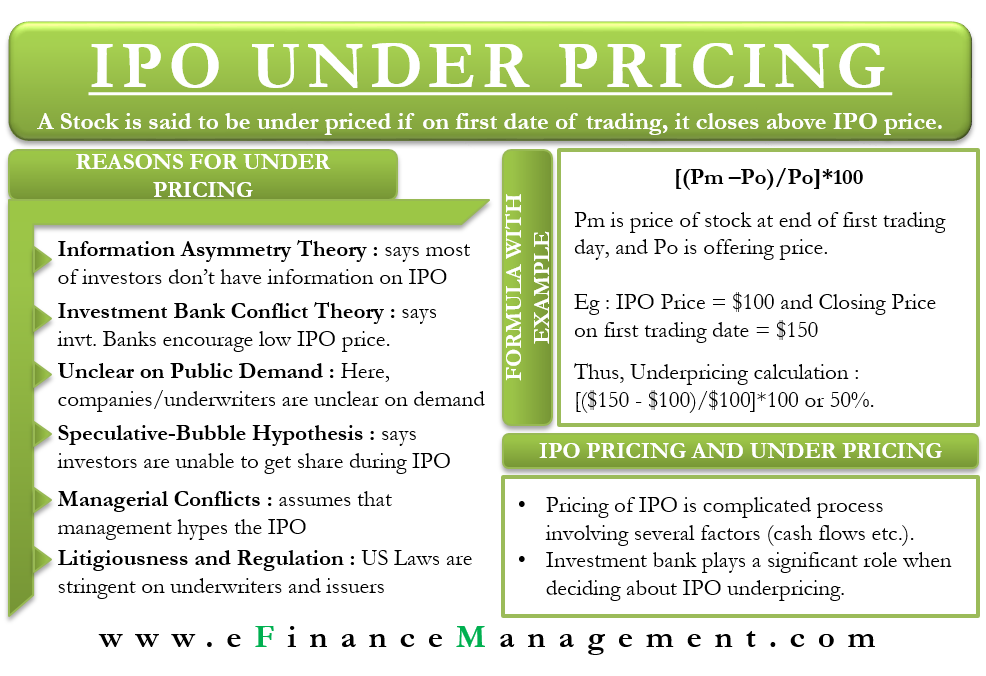
From the company's perspective, underpricing represents an indirect cost. It's often referred to as "money left on the table." Why? Because if the company had sold its shares at the higher closing price, it could have raised more capital. The difference between the offer price and the first-day closing price is a gain for the initial investors who bought at the IPO price, but it's a missed opportunity for the issuing company.
The total value of this indirect cost is calculated as:
A Worked Example
Your preference for practical calculations is key here, so let's apply these concepts to a concrete example. The image below presents a typical scenario for a company, Istar Enterprises, going public. We will use this data to perform the exact calculations required.

Let's use the provided information to calculate the four required figures:
Given Information:
- Shares Issued: 25,000,000
- Price per Share (Offer Price): $80.00
- Price, Close of First Day: $83.00
- IPO Underwriter Explicit Costs (Spread): 7% (or 0.07)
1. Total Money Raised from IPO (Gross Proceeds)
This is the total amount paid by investors.
2. Underwriter Costs
The underwriters take a 7% fee from the gross proceeds.
3. Net Proceeds to Company
This is what the company is left with after paying the underwriters.
4. Value of Company, End of First Day
This is the market's valuation of the company's new public shares after the first day of trading. It's based on the closing price.
Notice the "money left on the table" due to underpricing:
This $75 million represents an additional amount of capital Istar Enterprises could have raised if it had priced its IPO at the level the market was willing to bear at the end of the day.
The following reading formalizes these relationships and summarizes the flow of funds.
Reading: IPO Mechanics: From Proceeds to Value Offered
This reading from TEJU finance concisely lays out the mathematical relationships between net proceeds, gross proceeds, and the final market value of the offered shares.
Please read the entire page. Pay close attention to the section explaining the twofold reason for the difference between net proceeds and the value of offered shares. Then, review the formal calculations and the summary table, which neatly structure the concepts we just applied in our example.
Other Direct Costs of an IPO
While the underwriter's spread is the largest single cost, it's far from the only one. Going public involves a host of other expenses that a company must budget for. These direct costs are paid out of the IPO proceeds or by the company directly.
Understanding the Costs Associated with an IPO - Grassi
This article from Grassi Advisors provides a detailed breakdown of the various costs a company encounters when going public.
Focus on the section titled "Common Examples of Costs." Skim through the list which includes Underwriting, Legal, Accounting, SEC Registration, FINRA, and US Exchange Listing fees. You don't need to memorize the exact fee structures, but appreciate the variety of direct costs. Also, briefly review the section "Other IPO Costs to Consider" to understand the ongoing financial implications beyond the IPO event itself.
As the article highlights, the direct costs of an IPO are substantial and varied. They include:
- Legal Fees: For drafting the prospectus and ensuring regulatory compliance.
- Accounting Fees: For auditing financial statements to public company standards.
- Registration and Filing Fees: Paid to regulators like the SEC and FINRA.
- Exchange Listing Fees: Fees paid to the stock exchange (e.g., NYSE, Nasdaq) to have the shares listed for trading.
- Printing and Engraving Costs: For prospectuses and share certificates.
Furthermore, a significant financial implication is the increased ongoing cost of being a public company. This includes expenses for enhanced financial reporting, investor relations departments, and stricter regulatory compliance (e.g., Sarbanes-Oxley Act in the US).
Conclusion
We have now dissected the financial anatomy of an Initial Public Offering from the perspective of the issuing company. By focusing on the numbers, we can clearly see the benefits (raising capital) and the significant associated costs.
Key Takeaways:
- The primary goal of an IPO is to raise capital. The Gross Proceeds represent the total funds raised, while the Net Proceeds are what the company retains after fees.
- The main direct cost is the underwriting spread, typically a percentage (e.g., 4-7%) of the gross proceeds.
- Underpricing is a common phenomenon that creates an indirect cost, or "money left on the table," representing capital the company could have raised if its offer price had been higher.
- Beyond the underwriting spread, companies face numerous other direct costs (legal, accounting, regulatory) and must prepare for higher ongoing operational costs as a public entity.
In this lesson, we examined how a private company raises new equity from the public. But what if a company is already public and needs to raise more capital? The next lesson will address this by exploring the rights issue, a method for existing public companies to offer new shares to their current shareholders.