Welcome to our next lesson. In our previous session, we distinguished between the primary instruments of long-term finance—debt, preference shares, and ordinary shares. We established that bonds are debt instruments that provide investors with a predictable series of future cash flows.
Today, we will build directly on that foundation to address your next learning outcome: calculating the market price of a fixed-interest bond using discounted cash flow. This is a core skill in finance and a fundamental calculation for your CB1 exam. Your background in statistics will be helpful here, as the process involves determining the present-day value of a series of future payments, a concept closely related to calculating expected values over time.
The Fundamental Principle of Bond Valuation
At its heart, valuing a bond is an application of one of the most central principles in finance: the value of any asset is the present value of the future cash flows it is expected to generate. For a simple fixed-interest bond, these cash flows are known with certainty:
- A series of fixed interest payments, known as coupons.
- The repayment of the bond's face value (or par value) at the end of its life, known as the maturity date.
To find the bond's price, we simply add up the present value of all these future payments. The rate we use to discount these future cash flows is the market discount rate (also called the required rate of return or yield). This rate reflects the return investors could earn on other, similar investments in the market.
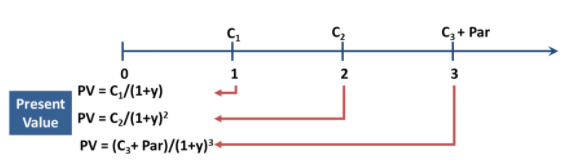
The Bond Pricing Formula
The process shown in the diagram can be expressed with a general formula. The price of a bond is the sum of the present values of its coupon payments (an annuity) and the present value of its face value (a lump sum).
Where:
- = Price of the bond (its present value)
- = Coupon payment per period
- = Face Value of the bond (the amount repaid at maturity)
- = Market discount rate per period
- = Number of periods until maturity
Let's start by seeing this formula in action with a clear, step-by-step calculation for a bond that pays interest annually.
Calculate Bond Price and Yield to Maturity (YTM) | Annual and Semi Annual Bonds
The video "Calculate Bond Price and Yield to Maturity" provides an excellent, practical demonstration of how to manually calculate a bond's price.
Please watch the first part of the video, from the beginning to the end of the annual calculation. The presenter breaks down the four key inputs and shows how to discount each year's cash flow individually before summing them up to find the total price.
As the video demonstrates, the process is methodical:
- Identify the inputs: Face Value (FV), coupon payment (C), number of years (n), and the market discount rate (i).
- List the cash flows: Determine the cash flow for each year—the coupon payment for all years except the last, and the coupon plus face value in the final year.
- Discount each cash flow: Calculate the present value of each individual cash flow using the formula , where 't' is the year of the cash flow.
- Sum the present values: Add up the present values of all cash flows to arrive at the bond's market price.
Premium, Discount, and Par: The Key Relationship
In the example from the video, the calculated price ($1,036.30) was higher than the face value ($1,000). This happened because the bond's coupon rate (5%) was higher than the market discount rate (4%). This illustrates a critical relationship in bond pricing.
The following resource from AnalystPrep clearly states the bond pricing formula and this relationship.
Bond Valuation (Calculations for CFA® and FRM® Exams)
This reading formally presents the bond pricing formula and summarizes the relationship between a bond's coupon rate and the market discount rate.
First, review the section under the heading "Bond Pricing with a Market Discount Rate" to see the formula laid out. Then, skip down to the summary that begins with "As these examples demonstrate" to understand the three possible scenarios.
To summarize the key idea:
- If Coupon Rate > Market Rate, the bond is attractive because it pays more than the market currently demands. Investors will bid the price up, so it trades at a premium (Price > Face Value).
- If Coupon Rate < Market Rate, the bond is unattractive because it pays less than the market demands. Its price must fall to offer a competitive return, so it trades at a discount (Price < Face Value).
- If Coupon Rate = Market Rate, the bond pays exactly what the market demands. It will trade at par (Price = Face Value).
The next video provides excellent intuitive explanations and calculations for each of these three scenarios.
Bond Prices And How They Are Related To Yield to Maturity (YTM)
The video "Bond Prices And How They Are Related To Yield to Maturity" walks through detailed examples of bonds trading at par, at a discount, and at a premium.
Please watch the following segments: At Par: Here, the coupon rate (8%) equals the required return (8%), and the price is exactly $1,000. At a Discount: The required return rises to 10%, which is higher than the 8% coupon. Notice how the price falls below $1,000. At a Premium: The required return falls to 6%, which is lower than the 8% coupon. The price now rises above $1,000.
Adjusting for Semi-Annual Coupon Payments
While some bonds pay coupons annually, it is very common for bonds (especially in North America) to pay them semi-annually (twice a year). This requires a simple adjustment to our inputs before we use the same pricing formula.
For a semi-annual bond, you must:
- Halve the annual coupon payment to get the periodic payment.
- Halve the annual market discount rate to get the periodic discount rate.
- Double the number of years to get the total number of periods.
Let's see how this works in practice.
Calculate Bond Price and Yield to Maturity (YTM) | Annual and Semi Annual Bonds
We return to the first video, which now explains how to handle semi-annual bonds.
Watch the section from 05:18 to 07:17. Pay close attention to how the presenter adjusts the three key variables (n, payment, and interest rate) for the semi-annual calculation.
Worked Example: Pricing a Semi-Annual Bond
Let's solidify this by working through a typical exam-style problem. Consider the second scenario presented in the image below.

The problem asks for the price of a $1,000,000 bond with the following characteristics:
- Maturity: 10 years
- Stated (Coupon) Rate: 10%, paid semi-annually
- Effective (Market) Rate: 12%
Let's calculate the price step-by-step.
-
Identify the annual inputs:
- FV = $1,000,000
- Annual Coupon Payment = 10% of $1,000,000 = $100,000
- Annual Market Rate (i) = 12%
- Years to Maturity = 10
-
Adjust for semi-annual periods:
- Number of periods (n) = 10 years × 2 = 20
- Periodic coupon payment (C) = $100,000 / 2 = $50,000
- Periodic market rate (i) = 12% / 2 = 6% or 0.06
-
Calculate the price:
We need to find the present value of an annuity of $50,000 for 20 periods, plus the present value of a $1,000,000 lump sum in 20 periods, all discounted at 6%.Using the annuity formula shortcut for the coupons:
Now, for the face value:
Finally, the total price of the bond is:
This matches the value in the table (rounding differences account for the slight discrepancy), confirming our understanding. Notice that because the 10% coupon rate is less than the 12% market rate, the bond correctly priced at a discount to its $1,000,000 face value.
Conclusion
In this lesson, we have focused on the mechanics of bond valuation. By mastering the discounted cash flow approach, you can determine the fair price of any fixed-interest bond.
Key Takeaways:
- A bond's price is the sum of the present values of its future coupon payments and its final face value repayment.
- The discount rate used is the market's required rate of return for a bond of similar risk and maturity.
- The relationship between the coupon rate and the market rate determines whether a bond trades at a premium (Price > FV), discount (Price < FV), or par (Price = FV).
- For semi-annual bonds, you must adjust the number of periods (n), the coupon payment (C), and the market discount rate (i) before performing the calculation.
We have consistently used the market discount rate as a given input to find the price. In our next lesson, we will invert the problem. We will start with a bond's known market price and work backwards to calculate the implied market discount rate, a crucial metric known as the Yield to Maturity (YTM).