In our previous lesson, we explored the world of stock exchanges, understanding their function as marketplaces for raising long-term capital and the rigorous requirements companies must meet to go public. Now that we know where companies raise funds, we will examine what they issue to do so.
This lesson directly addresses your next learning outcome: to compare the financial characteristics, risks, and trade-offs of ordinary shares, preference shares, and debt instruments. These three instruments form the bedrock of a company's capital structure. For both the company and the investor, the choice between them involves a fundamental trade-off between risk, return, and control. Understanding this dynamic is essential for the CB1 exam and for any financial analysis.
The Spectrum of Capital: Debt, Preference, and Ordinary Shares
When a company needs to raise long-term finance, it essentially has three categories of instruments to choose from. Think of them as a spectrum of risk and control:
-
Debt (e.g., Bonds, Loans): This is borrowed money. The company has a legal obligation to pay fixed, periodic interest to the lenders (creditors) and to repay the principal amount at a specified future date (maturity). Creditors are lenders, not owners.
-
Ordinary Shares (Common Stock): This represents a true ownership stake in the company. Shareholders are the owners, entitled to a share of the profits and possessing voting rights to influence company decisions. However, their returns are not guaranteed, and they bear the highest level of risk.
-
Preference Shares (Preferred Stock): This is a hybrid instrument with features of both debt and equity. Like debt, it typically pays a fixed dividend. Like equity, it represents an ownership stake, but one that usually comes without voting rights and has a higher claim on profits and assets than ordinary shares.
Let's begin by comparing the two forms of equity: ordinary and preference shares.
Equity Compared: Ordinary vs. Preference Shares
While both are types of shares, their features create very different risk and return profiles for an investor. The following video provides an excellent breakdown of these differences.
Common Stocks vs Preferred Stocks | Similarities and Differences
The video "Common Stocks vs Preferred Stocks" from Lumovest offers a clear, direct comparison of these two equity types.
Please watch from 00:48 to 04:54. As you watch, focus on the key distinctions explained: How investors profit from each type (capital gains vs. dividends). The difference in their risk profiles, driven by their priority in receiving payments. The contrast in voting rights.
As the video explains, the differences are significant:
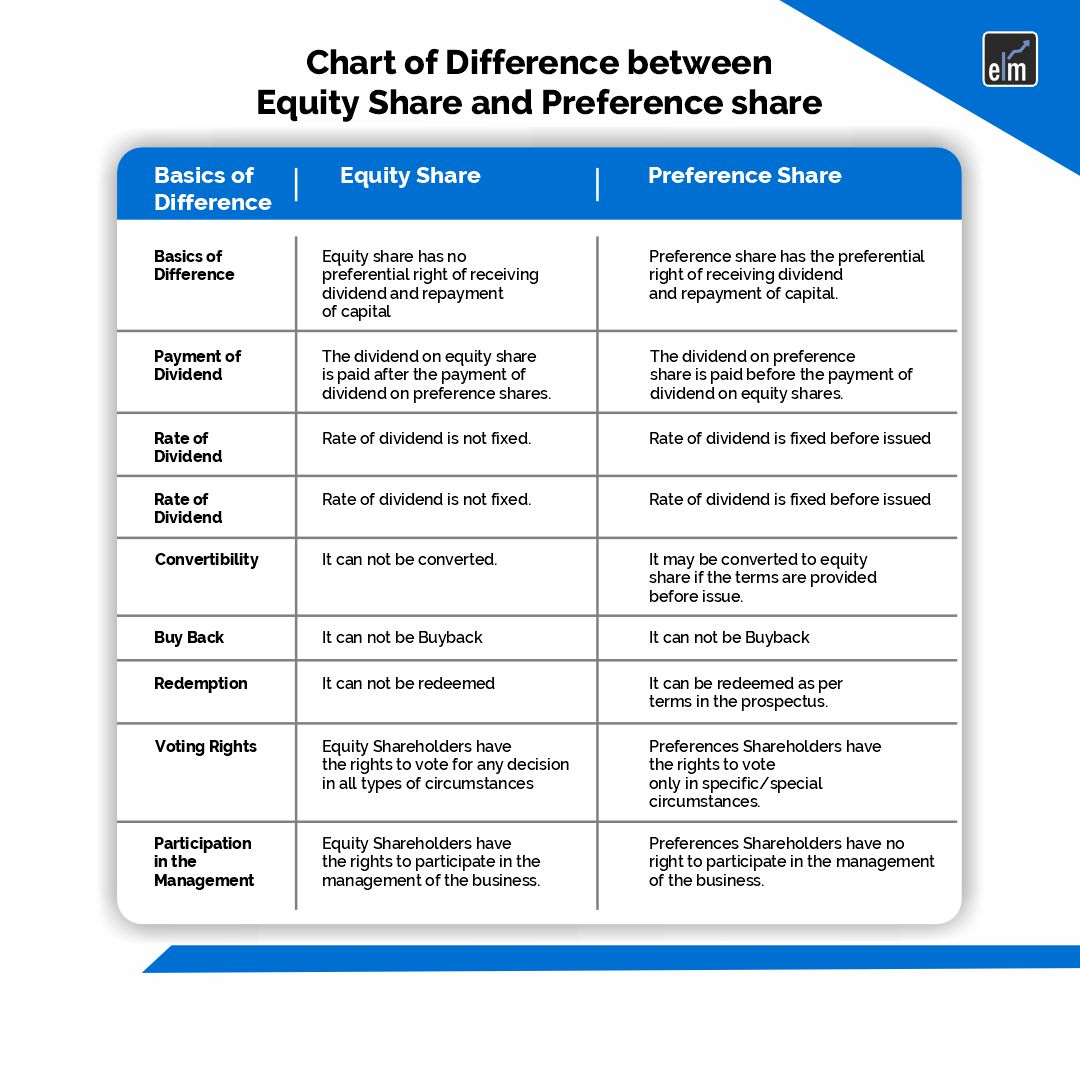
- Return Profile: Ordinary shareholders expect returns from two sources: dividends, which are variable and depend on the company's profitability and policy, and capital gains, the increase in the share's market price. In contrast, preference shareholders primarily receive a fixed dividend, and their share price tends to be much more stable, limiting the potential for large capital gains.
- Risk and Priority: The term "preference" refers to their priority over ordinary shareholders. In any given year, the company must pay the agreed dividend to preference shareholders before any dividends can be paid to ordinary shareholders. Furthermore, in the unfortunate event of a company being liquidated, preference shareholders have a claim on the company's assets that must be settled after creditors but before ordinary shareholders receive anything. This priority makes preference shares less risky than ordinary shares.
- Control (Voting Rights): This is the main advantage for ordinary shareholders. They have voting rights, allowing them to participate in key corporate decisions, such as electing the board of directors. Preference shareholders typically do not have voting rights, except in specific circumstances (e.g., if their dividends have not been paid for a period).
The chart below summarises these key differences.
The Hybrid Nature of Preference Shares
Preference shares are often described as a hybrid because they blend the characteristics of debt and equity. Their fixed dividend is bond-like, but the payment can be deferred without triggering bankruptcy, which is an equity-like feature.
Let's explore this bond-like nature and its implications.
Why I Prefer to Avoid Preferred Shares | Common Sense Investing
The video "Why I Prefer to Avoid Preferred Shares" by Ben Felix, while offering a critical perspective, contains an excellent explanation of the financial characteristics of preference shares.
Please watch the segment from 01:46 to 02:03. This part clearly explains how the fixed dividend and lack of a maturity date make preference shares behave like very long-term bonds.
This bond-like feature means that, like a bond, the market value of a preference share is sensitive to changes in interest rates. If prevailing interest rates rise, newly issued instruments will offer a higher return, making existing preference shares with their lower fixed dividend less attractive, and their price will tend to fall. The reverse is also true. This is a key risk for preference share investors that doesn't affect ordinary shares in the same direct way.
The Complete Picture: Debt vs. Preference vs. Ordinary Shares
Now, let's bring debt into the comparison to see the full capital structure spectrum. The defining characteristic that separates debt from all forms of equity is the legal obligation to pay.
- A company must pay interest on its debt. Failure to do so can lead to legal action and even forced bankruptcy.
- A company is not legally obligated to pay dividends on either preference or ordinary shares. It can suspend dividend payments if, for example, it faces a period of low profitability.
This distinction is the primary driver of the risk hierarchy.
The Priority of Claims
In finance, risk is often defined by the order in which you get paid. This "priority of claims" is most evident during liquidation but also applies to annual profits.
- Debt Holders (Creditors): Have the first claim. Interest must be paid out of pre-tax profits. In a liquidation, they are first in line to be repaid from the company's assets.
- Preference Shareholders: Have the next claim. Their fixed dividends are paid out of after-tax profits, but before ordinary dividends.
- Ordinary Shareholders: Have the residual claim. They get whatever is left after everyone else has been paid.
This hierarchy directly translates to risk: debt is the least risky, and ordinary shares are the most risky. Consequently, investors demand the highest potential return from ordinary shares to compensate for this risk.
A crucial point for the CB1 exam is the tax treatment. Because interest is paid before tax is calculated, it is considered a tax-deductible expense. Dividends are paid from after-tax profits. This "tax shield" on debt makes it a cheaper source of finance for the company.
The following reading from a corporate finance textbook provides a detailed numerical example comparing the costs of raising capital through debt, preference shares, and equity.
Cost of Capital: Effect of Capital Structure – Corporate Finance
This section of the textbook "Cost of Capital: Effect of Capital Structure" summarises the calculated costs for a company, MKZ Airlines, raising capital using different methods.
Please read the section titled Example 11.5 and the subsequent paragraph. Focus on the final comparison in Table 11.6. You don't need to worry about the formulas used to get the numbers for now (we'll cover those in a later module). The key is to understand the relative costs and the summary of trade-offs in the final paragraph.
The example reinforces the typical cost hierarchy from the company's perspective:
- Cost of Debt (after-tax): Cheapest (3.41% - 3.56% in the example).
- Cost of Preferred Stock: In the middle (6.81%).
- Cost of Equity: Most expensive (11.07%).
This ordering reflects the risk-return principle. Investors in ordinary shares bear the most risk, so they require the highest expected return, making it the most expensive source of capital for the company.
The table below consolidates the key characteristics for all three instruments. This is a critical summary for your exam revision.
| Feature | Debt (Bonds) | Preference Shares | Ordinary Shares |
|---|---|---|---|
| Claim on Assets | Highest priority (paid first) | Middle priority (after debt, before ordinary) | Lowest priority (residual claim) |
| Return to Investor | Fixed interest (coupon) payments | Fixed dividend payments | Variable dividends + capital gains |
| Risk to Investor | Lowest (fixed payment, priority claim) | Medium (dividend is fixed but can be deferred) | Highest (no guaranteed return, last in line) |
| Voting Rights | None | Typically none | Yes |
| Tax Impact for Co. | Interest is tax-deductible | Dividends paid from after-tax profit | Dividends paid from after-tax profit |
| Cost to Company | Lowest (due to low risk and tax shield) | Medium | Highest |
| Maturity | Fixed maturity date (principal is repaid) | Typically no maturity (perpetual) | No maturity |
Conclusion
In this lesson, we have dissected the three primary instruments of long-term finance. The choice between debt, preference shares, and ordinary shares is a core strategic decision for any company, balancing the cost of capital against the obligations and loss of control that each instrument entails.
Key Takeaways:
- The three main instruments exist on a spectrum of risk, return, and control.
- Ordinary Shares represent true ownership, offering voting rights and high potential returns (dividends and capital gains) in exchange for the highest risk (residual claim on assets and profits).
- Debt represents a loan, offering lower but more certain returns (fixed interest) and the highest claim on assets, making it the least risky option for an investor. It is also the cheapest for the company due to its tax-deductibility.
- Preference Shares are a hybrid, sitting in the middle. They offer fixed dividends with priority over ordinary shares but typically lack voting rights and are more expensive for the company than debt.
- The priority of claims is the fundamental principle that determines the risk and therefore the required return of each instrument.
Having established the characteristics of these instruments, we can now begin to value them. In the next lesson, we will focus on debt and learn how to calculate the market price of a bond by discounting its future cash flows.