Welcome to the first lesson in our module on Long-Term Financing. In the previous module, we concluded by examining how the tax-deductibility of interest creates a powerful incentive for companies to use debt. Now, we will begin our exploration of the markets and instruments companies use to raise long-term capital, starting with the very foundation of public capital markets: the stock exchange.
Your goal for this lesson is to describe the role of stock exchanges and the requirements for a company to achieve a public listing. This is a crucial first step in understanding how companies access the vast pool of capital offered by public investors. Mastering these concepts will provide the context for our upcoming lessons on Initial Public Offerings (IPOs) and the specific characteristics of shares and bonds.
1. The Role and Function of Stock Exchanges
At its core, a stock exchange is a marketplace for buying and selling securities, such as company shares and bonds. To understand its importance, we must distinguish between two types of market activity:
- Primary Market: This is where a company sells new shares to investors for the first time, typically through an Initial Public Offering (IPO). This is how the company raises capital directly.
- Secondary Market: This is where investors trade existing shares amongst themselves. The company is not directly involved in these transactions, and the money changes hands between investors.
A common misconception is that when you buy a share of a company on a stock market app, your money goes to the company. In reality, you are participating in the secondary market. The following video explains this distinction clearly and sets the stage for understanding how companies actually benefit from the stock market.
How a Company Benefits from the Stock Market
This video from Intelligent Stock Investing, "How a Company Benefits from the Stock Market," clarifies the difference between primary and secondary market transactions and introduces the main ways companies raise capital.
Please watch from the beginning to 02:31. The first part addresses the common misconception about where your money goes. The second part introduces the IPO as the primary way a company raises a large amount of cash from the public.
As the video explains, the primary benefit for a company is the ability to raise significant capital through an IPO. However, the existence of a healthy secondary market is what makes this possible. Why would anyone buy shares in an IPO if there were no way to sell them later? The secondary market provides liquidity, which is the ability to convert an asset into cash quickly.
Beyond raising capital and providing liquidity, stock exchanges perform several other vital roles in the economy.
The Wikipedia article on stock exchanges provides a comprehensive list of their functions.
Please read the section titled "Roles in the economy". As you read, focus on how the exchange acts as more than just a trading venue, influencing everything from savings allocation to corporate behaviour.
From this reading, we can summarize the key economic functions of a stock exchange:
- Raising capital for businesses: Providing a platform for companies to issue shares to the public.
- Mobilizing savings for investment: Channeling money from individuals and institutions who are saving to companies that need funds for growth.
- Facilitating acquisitions: Publicly traded shares can be used as a "currency" to buy other companies.
- Corporate governance: Exchanges enforce strict rules on listed companies regarding financial reporting and board structure, which can improve management standards.
- Barometer of the economy: The collective movement of stock prices, often tracked by an index like the S&P 500 or FTSE 100, serves as an indicator of broad economic health and investor sentiment.
2. The Path to a Public Listing: The IPO Process
For a private company to have its shares traded on a stock exchange, it must first "go public." The process of doing this is called an Initial Public Offering (IPO). This is a complex, regulated, and expensive undertaking that transforms the company's ownership structure.
The following video provides a clear, step-by-step overview of the IPO process.
This video, "The IPO Process" by The Plain Bagel, breaks down the journey a company takes to go public.
Please watch from 01:18 to 04:08. This segment details the key stages: Hiring an investment bank to underwrite the deal. Filing regulatory documents (e.g., with the SEC in the US). Creating a prospectus to market the shares to potential investors. Setting the IPO price and allocating shares. Finally, trading begins on the stock exchange.
This process is what allows a company to make the leap from being privately owned to being a publicly listed entity, whose shares can be bought and sold by the general public on an exchange.
3. Listing Requirements: The Rules of Entry
A stock exchange is not open to just any company. To protect investors and maintain market integrity, each exchange sets its own listing requirements. A company must meet these standards to be accepted for listing and must continue to meet them to remain listed.
These requirements can be grouped into two main categories, as shown in this diagram.
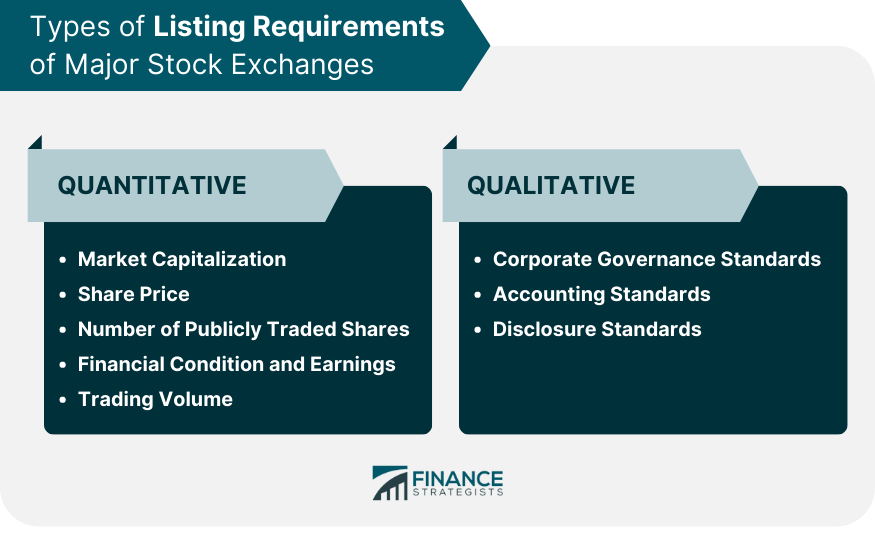
Let's explore these categories with specific, real-world examples.
Quantitative Requirements
These are numerical benchmarks related to a company's size, financial health, and share distribution. The goal is to ensure the company is substantial enough to warrant a public listing.
Qualitative Requirements
These are rules related to a company's governance, transparency, and operational standards. The goal is to ensure the company is well-run and provides investors with reliable information.
The following resource provides concrete examples of these requirements from several major global exchanges.
This section of the Wikipedia article gives specific numerical and descriptive requirements for listing on exchanges like the NYSE, NASDAQ, and LSE.
Please read the sections titled Listing requirements and the list of Examples that follows. Pay close attention to the specific figures mentioned, such as minimum market capitalization and earnings thresholds.
As you can see from the examples, a company wanting to list on the New York Stock Exchange (NYSE) needs a substantial financial track record (e.g., over $10 million in earnings over the last three years), whereas the London Stock Exchange (LSE) specifies a minimum market capitalization and requires three years of audited financials.
To provide a more detailed and practical view, which is highly relevant for the CB1 exam, let's look at a professional summary of the LSE's requirements. This document shows how requirements can differ even within the same exchange.
[PDF] London stock exchange - Highlights of listing requirements
This document from PwC provides a professional comparison of the listing requirements for two different segments of the London Stock Exchange: the Main Market and AIM (a market for smaller, growing companies).
Focus on the table that begins under the heading "This leaflet highlights the current listing requirements". Compare the requirements for the "Main Market (Premium Segment)" versus "AIM" on criteria such as: Public flotation: The percentage of shares that must be available to the public. Trading record requirement: The historical financial performance needed. Market capitalisation: The minimum total value of the company's shares. Also, review the section on Corporate governance for Premium listed companies to understand the qualitative rules, such as the composition of the board of directors.
This comparison clearly illustrates the trade-offs. A large, established company might aim for a Premium listing on the Main Market, which carries higher prestige but also more stringent rules. A smaller, high-growth company might choose AIM, which has more flexible requirements, making it easier to go public but potentially signaling a higher-risk investment.
Conclusion
In this lesson, we established the foundational role of stock exchanges in long-term corporate financing. They are not merely trading platforms but complex institutions that facilitate capital formation and enforce market discipline.
Key Takeaways:
- Stock exchanges operate both a primary market, where companies raise capital by issuing new securities (e.g., in an IPO), and a secondary market, where investors trade existing securities.
- Their key economic roles include raising capital, mobilizing savings, providing liquidity for investors, and improving corporate governance.
- The process of going public is known as an Initial Public Offering (IPO), a regulated procedure managed by investment banks.
- To be listed, companies must meet an exchange's listing requirements, which are both quantitative (e.g., minimum market capitalization, profits) and qualitative (e.g., corporate governance, accounting standards).
Now that we have a firm grasp of the environment where public securities are traded, our next lesson will delve into the specific instruments themselves. We will compare the financial characteristics, risks, and rewards of ordinary shares, preference shares, and debt, giving you the tools to analyze the building blocks of a company's capital structure.