Welcome to the final lesson of our module on Business Taxation. So far, we've examined Corporation Tax, VAT, and other key taxes as separate compliance requirements. Now, we will connect taxation directly to a company's strategic financial decisions. This lesson focuses on one of the most important principles in corporate finance: the preferential tax treatment of debt.
Your goal for this session is to demonstrate through calculation how the tax-deductibility of interest payments influences a company's financing decisions. This is a fundamental concept that explains why many companies choose to fund their operations with debt rather than just equity. Mastering this will provide a critical foundation for later modules on the cost of capital and capital structure.
1. The Interest Tax Shield: A Key Benefit of Debt
When a company needs to raise money, it has two primary choices: issue equity (shares) or take on debt (loans, bonds). How the returns to these capital providers are taxed is dramatically different:
- Payments to shareholders (dividends) are paid out of the company's after-tax profits. They are not a tax-deductible expense.
- Payments to lenders (interest) are treated as an operating expense, similar to salaries or rent. This means they are deducted from the company's profits before tax is calculated.
This tax-deductibility of interest creates a valuable benefit known as the interest tax shield. It is a reduction in a company's income tax liability that results directly from its use of debt financing.
The following resource provides a concise definition of this concept.
Interest Tax Shield | Formula + Calculator - Wall Street Prep
This article clearly defines the interest tax shield and its role in corporate finance.
Please read the first two sections, What is the Interest Tax Shield? and How to Calculate It. Focus on understanding why interest is considered a tax-deductible expense and how this creates a "shield" against taxes.
2. Calculating the Tax Savings
Since you prefer a numerical approach, let's quantify this benefit. The calculation is straightforward and directly demonstrates the tax savings.
The value of the interest tax shield in a given period is calculated with a simple formula:
To see this in action, let's compare two identical companies that differ only in their capital structure. Company A is funded entirely by equity (unlevered), while Company B uses a mix of equity and debt (levered).
The image below, taken from the Wall Street Prep article, provides a side-by-side comparison.
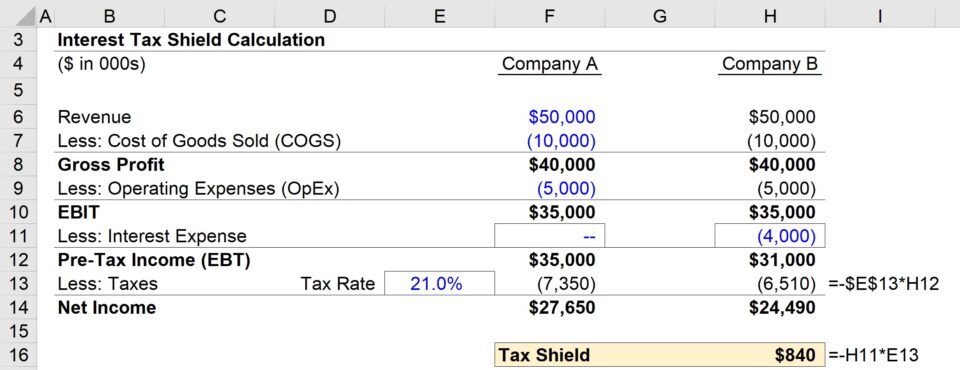
As you can see, both companies generate the same Earnings Before Interest and Tax (EBIT) of $35,000.
- Company A (No Debt): Its pre-tax income is the full $35,000. At a 21% tax rate, it pays $7,350 in taxes.
- Company B (With Debt): It first deducts its $4,000 interest expense. Its pre-tax income is only $31,000. At the same 21% tax rate, it pays $6,510 in taxes.
The tax saving is the difference between the taxes paid by Company A and Company B:
This is the interest tax shield. We can verify this with our formula:
This simple calculation is the core evidence for how financing decisions impact tax liabilities. The following reading provides the detailed text that accompanies the image we just analyzed.
Interest Tax Shield | Formula + Calculator - Wall Street Prep
This part of the Wall Street Prep article walks through the exact calculation we just performed.
First, review the formula and simple example. Then, read the detailed explanation of the two-company comparison in the section titled Interest Tax Shield Calculation Example. This will solidify your understanding of the side-by-side income statements.
3. Impact on Cash Flow and Firm Value
A lower tax bill means more cash stays within the company. This is a crucial point: even though Company B has a lower net income ($24,490 vs. $27,650), its total cash flow available to its investors (both shareholders and debtholders) is higher precisely because it paid less tax.
This insight forms the basis of the famous Modigliani-Miller (M&M) propositions with taxes. In simple terms, they argued that because of the interest tax shield, the total value of a levered firm is greater than that of an identical unlevered firm. The difference in value is the present value of all future tax shields.
This video provides an excellent visual and numerical explanation of this effect.
This video, "Modigliani and Miller Part 2" by Dr. Ronald Moy, clearly demonstrates how the tax shield increases cash flow and firm value.
Please watch the following segments: Comparison: Watch from 01:00 to 02:45 to see the side-by-side calculation of cash flow for an unlevered versus a levered firm. Note how the cash flow from assets is higher for the levered firm. Valuing the Shield: Continue from 02:45 to 03:59 to understand how the annual tax shield can be valued as a lump sum, representing the increase in the firm's value. Graphical View: Finally, watch from 03:59 to 05:27 to see a graph that illustrates how adding debt increases the value of the levered firm (VL) above the value of the unlevered firm (VU).
The key takeaway is that financing with debt doesn't just rearrange how the pie is sliced; the tax shield actually makes the entire pie bigger.
4. The After-Tax Cost of Debt
The tax shield also has a profound effect on how we measure the cost of different types of financing. Since the government effectively subsidizes debt through the tax deduction, the true cost of debt to the company is lower than the interest rate it pays to the lender. This is known as the after-tax cost of debt.
The formula to calculate it is:
Where the "Pre-Tax Cost of Debt" is the interest rate on the loan or bond. For example, if a company borrows money at 8% and its tax rate is 21%, the after-tax cost of that debt is:
This 6.32% is the effective cost of borrowing that the company should use in its financial analysis. This figure is a critical input into the Weighted Average Cost of Capital (WACC), a topic we will cover in detail in Module 11. For now, it's enough to see how the tax-deductibility of interest directly reduces the measured cost of debt.
This resource explains the calculation and its place within the WACC framework.
After-Tax Cost of Debt: Impact on WACC
This article from Phoenix Strategy Group provides a clear breakdown of the after-tax cost of debt formula and shows how it fits into the larger picture of WACC.
Please read the sections "How to Calculate After-Tax Cost of Debt" and "After-Tax Cost of Debt in WACC Calculation". Focus on the formula and the tables that break down the components. Note the WACC formula provided—you will see it again.
5. Application: EBIT-EPS Analysis
Finally, let's see how this plays out when a company is actively choosing between different financing plans. A common tool for this is EBIT-EPS Analysis, which compares how different funding options (e.g., all debt, all equity, or a mix) will affect the company's Earnings Per Share (EPS) at various levels of operating profit (EBIT).
The crucial step in this analysis is deducting interest from EBIT to arrive at taxable profit. This directly incorporates the tax shield effect into the decision-making process.
The following clips from a worked example illustrate this step for different financing scenarios.
#2 EBIT - EPS Analysis (Earning Per Share) - Financial Management ~ B.COM / BBA / CMA
This video, "#2 EBIT - EPS Analysis" from Saheb Academy, provides a full worked problem. We will focus only on the specific steps where interest and tax are calculated.
Watch these short segments to see the calculation in action: Plan 1 (All Debt): From 12:46 to 13:31, see how the interest on 30 lakh of debentures is calculated and deducted from EBIT. Plan 3 (Mixed): From 13:36 to 14:01, see how interest is calculated on only the 10 lakh debt portion. Tax Calculation: From 14:45 to 15:30, observe how tax is calculated on the Earnings Before Tax (EBT) for each plan, which is different due to the varying interest deductions. Recap: The clip from 25:36 to 26:08 provides a quick summary of the income statement flow: start with EBIT, deduct interest, then deduct tax.
This practical application shows how the tax-deductibility of interest is not just a theoretical concept but a concrete calculation that managers use to evaluate which financing option will be most beneficial for shareholders.
Conclusion
This lesson concludes our module on business taxation by bridging the gap between tax compliance and corporate strategy. We have established, through clear calculations, that the tax code provides a significant incentive for companies to use debt financing.
Key Takeaways:
- Interest payments on debt are tax-deductible, whereas dividend payments to shareholders are not.
- This creates an Interest Tax Shield, a quantifiable tax saving calculated as:
Interest Expense × Tax Rate. - The tax shield increases a company's cash flow and its overall market value.
- The true cost of debt to a firm is its After-Tax Cost of Debt, calculated as:
Pre-Tax Cost of Debt × (1 - Tax Rate). - This tax advantage makes debt a "cheaper" source of capital than equity, influencing a firm's choice of capital structure.
In our next module, we will begin our exploration of Long-Term Financing, starting with the different types of equity and debt instruments companies can issue. You will now be able to appreciate the crucial role that tax treatment plays in determining the relative attractiveness of these options.