Welcome to the first lesson of our seventh module, Constructing Financial Statements. In the previous module, we laid the groundwork for financial accounting, culminating in the preparation of the trial balance. That trial balance provides a snapshot of all our ledger accounts, but it's not yet ready for the outside world. To create meaningful financial statements, we must first make several year-end adjustments.
This lesson tackles one of the most significant of these adjustments: depreciation. You'll learn what depreciation represents and, more importantly, how to calculate it using the two most common methods. This is a fundamental skill for correctly stating a company's profit and the value of its assets, and it's a key building block for preparing the final accounts.
1. The Language of Depreciation
Before we dive into calculations, we need to be precise about the terms we'll be using. Depreciation is the systematic allocation of the cost of a tangible non-current asset over its useful life. It's an application of the accruals (or matching) concept, ensuring that the cost of an asset is recognized as an expense in the same periods that the asset helps to generate revenue.
To calculate depreciation, you need four key pieces of information.
7.2 Calculate and compare depreciation expense using straight-line ...
This section from the textbook "Explain and apply depreciation methods" clearly defines the essential vocabulary.
Please read the four bullet points under the main paragraph, from the definition of Cost to the definition of Depreciable amount. Pay close attention to how the depreciable amount is calculated, as this is the starting point for most depreciation calculations.
To recap, the key terms are:
- Cost: The initial purchase price of the asset plus any costs incurred to get it ready for use.
- Useful Life: The period over which the business expects to use the asset.
- Salvage Value (or Residual Value): The estimated value of the asset at the end of its useful life.
- Depreciable Amount: The total amount of depreciation to be charged over the asset's life, calculated as
Cost - Salvage Value.
With these terms in hand, we can now explore the methods for calculating the annual depreciation expense.
2. The Straight-Line Method: A Constant Approach
The straight-line method is the most straightforward way to calculate depreciation. It assumes that the asset contributes evenly to the business over its useful life, so the depreciation expense is the same in every single year.
The formula is simple and intuitive:
Let's watch a short video that demonstrates this calculation in practice.
Depreciation | How to Calculate Straight Line & Reducing Balance Depreciation
This video from Two Teachers provides a clear, concise explanation and example of the straight-line method.
Watch the segment from the beginning of the explanation to the end of the straight-line example. Notice how the calculation directly applies the formula using the historic value, residual value, and expected life of the van.
The key feature of the straight-line method is its consistency. The expense charged to the income statement and the reduction in the asset's book value are identical each year. This makes it simple to calculate and understand.
3. The Reducing Balance Method: An Accelerated Approach
In reality, many assets lose more value in their early years and less as they get older. Think of a new car or a computer. The reducing balance method (also known as the diminishing balance method) reflects this by charging a higher depreciation expense in the early years of an asset's life, with the expense decreasing over time.
Instead of a fixed annual amount, this method applies a fixed percentage to the asset's net book value (NBV) at the start of each year. The NBV is the asset's original cost minus all the depreciation charged to date (the accumulated depreciation).
The following video explains how this works, using the same van example from before.
Depreciation | How to Calculate Straight Line & Reducing Balance Depreciation
This next segment from the same Two Teachers video explains the reducing balance method.
Please watch the section from the start of the explanation until the end of the year-by-year calculation. Observe how the depreciation for each year is based on the new, lower book value from the end of the previous year.
As a statistician, you might find an interesting parallel here. The formula for the net book value after n years under the reducing balance method is:
This is analogous to calculating the present value of a single sum with a discount rate, or a form of exponential decay. You can use this formula to quickly find the book value of an asset after several years without calculating each year individually.
Reducing Balance Method of Depreciation | Cambridge (CIE) AS ...
This revision note from Save My Exams provides a concise summary and a worked example that illustrates both the year-by-year calculation and the "compound interest" style formula.
Read the sections titled "How do I calculate..." and then review the worked example under Method 2 to see this mathematical shortcut in action.
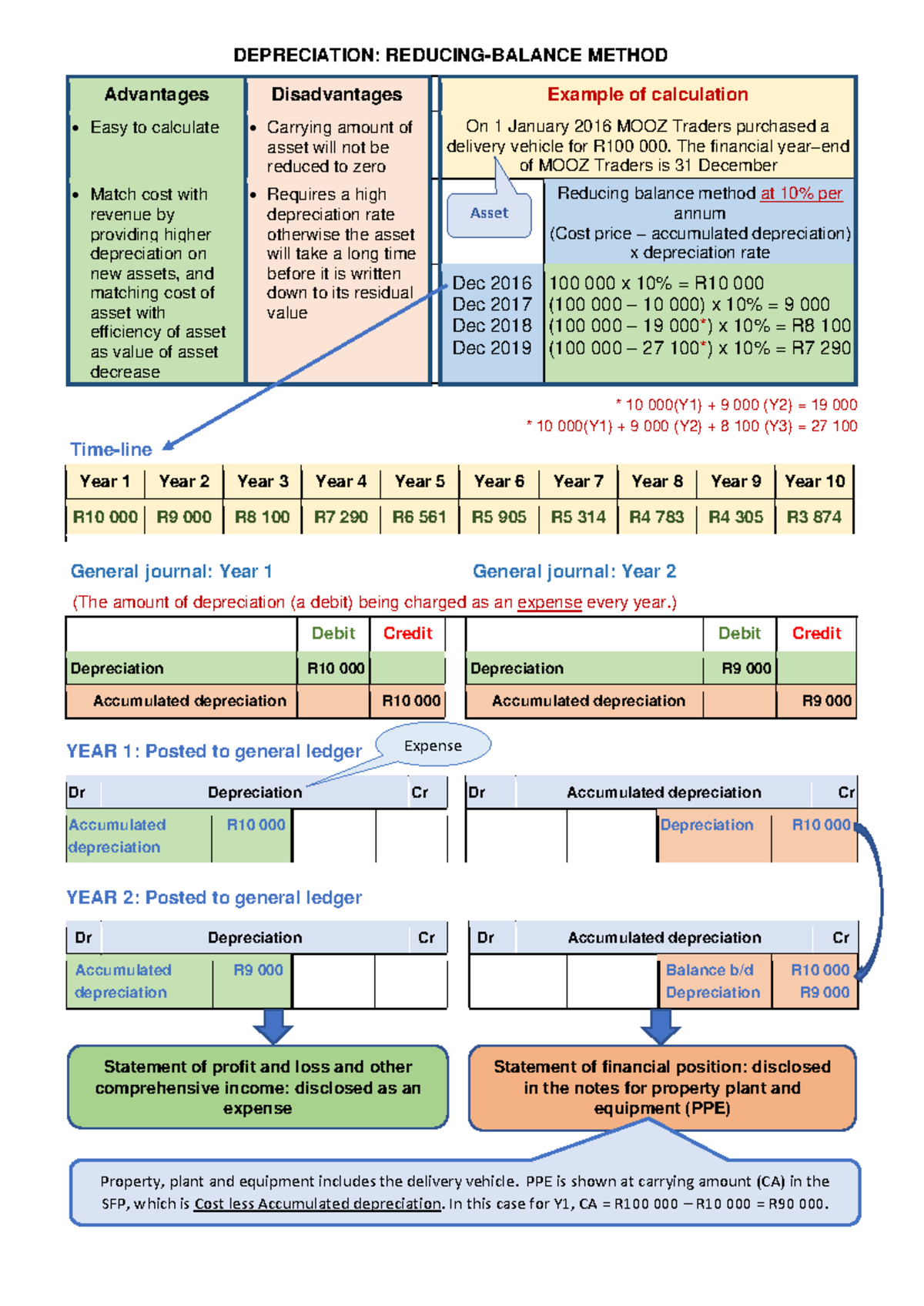
The image below provides a fantastic, comprehensive overview of the reducing balance method, from the initial calculation to how it flows through the financial records.
4. Comparing the Methods
The choice between the straight-line and reducing balance methods has a significant impact on a company's reported profits and asset values. The graph below visualizes the difference in how an asset's book value declines over time under each method.

While the annual depreciation charge differs, it's crucial to remember that the total depreciation over the asset's entire life will be the same under both methods. Both will depreciate the asset from its original cost down to its salvage value.
5. Comprehensive Worked Example
Let's solidify your understanding by working through a full example using both methods. This will allow you to see the numbers side-by-side and practice constructing a depreciation schedule—a table that tracks the asset's value over time.
Scenario: A company purchases a machine for $50,000. It has an estimated useful life of 5 years and an expected salvage value of $5,000.
Method 1: Straight-Line Depreciation
-
Calculate the annual depreciation expense:
-
Create the depreciation schedule:
| Year | Opening NBV | Depreciation Expense | Accumulated Depreciation | Closing NBV |
|---|---|---|---|---|
| 1 | $50,000 | $9,000 | $9,000 | $41,000 |
| 2 | $41,000 | $9,000 | $18,000 | $32,000 |
| 3 | $32,000 | $9,000 | $27,000 | $23,000 |
| 4 | $23,000 | $9,000 | $36,000 | $14,000 |
| 5 | $14,000 | $9,000 | $45,000 | $5,000 |
Notice that the closing NBV at the end of Year 5 is exactly the salvage value ($5,000), and the total accumulated depreciation is the depreciable amount ($45,000).
Method 2: Reducing Balance Depreciation
Let's use the "double-declining balance" method, a common variant where the rate is double the straight-line rate.
-
Calculate the depreciation rate:
- Straight-line rate =
- Reducing balance rate =
-
Create the depreciation schedule:
| Year | Opening NBV | Calculation | Depreciation Expense | Accumulated Depreciation | Closing NBV |
|---|---|---|---|---|---|
| 1 | $50,000 | $20,000 | $20,000 | $30,000 | |
| 2 | $30,000 | $12,000 | $32,000 | $18,000 | |
| 3 | $18,000 | $7,200 | $39,200 | $10,800 | |
| 4 | $10,800 | $4,320 | $43,520 | $6,480 | |
| 5 | $6,480 | * | $1,480 | $45,000 | $5,000 |
*A crucial rule: You cannot depreciate an asset below its salvage value. In Year 5, applying the 40% rate would give a depreciation of $2,592, taking the closing NBV to $3,888, which is below the $5,000 salvage value. Therefore, the depreciation expense in the final year is simply the amount needed to reduce the NBV to the salvage value ($6,480 - $5,000 = $1,480).
Conclusion
In this lesson, you've learned how to perform one of the most essential year-end adjustments. You are now equipped to calculate depreciation, a critical component in determining a company's true profit and asset valuation.
Key Takeaways:
- Depreciation is the process of allocating an asset's cost over its useful life, not a measure of its market value.
- The straight-line method results in a constant annual depreciation expense, making it simple and predictable.
- The reducing balance method is an accelerated method that results in a higher depreciation expense in the early years and a lower expense in later years, often better reflecting an asset's pattern of use.
- The total depreciation recognized over an asset's life is the same regardless of the method used; only the timing of the expense differs.
We have now tackled our first major adjustment for constructing financial statements. In the next lesson, we will continue this process by learning how to account for accruals and prepayments, which are adjustments for expenses and revenues that belong to a different period than when the cash was paid or received.