Welcome to your second lesson in the "Constructing Financial Statements" module. In our previous session, we explored depreciation, our first major year-end adjustment. We established that these adjustments are crucial for upholding the matching principle, which dictates that an entity's expenses should be recognized in the same period as the revenues they helped to generate.
Today, we continue this vital process by focusing on accruals and prepayments. These adjustments deal with the common situation where cash is paid or received in a different period from when the expense is incurred or the income is earned. Mastering this topic is essential for ensuring that the Statement of Profit or Loss accurately reflects a company's performance for the year, and that the Statement of Financial Position gives a true picture of its assets and liabilities.
1. The Core Principle: Matching and Timing
The entire concept of accruals and prepayments hinges on the matching principle. While cash flow is important, for financial reporting, the timing of the economic activity is what matters most. An expense is "real" when the service is used or the benefit is received, not just when the bill is paid.
To start, let's watch a brief introduction that grounds these ideas in a simple example and links them directly to the matching concept.
Accruals and Prepayments Simplified
The video "Accruals and Prepayments Simplified" from Steve Willis ACCA offers a very clear entry point into this topic.
Please watch the initial segment from the simple example. Focus on how the video explains the matching concept: recognizing revenue and expenses in the period they occur, not when cash changes hands.
This principle gives rise to four distinct scenarios we need to account for at the end of a financial period. The following video systematically defines each one and, crucially, classifies it as either a current asset or a current liability.
Accounting for Beginners | Part 4 | Accruals & Prepayments
This video, "Accounting for Beginners | Part 4," from Counttuts provides excellent, clear definitions.
Watch the section from the four types where the four categories are introduced. Then, continue watching from the classification to understand why each is an asset or liability.
To summarize the key classifications from the video:
| Type | Description | Classification | Rationale |
|---|---|---|---|
| Prepaid Expense | Expense paid in advance, but not yet incurred. | Current Asset | The business has a right to a future service/good. |
| Accrued Expense | Expense incurred, but not yet paid. | Current Liability | The business has an obligation to pay for a past service. |
| Prepaid Income | Income received in advance, but not yet earned. | Current Liability | The business has an obligation to provide a future service/good. |
| Accrued Income | Income earned, but not yet received. | Current Asset | The business has a right to receive cash for a past service. |
Now, let's work through the mechanics of recording these adjustments, starting with prepayments.
2. Accounting for Prepayments
A prepayment is a payment made in the current period for an expense that will benefit a future period. Think of paying your annual insurance premium or a six-month software subscription upfront.
When the payment is made, it doesn't immediately become an expense. Instead, it is recorded as a current asset, often called "Prepayments." This asset represents the future economic benefit the company is entitled to. Then, as time passes and the benefit is "used up," the asset is gradually converted into an expense on the Statement of Profit or Loss.
Example: Prepaid Software Subscription
Let's use a practical example. A company signs a $60,000 contract on November 1st for a six-month software subscription and pays the full amount upfront. Its financial year ends on December 31st.
-
Initial Payment (November 1st): The company has paid $60,000, but none of it is an expense yet. It's an asset.
- Debit Prepaid Expenses (an asset) $60,000
- Credit Cash (an asset) $60,000
-
Monthly Expense Recognition: Each month, one-sixth of the subscription is used. The monthly expense is .
- November 30th: Recognize one month of expense.
- Debit Software Expense $10,000
- Credit Prepaid Expenses $10,000
- December 31st (Year-End): Recognize another month of expense.
- Debit Software Expense $10,000
- Credit Prepaid Expenses $10,000
- November 30th: Recognize one month of expense.
At the year-end on December 31st:
- The Statement of Profit or Loss will show a total Software Expense of $20,000 ($10,000 for Nov + $10,000 for Dec).
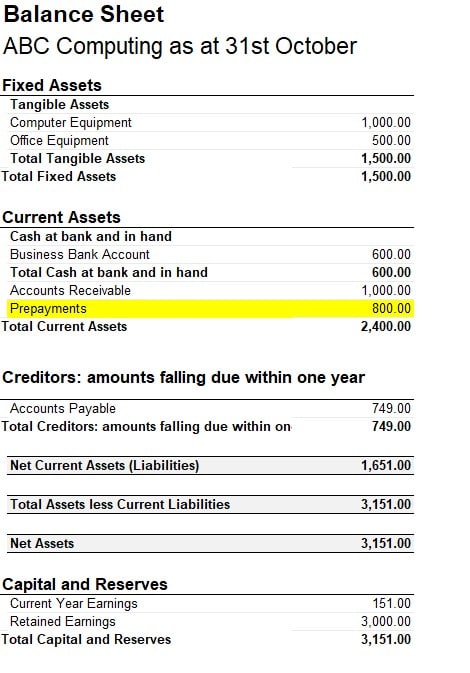
- The Statement of Financial Position will show a Current Asset called "Prepayments" of $40,000 ($60,000 initial asset - $20,000 expensed). This is the portion that relates to the next financial year.
This image shows exactly how such a prepayment would appear on the balance sheet.
For a visual walkthrough of the T-account entries for a prepayment, let's return to the Steve Willis video.
Accruals and Prepayments Simplified
This segment demonstrates the T-account mechanics for a prepaid rent example.
Watch from the prepayment example. Observe how the total cash paid is debited to the Rent expense account, but only the portion used during the year is transferred to the P&L. The remaining balance becomes the closing prepayment asset.
3. Accounting for Accruals
An accrual is the opposite of a prepayment. It recognizes an expense that has been incurred in the current period but for which payment will only be made in a future period. Common examples include utilities used in the last month of the year but billed in the next, or salaries earned by employees but paid after the year-end.
The adjustment involves recognizing the expense in the current period's Statement of Profit or Loss and creating a corresponding current liability, often called "Accruals" or "Accrued Expenses."
Example: Accrued Legal Services
A company signs a $60,000 contract on November 1st for six months of legal services. The company will pay the full amount at the end of the contract in April of the next year. Its financial year ends on December 31st.
- Monthly Expense Recognition: Even though no cash has been paid, the company is using the legal services each month. It must recognize a monthly expense of .
- November 30th: Recognize one month of expense and the corresponding liability.
- Debit Legal Expense $10,000
- Credit Accrued Expenses (a liability) $10,000
- December 31st (Year-End): Recognize another month of expense.
- Debit Legal Expense $10,000
- Credit Accrued Expenses (a liability) $10,000
- November 30th: Recognize one month of expense and the corresponding liability.
At the year-end on December 31st:
- The Statement of Profit or Loss will show a total Legal Expense of $20,000 ($10,000 for Nov + $10,000 for Dec).
- The Statement of Financial Position will show a Current Liability called "Accrued Expenses" of $20,000. This reflects the company's obligation to pay for services already received.
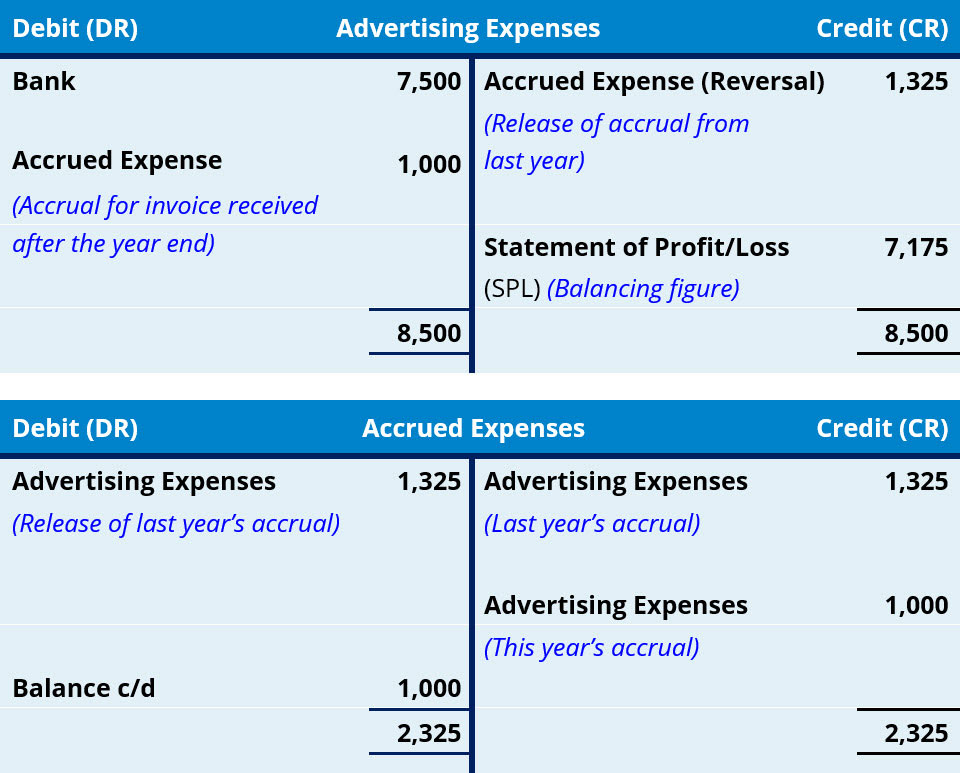
The image below shows how these entries would flow through the T-accounts for an advertising expense.
The logic for accrued expenses is demonstrated well in the following video segment.
Accruals and Prepayments Simplified
This part of the video explains accounting for an expense paid in arrears (an accrual).
Watch the section from the accrual scenario. Notice that even though only $600 was paid, the P&L is charged for the full 8 months of rent used ($800), and the $200 difference is recorded as a closing liability.
4. A Systematic Template for Exam Questions
For your CB1 exam, you'll need to be able to quickly determine the correct expense or income for the Profit & Loss statement given opening and closing balances for accruals and prepayments, along with cash paid or received. A systematic approach is invaluable.
The following template provides a powerful, mechanical method for solving these problems using T-accounts. Given your background, you'll likely appreciate this structured, rule-based approach.
Accruals and Prepayments Simplified
The final part of this video introduces a T-account template and applies it to an exam-style question. This is highly practical for your exam preparation.
First, watch the explanation of the template. Pay close attention to the placement of opening/closing balances for prepayments and accruals, and the positions of Cash and P&L entries. Then, see it in action as the presenter uses it to solve an ACCA exam question.
Let's recap the Expense Account template from the video. It's built on a few key principles of double-entry bookkeeping:
| Debit (DR) | Credit (CR) |
|---|---|
| Opening Prepayment b/f | Opening Accrual b/f |
| Cash Paid | P&L Charge for the year (Expense) |
| Closing Accrual c/f | Closing Prepayment c/f |
| Total | Total |
In any question, you will be given most of these figures and asked to find the missing one, which is often the P&L charge. By plugging the known values into this template, the balancing figure becomes easy to calculate. This method is far more reliable under exam pressure than trying to reason from first principles every time.
Conclusion
You have now tackled your second major year-end adjustment. You can see how these adjustments refine the raw numbers from the trial balance to create financial statements that provide a "true and fair" view of the business, aligning with the crucial matching principle.
Key Takeaways:
- Accruals and prepayments are adjustments that ensure income and expenses are recorded in the period they are earned or incurred, not when cash moves.
- Prepaid Expenses and Accrued Income are Current Assets, representing future benefits or cash to be received.
- Accrued Expenses and Prepaid Income are Current Liabilities, representing obligations to pay cash or provide future services.
- The T-account template provides a systematic and reliable method for calculating the correct P&L and Balance Sheet figures in exam scenarios.
In our next lesson, we will continue our journey through year-end adjustments by examining how to account for provisions and bad debts. This involves estimating future liabilities and recognizing that not all customers will pay what they owe, another key aspect of applying prudence in accounting.