Hello! In our last lesson, we focused on converting the adjusted trial balance into a Statement of Profit or Loss to determine a company's net income for the period. This "bottom line" figure is crucial, but it only tells part of the story. The next logical step is to understand what happens to that profit. Does the company retain it for future growth, or distribute it to its owners?
This brings us to today's topic: the Statement of Changes in Equity (SoCE). This statement serves as a vital bridge, connecting the Statement of Profit or Loss to the Statement of Financial Position. It meticulously tracks the changes in a company's equity from the beginning to the end of an accounting period. Your preference for practical, numerical examples will be key today, as we will work through constructing this statement from start to finish. By the end of this lesson, you will be able to prepare a complete Statement of Changes in Equity.
1. The Purpose and Components of the Statement of Changes in Equity
At its core, equity represents the owners' stake in the company. For a limited company, this isn't a single number but a collection of different accounts. The SoCE explains the movement in each of these accounts over a period. The main components you'll encounter are:
- Share Capital: The nominal or par value of shares issued to owners.
- Share Premium (or Additional Paid-in Capital): The amount shareholders pay for shares that is above the nominal or par value.
- Retained Earnings: The cumulative net profits of the company that have not been paid out to shareholders as dividends. This is where the net income we calculated in the last lesson makes its appearance.
- Other Reserves: This can include items like a Revaluation Reserve, which arises if the company revalues its assets upwards, or reserves for unrealized gains and losses on certain financial instruments.
The statement is typically presented in a columnar format, with each equity component having its own column. The rows show the transactions that caused the balances to change during the year. To get a clear overview of this structure and its purpose, let's start with a short introductory video.
Statement of Changes in Equity | Company | Explained with Examples
The video "Statement of Changes in Equity | Company | Explained with Examples" by Counttuts provides a concise introduction to the statement's purpose, format, and common components.
Please watch the segment from the purpose and format. This will introduce you to the typical layout and the key elements we will be working with.
As you saw in the video, the statement starts with the opening balance of equity, details the changes throughout the year—such as profit, dividends, and share issues—and ends with the closing balance.
2. A Step-by-Step Worked Example
The best way to understand the SoCE is to build one. We'll work through a practical example that is very common in exams, where you must construct the statement using information from comparative financial positions and some additional notes.
The video you just started watching continues with an excellent, detailed example. It will guide you through the process of:
- Identifying the opening balances for each equity component from the previous year's Statement of Financial Position.
- Incorporating the profit for the year into Retained Earnings.
- Deducting dividends paid from Retained Earnings.
- Inferring the value of new shares issued during the year by comparing the opening and closing balances of Share Capital and Share Premium.
- Calculating the final closing balances and reconciling the totals.
Statement of Changes in Equity | Company | Explained with Examples
Let's continue with the first worked example from the Counttuts video.
Watch the walkthrough from Example 1. Pay close attention to how the presenter uses the 2019 and 2020 Statement of Financial Position figures to deduce the movements in the equity accounts. This technique of "finding the missing piece" is a crucial skill.
Here is a static image showing a similar, cleanly laid-out statement. Notice how each transaction affects specific columns, and how the rows and columns all add up.
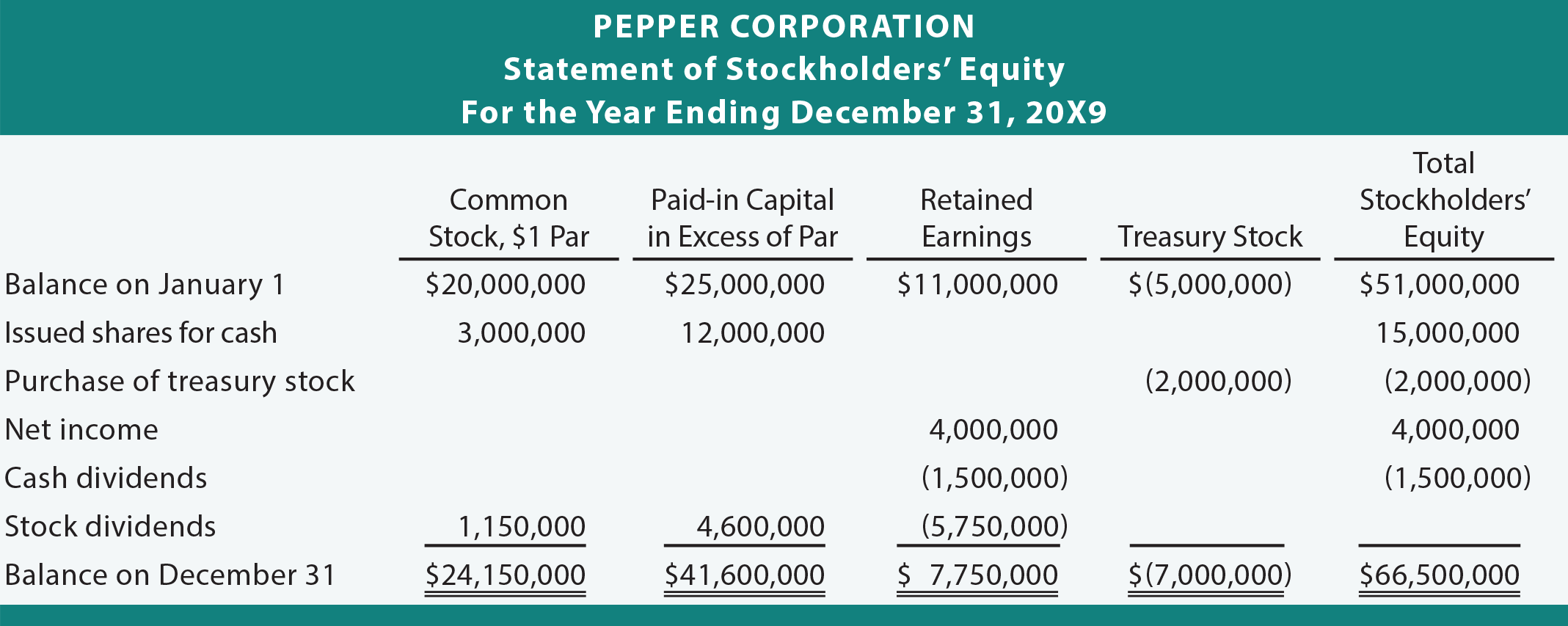
3. A More Complex Scenario
Building on that foundation, let's examine a slightly more complex case. This next example introduces a new element, the Revaluation Reserve, and involves more detailed calculations for issuing shares and paying dividends. This is where your quantitative skills will be particularly useful.
The key calculations to focus on are:
- Share Issue: When shares are issued for a price higher than their par value, you must calculate how much of the proceeds goes to the 'Share Capital' account (the par value portion) and how much goes to the 'Share Premium' account (the excess portion).
- Dividend Calculation: Dividends are often declared on a "per share" basis. To find the total dividend amount, you must first calculate the total number of shares outstanding at the date the dividend is declared, which may include new shares issued during the year.
This next segment of the video walks through these precise calculations.
Statement of Changes in Equity | Company | Explained with Examples
Now, let's tackle the second example from the same video, which adds more layers of calculation.
Watch from Example 2. Focus on two key parts: The calculation of the share premium when new shares are issued (share premium calculation). The logic for calculating the total dividend payment based on the total number of shares in issue at year-end (dividend calculation).
Real-world statements can be even more detailed. For example, large public companies like Bank of America have an additional section called Accumulated Other Comprehensive Income (AOCI), which is where items like the revaluation surplus, as well as unrealized gains or losses on certain investments, are grouped.

4. Practice Exercise
To consolidate your understanding, let's look at a practice problem. The following resource contains a comprehensive exercise where you are given a company's balance sheet, income statement, and additional information, and are asked to prepare the Statement of Changes in Equity. This is an excellent test of your ability to pull information from different sources and assemble it correctly.
[PDF] EXERCISES LESSON 6 STATEMENT OF CHANGES IN EQUITY
This PDF document provides excellent, exam-style practice questions with full solutions.
Find Exercise 2 within the document. Before looking at the solution, try to map out the Statement of Changes in Equity for year 200X using the financial statements and notes provided. Ask yourself: What are the opening balances? What was the profit for the year? How was last year's profit distributed (dividends vs. reserves)? What was the impact of the capital increase? Once you have a draft, compare your work with the detailed solution that follows.
Conclusion
In this lesson, we have focused on constructing the Statement of Changes in Equity. We've seen that it is a dynamic report that explains how the owners' stake in a company has evolved over a period, providing a crucial link between the company's performance (Net Income) and its financial position.
Key Takeaways:
- The SoCE reconciles the opening and closing balances of each component of equity (Share Capital, Share Premium, Retained Earnings, etc.).
- Net Income from the Statement of Profit or Loss increases Retained Earnings.
- Dividends paid to shareholders decrease Retained Earnings.
- Issuing new shares increases Share Capital and, if applicable, Share Premium.
- The final, total closing balance of equity calculated on the SoCE is the figure that will be presented in the Statement of Financial Position.
We have now prepared two of the main financial statements. The final closing equity figure we've just calculated is a critical component of our next task. In the upcoming lesson, we will prepare the Statement of Financial Position (or Balance Sheet), completing the core set of financial statements and seeing how everything fits together through the fundamental accounting equation: Assets = Liabilities + Equity.