Welcome to the next stage of our work in constructing financial statements. In our previous lessons, we've done the detailed preparatory work of making year-end adjustments for depreciation, accruals, provisions, and inventory valuation. All of this effort culminates in the adjusted trial balance. Today, we will take that critical document and use it to build the first of the three main financial statements: the Statement of Profit or Loss, also known as the Income Statement.
This lesson is pivotal. It's where we translate a long list of debit and credit balances into a structured narrative about a company's financial performance. We will systematically identify, extract, and organize revenue and expense accounts to arrive at the single most-watched figure in finance: the net income, or "bottom line." Your preference for practical, numerical examples will be central to our work today as we transform raw data into a polished financial report.
1. The Adjusted Trial Balance: Our Starting Point
Before we can prepare any financial statement, we need a complete and accurate list of all the company's accounts and their final balances for the period. This is the role of the adjusted trial balance. It's prepared after all adjusting entries (like the ones we've studied for depreciation and inventory) have been recorded. It serves as the single source of truth for constructing the financial statements.
An adjusted trial balance lists every account—assets, liabilities, equity, revenues, and expenses—and confirms that total debits equal total credits. Our job is to filter this list and select only the accounts that measure performance: revenues and expenses.
To understand where the trial balance fits into the overall accounting cycle, the following video provides a concise overview.
Turn a Trial Balance into an Income Statement in 4 steps
The video "Turn a Trial Balance into an Income Statement in 4 steps" by The Financial Controller provides excellent context. It shows the flow of data from individual transactions to the final financial statements.
Please watch the segment from the data flow. Pay close attention to the distinction made between Balance Sheet accounts, which are a snapshot in time, and Income Statement accounts, which represent activity over a period. This is a crucial concept.
2. Identifying and Extracting Revenue and Expense Accounts
With our adjusted trial balance in hand, the first practical step is to identify all the income (revenue) and expense accounts.
- Income/Revenue Accounts: These represent the earnings of the business from its primary activities (like
Service RevenueorSales) or other sources (Interest Revenue). In the trial balance, they will almost always have a credit balance. - Expense Accounts: These are the costs incurred to generate revenue (e.g.,
Salaries Expense,Rent Expense,Cost of Goods Sold). In the trial balance, they will have a debit balance.
The following guide from Accountingverse breaks down this identification and extraction process into clear, manageable steps.
How to Prepare an Income Statement - Accountingverse
This article provides a straightforward, step-by-step methodology for preparing an income statement from an adjusted trial balance.
Please read the following sections: Start with Step 1, which reinforces the role of the adjusted trial balance. Next, read Step 3 to see how revenue accounts are handled. Finally, read Step 4, which explains how to list and sum the expenses. Note the practical tip of listing expenses from highest to lowest.
3. Structuring the Statement: The Multi-Step Format
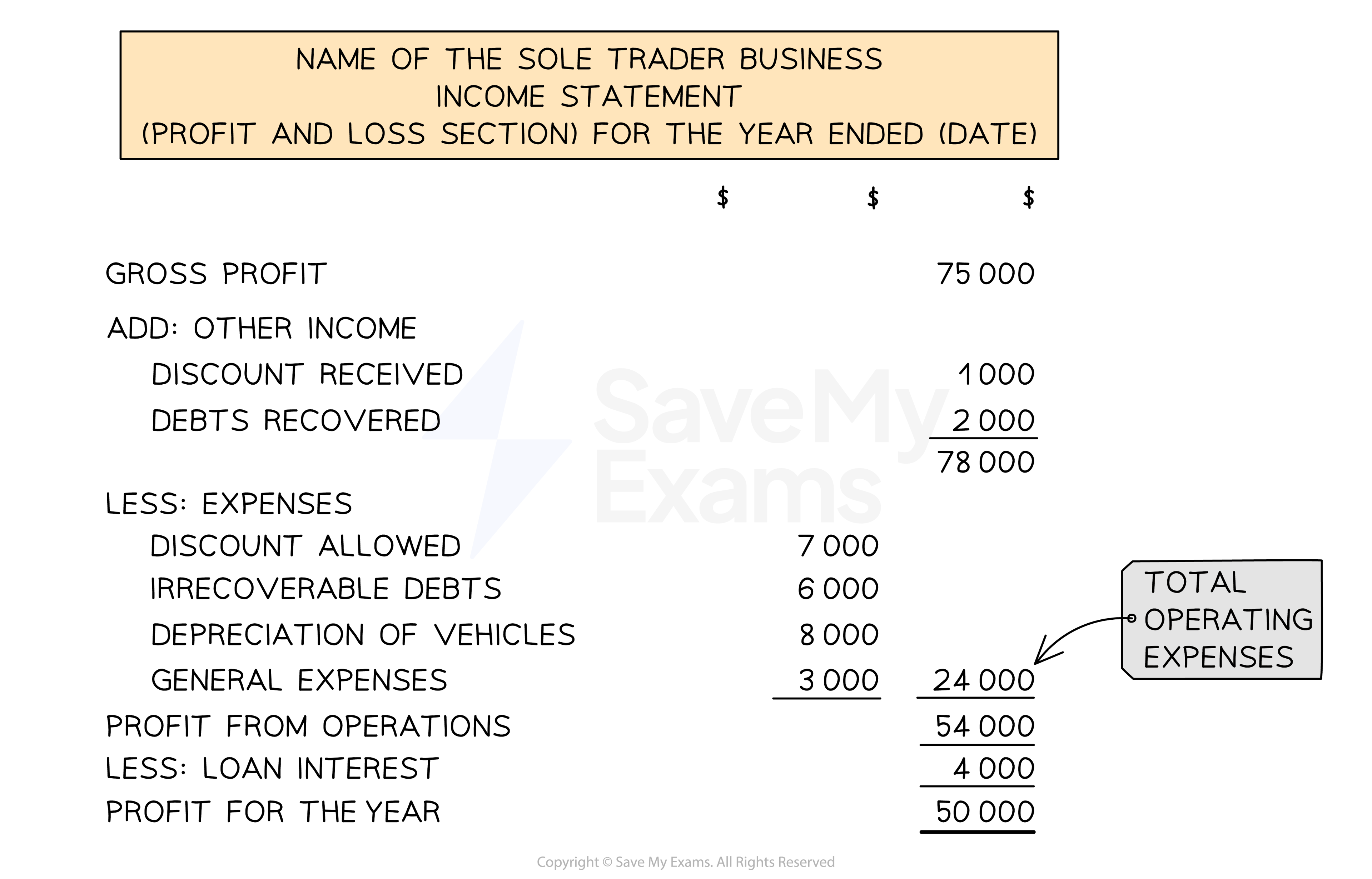
Simply listing all revenues and subtracting all expenses (a "single-step" statement) gives you the net income, but it hides valuable information. A more insightful approach, and the standard for most businesses, is the multi-step income statement. This format presents key subtotals that provide a deeper look into the company's profitability.
The key subtotals are:
- Gross Profit: Calculated as
Revenue - Cost of Goods Sold. This tells you how profitable the core product or service is before considering other operating costs. - Profit from Operations (Operating Profit): Calculated as
Gross Profit - Operating Expenses. This shows the profit from the company's principal business activities. - Profit Before Tax: The profit after including non-operating items like interest expense.
- Net Income (Profit for the Year): The final profit after accounting for income tax.
The image below shows a classic multi-step layout.
For a complete, worked example showing how to create a multi-step statement from a trial balance, let's turn to a more detailed resource.
Preparing a Multiple Step Income Statement
This PDF document provides an adjusted trial balance and then walks through the logic and final presentation of a full multi-step income statement, including the calculation of income tax.
First, read the instructions, which explain the order of operations: calculating Net Sales, Gross Profit, Operating Income, and finally Net Income. Then, study the final solution at the end of the document to see how these instructions are applied to produce the finished statement.
4. A Step-by-Step Worked Example
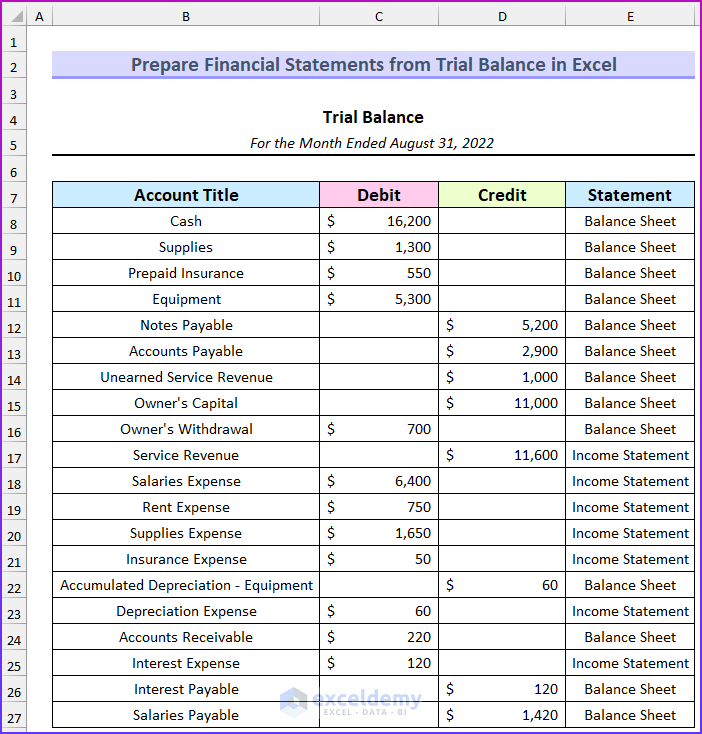
Let's now apply these principles together. We will use the adjusted trial balance from the image we saw earlier (LINK) to prepare a multi-step Statement of Profit or Loss.
Adjusted Trial Balance Data (Income Statement Accounts Only):
- Service Revenue: $11,600 (Credit)
- Salaries Expense: $6,400 (Debit)
- Rent Expense: $750 (Debit)
- Supplies Expense: $1,650 (Debit)
- Insurance Expense: $50 (Debit)
- Depreciation Expense: $60 (Debit)
- Interest Expense: $120 (Debit)
Step 1: Prepare the Heading
Every financial statement must have a three-line heading: Company Name, Statement Title, and Period Covered.
Step 2: List Revenues
This company is a service business, so it has Service Revenue instead of Sales and Cost of Goods Sold. Therefore, its Gross Profit is the same as its total revenue.
Step 3: List and Total Operating Expenses
Operating expenses are the costs of running the primary business operations. We'll group them together.
Step 4: Calculate Operating Profit
This is Revenue minus Total Operating Expenses.
Step 5: Include Other Income/Expenses
Interest expense is considered a financing cost, not an operating one, so it's listed separately after Operating Profit.
Step 6: Calculate Net Income
The final step is to calculate the profit. We will assume no income tax for this example.
Here is the final statement:
| Example Company | ||
|---|---|---|
| Statement of Profit or Loss | ||
| For the Month Ended August 31, 2022 | ||
| $ | ||
| Service Revenue | 11,600 | |
| Operating Expenses: | ||
| Salaries Expense | 6,400 | |
| Supplies Expense | 1,650 | |
| Rent Expense | 750 | |
| Depreciation Expense | 60 | |
| Insurance Expense | 50 | |
| Total Operating Expenses | (8,910) | |
| Operating Profit | 2,690 | |
| Interest Expense | (120) | |
| Profit for the period (Net Income) | 2,570 |
This structured format clearly separates the results of core operations (Operating Profit) from the impact of financing decisions (Interest Expense).
For a video demonstration of this process, the following clip provides a very clear, narrated walkthrough.
How to Prepare Financial Statements from an Adjusted Trial Balance
The video "How to Prepare Financial Statements from an Adjusted Trial Balance" from Wild Accounting gives a direct and easy-to-follow demonstration.
Please watch the section covering the income statement, from the income statement preparation. This will solidify your understanding of how to pull the numbers from the trial balance and place them in the correct part of the statement.
Conclusion
In this lesson, we have bridged the gap between raw data and financial reporting. We've learned how to take an adjusted trial balance and methodically transform it into a multi-step Statement of Profit or Loss. This process is fundamental to financial accounting and provides a powerful lens through which to view a company's performance.
Key Takeaways:
- The adjusted trial balance is the starting point for preparing all financial statements.
- The Statement of Profit or Loss is constructed using only the revenue (credit balances) and expense (debit balances) accounts.
- The multi-step format provides critical insights by calculating subtotals like Gross Profit and Operating Profit.
- The final result, Net Income, represents the company's overall profitability for the period.
We have now successfully calculated the profit for the period. The next logical question is: what does the company do with this profit? This is where our next lesson begins. We will prepare the Statement of Changes in Equity, which shows how the net income we just calculated, along with any transactions with owners (like dividends), links the opening and closing equity balances for the period.