Welcome to the next lesson in our journey through the construction of financial statements. In our last session, we delved into provisions and bad debts, seeing how the principle of prudence guides us to anticipate and account for potential losses on our receivables. Today, we'll tackle another critical year-end adjustment: the valuation of inventory.
This topic is crucial because the value we assign to our inventory directly impacts two key figures in the financial statements. First, it determines the Cost of Goods Sold (COGS) on the Statement of Profit or Loss. Second, it sets the value of inventory as a current asset on the Statement of Financial Position. An incorrect valuation can significantly misstate a company's profitability and its net worth.
The central challenge arises when a company buys identical items at different prices throughout a period. When an item is sold, which purchase cost should be assigned to it? We'll explore the two primary methods sanctioned by international accounting standards to solve this problem: First-In, First-Out (FIFO) and Weighted Average Cost (AVCO). Your background in statistics will be helpful here, as you'll see how different underlying assumptions about cost flows lead to different, yet equally valid, results.
1. The Basics of Inventory Valuation
Inventory refers to goods that a business holds for the purpose of resale. For a manufacturing company, this can include raw materials, work-in-progress, and finished goods. For a retailer, it's simply the merchandise on the shelves.
When it's time to prepare financial statements, we must determine two things:
- The cost of the inventory that was sold during the period (Cost of Goods Sold).
- The cost of the inventory that remains unsold at the end of the period (Closing Inventory).
The fundamental principle is:
This total cost must then be allocated between the goods that were sold and the goods that remain. The method of allocation is what we are here to study.
Let's start by getting a clear conceptual overview of the two main methods we'll be using.
INVENTORY VALUATION (FIFO & WEIGHTED AVERAGE) - PART 1
The video "INVENTORY VALUATION (FIFO & WEIGHTED AVERAGE) - PART 1" from FOG Accountancy Tutorials provides an excellent introduction. It explains the purpose of inventory valuation and the core ideas behind the FIFO and Weighted Average methods.
Please watch from the beginning to the explanation of methods. Pay attention to the instructor's conceptual explanation of what "first-in, first-out" means (FIFO explanation) and the logic behind using a weighted average (AVCO explanation).
2. The Stores Ledger Card: Our Primary Tool
To apply these methods in a systematic way, accountants use a perpetual inventory system, where inventory records are updated continuously for every purchase and sale. The primary document for this is the Stores Ledger Card (or stock record card). It tracks the quantity, unit cost, and total value of inventory as it moves in and out of the business.
The FOG Accountancy Tutorials video provides a clear walkthrough of the typical format of a stores ledger card, which we will use in our examples.
INVENTORY VALUATION (FIFO & WEIGHTED AVERAGE) - PART 1
Before we dive into the calculations, let's familiarise ourselves with the tool. This segment shows how to structure the stores ledger card.
Watch from drawing the format. Notice the three main sections: Receipts, Issues, and Balance, each with columns for Quantity, Unit Price, and total Amount. This structure is key to keeping our calculations organized.
3. The FIFO (First-In, First-Out) Method
The FIFO method operates on a simple, logical assumption: the first items that came into the inventory are the first ones to be sold. This often mirrors the physical flow of goods, especially for perishable items like groceries, where a shop would want to sell the oldest stock first.
When we issue (sell) goods under FIFO:
- We use the price of the oldest batch of inventory first.
- Once that batch is depleted, we move to the next oldest batch, and so on.
- The closing inventory will therefore be valued at the prices of the most recent purchases.
Let's see this in action. The best way to understand FIFO is to work through a detailed numerical example.
INVENTORY VALUATION (FIFO & WEIGHTED AVERAGE) - PART 1
The video now applies the FIFO method to a multi-transaction example. This is a comprehensive, step-by-step demonstration that is perfect for understanding the mechanics.
Please watch the detailed FIFO walkthrough from the FIFO method. As you watch, focus on how the "Issues" are priced. When an issue of 130 units is made on June 15th (example issue), notice how the cost is built up by first exhausting the oldest stock (20 units @ $4), then the next batch (100 units @ $5), and finally taking the remainder from the next batch (10 units @ $6).
4. The Weighted Average Cost (AVCO) Method
The AVCO method takes a different approach. Instead of tracking individual batches, it smooths out price variations by calculating a new weighted average cost per unit after each new purchase. This average cost is then used to value all issues until the next purchase arrives.
The formula to calculate the new average cost after a purchase is:
This method is particularly useful for inventory where it's impractical or impossible to distinguish between different batches (e.g., fuel in a storage tank).
Let's apply this to the same set of transactions to see how the outcome differs.
INVENTORY VALUATION (FIFO & WEIGHTED AVERAGE) - PART 1
The video now solves the exact same problem using the AVCO method. This provides a direct and powerful comparison.
Please watch the AVCO walkthrough from the Weighted Average method. The key moment to observe is after each "Receipt". For example, on June 2nd (example receipt), see how the quantities are added (60+100=160), the values are added (240+500=740), and a new average price is calculated (740/160 = $4.63). This new price is then used for all subsequent issues until the next receipt.
5. Comparing the Methods and Their Impact
As you saw in the detailed example, the choice of inventory valuation method leads to different figures for both the cost of goods sold and the closing inventory value.
- FIFO Closing Inventory: 100 units @ $8.00 = $800
- AVCO Closing Inventory: 100 units @ $6.38 = $638
This difference is not an error; it's a direct consequence of the different cost flow assumptions. The following image provides a simple illustration of this divergence.
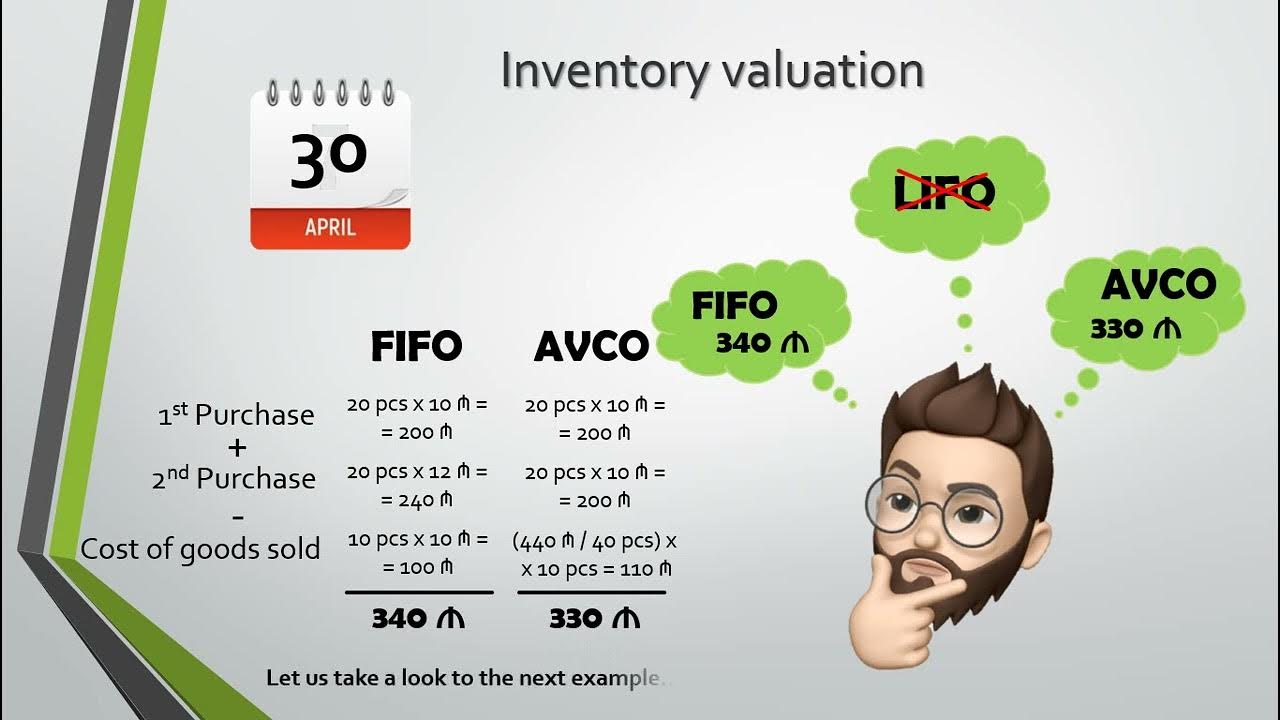
So, which method is "better"? Neither. Both are acceptable under accounting standards. The choice depends on the nature of the business and its inventory. However, the choice has significant financial implications, especially in a period of changing prices (inflation or deflation).
During a period of rising prices (inflation):
- FIFO matches the older, lower costs against revenue. This results in a lower COGS, a higher reported profit, and a higher valuation of closing inventory on the Statement of Financial Position (since closing stock reflects the most recent, higher prices).
- AVCO averages the costs, so its reported profit and inventory valuation will typically fall somewhere between FIFO and LIFO (a method not permitted by IFRS).
FIFO vs. LIFO vs. Weighted Average Cost
The video "FIFO vs. LIFO vs. Weighted Average Cost" by Edspira offers a concise summary of how these methods affect the income statement.
Watch this short clip from the comparison to reinforce your understanding of how each method performs in an inflationary environment.
For a more detailed read on the mechanics and another worked example, you can review the following document.
[PDF] Stock Valuation and Valuation of Inventory - Dr.Nishikant Jha Ph.D
This document by Dr. Nishikant Jha provides another complete, side-by-side calculation for both FIFO and Weighted Average methods.
Review Illustration 3, which shows the full stores ledger calculation for both methods on the same data set. Then, review Illustration 13, which shows how these different inventory values translate into different Gross Profit figures.
Conclusion
Today, we have explored the critical accounting process of inventory valuation. You've learned the mechanics of the two primary methods, FIFO and Weighted Average, and seen how to apply them using a stores ledger card.
Key Takeaways:
- Inventory valuation is essential as it affects both the Cost of Goods Sold (profitability) and the Closing Inventory value (assets).
- FIFO assumes the first units bought are the first ones sold. In times of inflation, this leads to higher reported profits and a higher inventory valuation.
- AVCO calculates a new average cost after each purchase and uses this to value sales. This method smooths out price fluctuations.
- The choice of method is an accounting policy decision, but it must be applied consistently to ensure comparability of financial statements over time.
In our next lesson, we will begin to assemble the pieces we've learned. We will take an adjusted trial balance—which includes figures for depreciation, accruals, prepayments, provisions, and the inventory values we calculated today—and use it to prepare a full Statement of Profit or Loss.