Introduction
In our last lesson, we explored the versatile ... syntax, seeing how it functions as both the rest and spread operator. You saw a glimpse of destructuring when we used the rest operator to gather remaining elements from an array. Today, we'll expand on that foundation to significantly improve the way you design and write functions.
The goal of this lesson is to learn how to use default parameters and destructuring in function signatures for cleaner interfaces. As a software engineer, you know that functions with long, ordered lists of arguments can be brittle and hard to use. By the end of this lesson, you'll be able to create functions that are more robust, self-documenting, and flexible by accepting a single "options" object.
The Old Way vs. The New Way: Default Parameters
Before ES6, if you wanted to provide a default value for a function parameter, you had to write boilerplate code inside the function to check if a value was provided. A common pattern was using the logical OR operator (||) or a conditional check.
The image below, from Samantha Ming's collection of JavaScript tidbits, perfectly illustrates the shift to a much cleaner syntax with ES6.
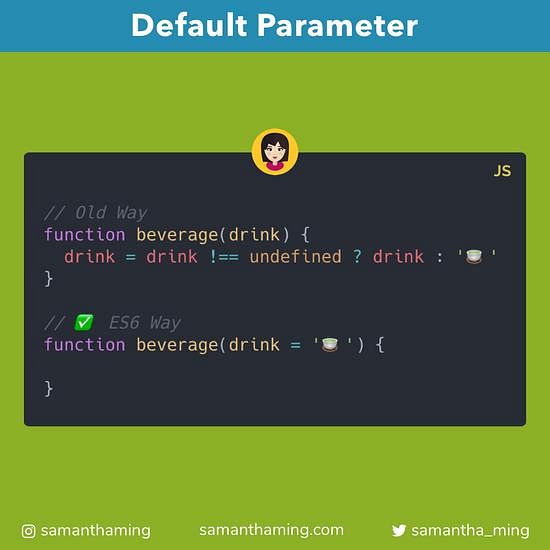
The modern syntax function beverage(drink = '☕️') is not just shorter; it's more explicit about the function's contract.
However, there's a critical detail to understand about how default parameters work. They are only applied when an argument is undefined. If you pass null, 0, false, or an empty string, that value will be used, and the default will not be triggered. This is a key difference from the old param = param || defaultValue pattern, which would incorrectly replace "falsy" values.
This resource provides a concise explanation of this behavior.
JavaScript Function Parameters: Default, Rest & ...
This guide from PlayCode.io clearly outlines the rules for default parameters.
Read the section on Default Parameters. Pay close attention to the null vs undefined callout, as this is a common source of confusion and bugs.
Creating Smarter Functions with Destructuring
Now, let's address a common pain point in software development: functions with too many parameters. Consider a function that creates a UI component:
function createModal(title, text, showCloseButton, theme, animation) {
  // ... implementation
}
Calling this function is cumbersome. You must remember the exact order of arguments. If you only want to specify the animation and use defaults for the others, you're forced to pass undefined for the intermediate parameters:
createModal(undefined, undefined, undefined, undefined, 'fade'); // Hard to read and error-prone
This is where combining destructuring with default parameters shines. Instead of passing multiple arguments, we can pass a single options object. The function can then destructure this object directly in its signature.
This approach offers several advantages:
- Readability: The call site becomes self-documenting, as keys label the values:
createModal({ animation: 'fade', title: 'Welcome' }). - Flexibility: The order of properties in the object doesn't matter.
- Maintainability: Adding new optional parameters doesn't break existing code that calls the function.
The following article provides a superb, in-depth look at this powerful pattern.
This article from The Modern JavaScript Tutorial explains exactly how to leverage destructuring to create what it calls "Smart function parameters."
Please read the section Smart function parameters. It walks through the problem of multiple arguments and presents the destructuring pattern as the solution. Focus on how it combines destructuring syntax with default values.
For a more hands-on demonstration, the following video from Web Dev Simplified shows this exact technique in a practical context.
Why Is Array/Object Destructuring So Useful And How To Use It
This video highlights why using destructuring in function parameters is one of its most powerful applications.
Watch the segment from this point. The presenter refactors a function to use object destructuring in its arguments, clearly demonstrating the improvement in code clarity and flexibility.
The Ultimate Robust Function: Handling Missing Arguments
There is one final, crucial piece to this pattern. What happens if you call our showMenu function from the article with no arguments at all?
showMenu(); // Uncaught TypeError: Cannot destructure property 'title' of 'undefined'
The code fails because it's trying to get the title property from undefined. To make the function truly robust, we need to provide a default value for the entire options object itself. This is done by adding = {} after the destructuring pattern.
// The {title, ...} part is the parameter.
// The = {} part is the default value for that parameter.
function showMenu({title = "Untitled", width = 200, height = 100, items = []} = {}) {
  alert( `${title} ${width} ${height}` ); // Untitled 200 100
}

showMenu(); // Works perfectly!
This small addition ensures that if no object is passed, the function will destructure an empty object ({}), allowing all the inner default values to be applied correctly. This pattern is standard practice for writing resilient and developer-friendly library functions and APIs.
Let's try a practical task from the javascript.info article to solidify this.
This task asks you to apply object destructuring with both renaming and default values.
Find the task at the end of the page called Destructuring assignment. Try to solve it yourself before looking at the provided solution. This will test your ability to extract properties, rename one (years to age), and provide a default for a missing one (isAdmin).
Conclusion
In this lesson, you've learned a powerful set of techniques for creating function interfaces that are clean, flexible, and robust. By moving from positional arguments to a single "options" object and leveraging destructuring and default values in the function signature, you can write code that is significantly easier for you and other developers to use and maintain.
Key Takeaways:
- Default Parameters: Use the
param = defaultValuesyntax in function signatures to provide fallback values when an argument isundefined. - The Options Object Pattern: For functions with multiple optional parameters, accept a single object argument to avoid the pitfalls of ordered, positional parameters.
- Destructuring in Signatures: Unpack properties from the options object directly in the function's parameter list for immediate access to variables.
- Robustness is Key: Always provide a default empty object (
= {}) for a destructured object parameter to handle calls where no argument is provided, preventing runtime errors.
In our next lesson, we will shift gears to tackle one of the most fundamental concepts in JavaScript: asynchronicity. You will learn how to use callbacks to manage operations that don't complete immediately, a cornerstone of programming for both the browser and Node.js.