Welcome back. In the previous module, we constructed a robust I/O layer for our vector database, culminating in the ability to durably save our data to disk using mmap and msync. With the foundation for data persistence now in place, our focus shifts from storage to retrieval. How do we find what we're looking for in this large collection of vectors?
This lesson marks the beginning of our exploration into search algorithms. Your learning outcome is to implement a brute-force (sequential scan) search to find the k-nearest neighbors for a query vector. This method, while simple, is the most fundamental search technique. It serves as the "ground truth" for correctness and will become the essential performance baseline against which all our future, more sophisticated search methods will be measured.
What is k-Nearest Neighbor (k-NN) Search?
The core task of a vector database is similarity search. Given a query vector (e.g., representing an image or a piece of text), we want to find the items in our database that are most similar to it. In the high-dimensional space of vectors, "similarity" is synonymous with "proximity." The k-Nearest Neighbor (k-NN) problem is the formalization of this task: for a given query vector, find the k vectors in the database that are closest to it according to a chosen distance metric (like the Euclidean or Cosine distance we implemented in Module 2).
To solidify this concept, let's review a formal definition of the k-NN search problem.
[PDF] k-nearest neighbor search: fast gpu-based implementations
This research paper provides a concise introduction to the k-NN search problem.
Read the introduction to the kNN search problem. This will formalize the concepts of reference points (our database vectors), a query point, and the goal of finding the k closest neighbors.
The Brute-Force Algorithm: An Exhaustive Search
The most direct way to solve the k-NN problem is with a brute-force or exhaustive search. The principle is simple: compare the query vector to every single vector in the database, calculate all the distances, and then identify the k smallest ones. There are no shortcuts.
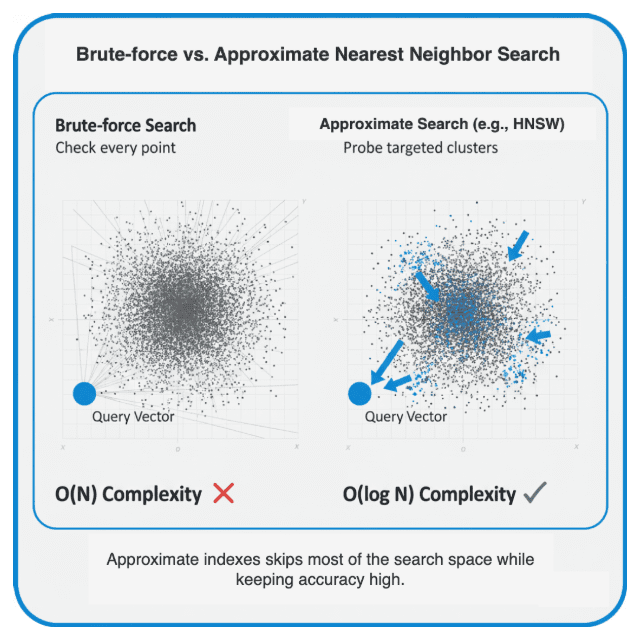
This exhaustive approach is often called a sequential scan, as it involves iterating through the entire dataset sequentially. While its computational cost is high, its great advantage is that it guarantees perfect accuracy. It will always find the true nearest neighbors. For this reason, it's considered the "gold standard" for evaluating the accuracy of more complex, faster algorithms.
The steps of the brute-force algorithm are straightforward. The paper you just looked at provides a clear, step-by-step breakdown.
[PDF] k-nearest neighbor search: fast gpu-based implementations
This section explicitly details the brute-force algorithm.
In the same paper, find Section 2.1, "Algorithm". Read the three steps of the brute-force algorithm. Note the mention of computational complexity, O(nmd). For our case with a single query (n=1), this is O(md), where m is the number of vectors and d is their dimension. This highlights the linear dependency on the size of the dataset.
From Algorithm to Implementation
The algorithm described is:
- Compute the distance between the query
qand allmreference points. - Sort the
mdistances. - Select the
kpoints with the lowest distances.
Step 2, sorting all m distances, is inefficient if m is large and k is small. We don't need a fully sorted list of all m distances; we only care about the top k. A more efficient approach is to maintain a small, bounded list of the k best candidates found so far as we iterate through the database.
Here is a more practical implementation strategy:
- Create a temporary array or list to hold up to
kresults (e.g., pairs ofdistanceandvector_id). - Iterate through every vector in the database from
i = 0tom-1.
a. Calculate the distance between the query vector and vectori.
b. If the results list has fewer thankitems, add the new result (distance,i) to the list.
c. If the results list is full (haskitems), find the result with the largest distance in the list. If the newly calculated distance is smaller than this largest distance, replace that entry with the new result. - After iterating through all
mvectors, the list will contain theknearest neighbors. - As a final step, sort this small list of
kresults by distance to present them in order.
This approach avoids the O(m log m) cost of a full sort, replacing it with a linear scan of size k at each step, making the cost of maintaining the list closer to O(m*k). In the next lesson, we will improve this further using a data structure specifically designed for this task: a max-heap.
For a clear walkthrough of this logic, the following video implements k-NN from scratch in Python. While the language is different, the core algorithm for finding and tracking the nearest neighbors is identical to our plan.
K-Nearest Neighbors (KNN) FROM SCRATCH in Python
This video by Harry Connor AI provides a from-scratch implementation of the k-NN algorithm. The logic translates directly to what we need to build in C.
Watch the section where the predict_class method is implemented, from this timestamp. Pay attention to the sequence: Calculate distances to every point. Get the indices of the k smallest distances (np.argsort). Retrieve the corresponding neighbors. This is the brute-force method in action. Our C implementation will follow the same pattern, but with our optimized candidate list approach instead of a full sort.
Implementing db_search_knn in C
Now, let's translate this into C code for our project. First, we need a structure to hold a single search result.
// In your main header file (e.g., vdb.h)


#include <stdint.h>

// Represents a single search result
typedef struct {
    float distance;
    uint32_t id; // The index of the vector in the database
} SearchResult;
Next, you will implement the search function itself. This function will live in your main implementation file (e.g., vdb.c). It will take the database handle, a query vector, the value of k, and an output array to store the results.
Here is a skeleton for your implementation. Your task is to fill in the logic.
#include <float.h> // For FLT_MAX

// Helper function to sort results by distance for the final output
int compare_search_results(const void* a, const void* b) {
    SearchResult* res_a = (SearchResult*)a;
    SearchResult* res_b = (SearchResult*)b;
    if (res_a->distance < res_b->distance) return -1;
    if (res_a->distance > res_b->distance) return 1;
    return 0;
}

// Performs a brute-force k-NN search.
// 'results' must be a pre-allocated array of size k.
void db_search_knn(Db* db, const float* query_vector, uint32_t k, SearchResult* results) {
    // 1. Initialize the results array with "worst possible" values.
    for (uint32_t i = 0; i < k; ++i) {
        results[i].distance = FLT_MAX;
        results[i].id = -1; // Invalid ID
    }

    uint32_t vector_count = db->metadata->vector_count;
    uint32_t dim = db->metadata->dim;

    // 2. Iterate through all vectors in the database.
    for (uint32_t i = 0; i < vector_count; ++i) {
        float* db_vector = (float*)(db->mapped_region + db->metadata->data_start_offset + (i * dim * sizeof(float)));

        // Calculate distance (using your function from Module 2, e.g., euclidean_distance_naive)
        float dist = euclidean_distance_naive(query_vector, db_vector, dim);

        // 3. Keep track of the top k results.
        // Find the current worst result in our candidate list.
        float max_dist_in_results = -1.0f;
        int worst_idx = -1;
        for (uint32_t j = 0; j < k; ++j) {
            if (results[j].distance > max_dist_in_results) {
                max_dist_in_results = results[j].distance;
                worst_idx = j;
            }
        }

        // If the new distance is better than the worst one in our list, replace it.
        if (dist < max_dist_in_results) {
            results[worst_idx].distance = dist;
            results[worst_idx].id = i;
        }
    }

    // 4. Sort the final k results by distance.
    qsort(results, k, sizeof(SearchResult), compare_search_results);
}
Your Task: Integrate this db_search_knn function into your project. You will need to use the euclidean_distance_naive function you wrote in Module 2. Make sure your Db struct and file layout logic from previous lessons are correctly used to locate the vector data. Write a small test in your main function to insert a few vectors and then perform a search to verify it works.
The Faiss library from Meta is a great example of a real-world, high-performance similarity search library. It provides a brute-force index called IndexFlatL2 that does exactly what we are implementing now.
Faiss: A library for efficient similarity search
This article from Meta Engineering introduces their high-performance Faiss library and the core concepts of similarity search.
First, read the section Evaluating similarity search. This reinforces the idea of brute-force as the "gold standard" for accuracy. Then, look at the code example under the heading The index object. The line index = faiss.IndexFlatL2(d) creates a brute-force index, and index.search(xq, k) performs the search. This is the public API for the exact functionality you are building from scratch in C.
Conclusion
In this lesson, you have implemented the most fundamental algorithm in similarity search. While simple, the brute-force k-NN search is an indispensable part of our project.
Here are the key takeaways:
- Brute-force k-NN (or sequential scan) is an exhaustive search that compares a query vector to every other vector in a dataset.
- It is computationally expensive, with a complexity of
O(N*d)forNvectors of dimensiond, but it guarantees 100% accuracy. - This perfect accuracy makes it the "gold standard" for benchmarking faster, approximate search methods.
- An efficient implementation avoids sorting all
Ndistances by maintaining a bounded list of thekbest candidates found so far.
You've now built a correct, if slow, search capability. This is a major milestone. However, the linear scan to find the "worst" candidate in our results array at every step is a small but noticeable inefficiency.
In our next lesson, we will address this directly. You will learn how to use a bounded max-heap data structure to efficiently track the top 'k' candidates during a search. This will provide a significant performance improvement over our current array-based approach and introduce you to a classic and powerful computer science tool.