Hello! It's great to have you back.
In our last session, we added the first two "plays" to our thermodynamics playbook: the constant volume (isochoric) and constant pressure (isobaric) processes. We saw that in an isochoric process, all the heat added goes into internal energy, while in an isobaric process, the heat must both increase internal energy and do work.
Today, we're going to explore the third of our four fundamental processes. Our goal is to analyze constant temperature (isothermal) processes for an ideal gas and calculate the work and heat transfer.
This one has a fascinating twist. Think about it: when you let a gas expand, it pushes on its surroundings and does work. That energy has to come from somewhere. Normally, it comes from the kinetic energy of the gas molecules, which means the gas cools down. So, how can we make a gas expand and do work without its temperature dropping? That's the puzzle we'll solve today.
Intuition First: The Slow, Careful Expansion
Let's return to our favorite piston-cylinder setup. The gas is at some initial state (P₁, V₁, T₁). We want to let it expand to a final volume V₂ while keeping the temperature locked at T₁.
If we just remove the weights on the piston and let it fly upwards, the gas will expand rapidly. The molecules doing the work of pushing the piston will lose kinetic energy, and the gas will cool down significantly. This is not an isothermal process.
To keep the temperature constant, we need to do two things:
- Go slowly. We have to remove the weights one by one, maybe even grain by grain, allowing the system to stay in equilibrium at every tiny step. This is our idea of a quasi-static process.
- Add heat. As the gas expands and does a tiny bit of work, it will try to cool down. We must immediately supply it with the exact same amount of energy in the form of heat to bring its temperature right back up.
To do this, we imagine placing our cylinder on a thermal reservoir. Think of this as a huge source of energy (like an ocean or a giant block of metal) that is kept at our desired temperature, T₁. If the gas inside the cylinder gets even a fraction of a degree cooler, heat automatically flows from the reservoir into the gas. If the gas gets a tiny bit hotter, heat flows out. This reservoir ensures the temperature stays constant.
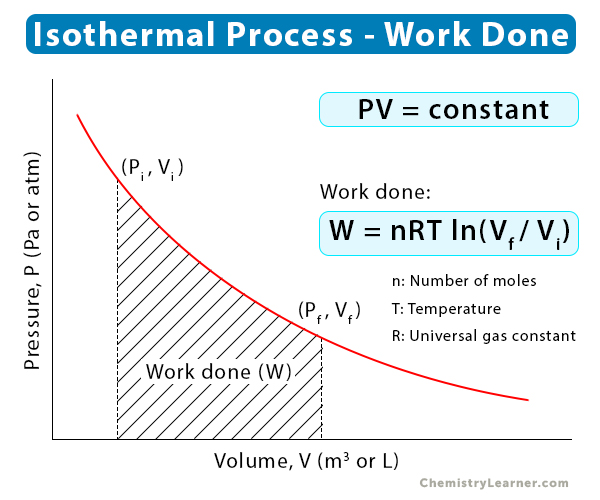
The First Law's Big Secret for Isothermal Processes
This setup has a profound implication for the First Law of Thermodynamics. For an ideal gas, we know internal energy is a function of temperature only: ΔU = m·c_v·ΔT.
In an isothermal process, the temperature is constant, so ΔT = 0.
This means... ΔU = 0!
The internal energy of an ideal gas does not change during an isothermal process.
Now let's look at the First Law:
If ΔU = 0, then:
This is a crucial insight. For an ideal gas undergoing an isothermal process, the heat added to the system is exactly equal to the work done by the system. Every single joule of energy you add as heat gets immediately converted into work. The gas acts like a perfect energy-conversion pipeline.
To get a great visual and conceptual walkthrough of this, the following video explains it very clearly.
Work done by isothermic process | Thermodynamics | Physics | Khan Academy
This video from Khan Academy introduces the isothermal process using our familiar piston-cylinder example. It does a fantastic job explaining why a thermal reservoir is needed and how it leads to the conclusion that the change in internal energy is zero, and therefore heat equals work.
Please watch from the beginning to 7:31 and then from 16:10 to 18:42. The first part sets up the physical intuition, and the second part summarizes the energy balance (Q=W).
The Math: Calculating Work for a Curved Path
In the isobaric process, calculating work was easy (W = PΔV) because the path on the P-V diagram was a flat horizontal line. But for an isothermal process, the path is a curve. How do we find the area under a curve? With calculus, of course!
Let's derive the formula for work. Since you're comfortable with calculus, you'll see how this flows directly from the definitions we've already learned.
Thermodynamics, PV Diagrams, Internal Energy, Heat, Work...
This document provides a clear, step-by-step derivation of the work formula for an isothermal process. It starts with the basic work integral and uses the ideal gas law to solve it. It also includes a great worked example that we can refer to later.
Please read the section that starts around the line, '...how can we calculate the work required to compress this particular gas?' and ends just before '...now let's finish this problem'. Focus on how the integral W = ∫P dV is transformed using the ideal gas law.
Let's walk through that logic together.
-
Start with the definition of work:
-
Express P in terms of V: We can't integrate
Pdirectly because it's not constant. But for an ideal gas, we knowPV = nRT. We can rearrange this to express pressure as a function of volume: -
Substitute into the integral:
-
Pull out the constants: In an isothermal process,
Tis constant. The number of molesnand the gas constantRare also constants. So we can pull the wholenRTterm outside the integral. -
Solve the integral: As you know from calculus, the integral of
1/Vis the natural logarithm of V,ln(V). -
Evaluate at the boundaries: This gives us
nRT * (ln(V₂) - ln(V₁)). Using the logarithm property thatln(a) - ln(b) = ln(a/b), we get our final, powerful result:
And since we know Q = W for this process, the heat transferred is:
Sometimes, you might know the pressures instead of the volumes. For an isothermal process, Boyle's Law applies: P₁V₁ = P₂V₂. This means the volume ratio V₂/V₁ is equal to the inverse pressure ratio P₁/P₂. So, we can also write the work formula as:
Isothermal Process Summary
| Property | Description | Formula |
|---|---|---|
| Name | Isothermal | T = constant |
| Internal Energy | No change for an ideal gas. | ΔU = 0 |
| First Law | Heat added equals work done. | Q = W |
| Work Done (W) | Area under the hyperbolic P-V curve. | W = nRT ln(V₂/V₁) |
| P-V Diagram | A hyperbolic curve (PV=const). |
Test your understanding!
Question 1: A gas undergoes an isothermal compression. Is the work done (W) positive or negative? Is heat (Q) added to the gas or removed from it?
Show answer
During compression, work is done on the gas, so W is negative. Because Q = W for an isothermal process, Q is also negative, meaning heat must be removed from the gas to keep its temperature from rising due to the compression.
Question 2: Two identical cylinders are filled with the same amount of ideal gas at the same initial state. Cylinder A expands isothermally to double its volume. Cylinder B expands isobarically to double its volume. Which process does more work?
Show answer
The isobaric process (Cylinder B) does more work. On a P-V diagram, both processes start at the same point (P₁, V₁) and end at the same volume (2V₁). However, the isobaric process is a horizontal line at P₁, while the isothermal process is a curve that drops below P₁. The area under the horizontal line is greater than the area under the curve, so the isobaric process does more work.
Worked Numerical Problems
Let's get our hands dirty and solve some problems. The key is to correctly identify the process, list your knowns, and apply the right formula. Remember to always use absolute temperature (Kelvin) in these equations!
Problem 1: Isothermal Expansion
3.2 moles of an ideal gas expands from a pressure of 5.0 atm to 1.4 atm at a constant temperature of 127°C.
a) Is work done by the gas or on the gas?
b) Calculate the work done in Joules.
c) How much heat was transferred?
(Use R = 8.314 J/mol·K)
Show step-by-step solution
- Identify the process: The temperature is constant, so this is an isothermal expansion.
- List knowns and convert units:
n = 3.2molesP₁ = 5.0atmP₂ = 1.4atmT = 127°C. We MUST convert this to Kelvin:T = 127 + 273.15 = 400.15 K.
- Part (a): Direction of work:
The gas is expanding (pressure is dropping), so it is pushing on its surroundings. Work is done by the gas. This means our calculatedWshould be positive. - Part (b): Calculate the work (W):
We are given pressures, not volumes, so we'll use the pressure version of the work formula:
Plug in the values:
First, calculate the natural log term:ln(5.0 / 1.4) = ln(3.571) ≈ 1.273.
The value is positive, as expected for an expansion. - Part (c): Calculate the heat transferred (Q):
For an isothermal process,Q = W.
SinceQis positive, this amount of heat was added to the gas from the reservoir.
Problem 2: Isothermal Compression
A piston-cylinder device contains 0.1 kg of helium at 300 K. It is compressed isothermally from an initial volume of 0.5 m³ to a final volume of 0.2 m³. How much work is required, and how much heat is transferred?
(For helium, R = 2.0769 kJ/kg·K)
Show step-by-step solution
- Identify the process: Constant temperature, so it's isothermal compression.
- List knowns:
m = 0.1kgT = 300 K(already in Kelvin, great!)V₁ = 0.5 m³V₂ = 0.2 m³R = 2.0769 kJ/kg·K
- Calculate the work (W):
We are given volumes. Since our gas properties (R) are in terms of mass, we'll use the mass-based formula, which isW = mRT ln(V₂/V₁).
Plug in the values:
First, calculate the natural log term:ln(0.2 / 0.5) = ln(0.4) ≈ -0.916.
The work is negative, which makes sense. We had to do work on the gas to compress it. The "work required" is 57.1 kJ. - Calculate the heat transferred (Q):
For an isothermal process,Q = W.
The heat is also negative, meaning 57.1 kJ of heat had to be removed from the cylinder during the compression to keep the temperature from rising.
Conclusion
Fantastic! We've now mastered the isothermal process. We've seen that it's a slow, controlled process that requires a thermal reservoir to maintain a constant temperature.
Key Takeaways:
- Isothermal (Constant Temperature):
- Real-world model: A slow expansion/compression in contact with a large heat bath.
- For an ideal gas, internal energy does not change:
ΔU = 0. - This simplifies the First Law to
Q = W. - The work done is calculated by integrating, leading to:
W = nRT ln(V₂/V₁). - On a P-V diagram, it's a hyperbolic curve.
Preview of the Next Lesson
We have now analyzed processes where Volume, Pressure, and Temperature are held constant. What's left?
In our next lesson, we will investigate the adiabatic process. This is the opposite of the slow, careful isothermal process. An adiabatic process happens so fast, or in such a well-insulated container, that there is no time for heat to transfer (Q = 0). What happens to work, temperature, and pressure then? We'll find out