Hello! Welcome back.
In our last session, we mastered the isothermal process. We learned that to keep an ideal gas's temperature constant during an expansion, we had to slowly add heat (Q) to exactly match the work (W) being done. The gas acted like a perfect energy pipeline, with the big takeaways being ΔU = 0 and Q = W.
Today, we're flipping that idea on its head. What happens if a process occurs in a perfectly insulated container, or happens so incredibly fast that there's no time for any heat to be transferred? This is the adiabatic process, where Q = 0. This is our fourth and final fundamental process, and it's key to understanding how real-world devices like engines and compressors operate at high speeds.
Our goal for this lesson is to analyze reversible adiabatic (isentropic) processes for an ideal gas and apply the relation PV^k = constant.
Intuition First: The Fast and the Insulated
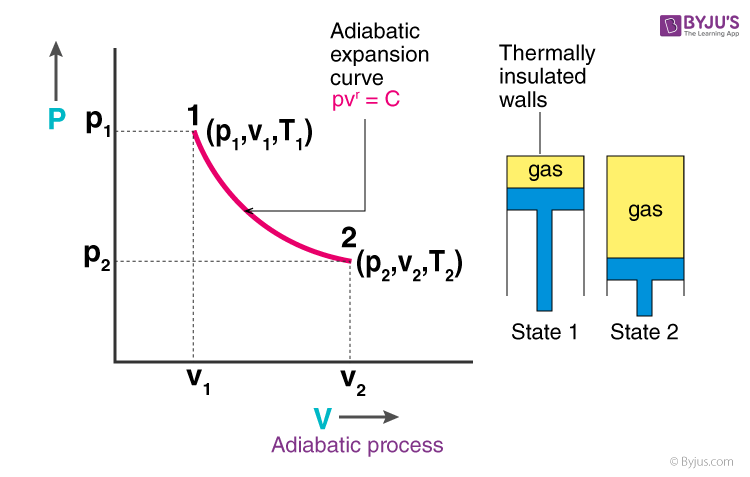
Let's go back to our trusty piston-cylinder. How can we ensure zero heat transfer (Q = 0)?
- Perfect Insulation: Imagine wrapping the entire cylinder in the best thermos blanket imaginable. No heat can get in or out.
- Extreme Speed: Imagine just kicking the locks off the piston and letting it fly. The expansion or compression happens so fast that heat simply doesn't have time to cross the boundary.
This second scenario is incredibly common. The compression and power strokes in your car's engine happen in milliseconds—they are approximately adiabatic.
So, what does Q = 0 mean for our energy balance? Let's look at the First Law:
If Q = 0, the law simplifies dramatically to:
In plain English, this means any work done by the gas comes directly from its own internal energy.
- Adiabatic Expansion: If the gas expands and does work on the surroundings (
Wis positive), its internal energy must decrease (ΔUis negative). Since the internal energy of an ideal gas is all about the kinetic energy of its molecules, the gas cools down. - Adiabatic Compression: If we do work on the gas to compress it (
Wis negative), its internal energy must increase (ΔUis positive). The gas heats up.

You've felt this in real life:
- Compressed Air Can: When you spray a can of compressed air, it gets noticeably cold. The gas inside expands rapidly (adiabatically), does work to push the outside air away, and its internal energy and temperature plummet.
- Bike Pump: As you pump up a tire, you're rapidly compressing air. You're doing work on the air, and the pump gets hot. This is a nearly adiabatic compression increasing the air's internal energy.
The Math: Deriving the Adiabatic Relationships
In an isothermal process, the relationship between pressure and volume was simple: PV = constant. For an adiabatic process, the relationship is different because the temperature is also changing. We need to derive the new rule.
The derivation involves a bit of calculus, combining the First Law (dU = -dW), the definitions of specific heat (dU = m c_v dT), and the ideal gas law (PV = mRT). The following video walks through this derivation beautifully, starting from the first principles we just discussed.
Ideal Gas Adiabatic/Isentropic Relations
This video from Postcard Professor will show us how to derive the famous adiabatic process equations starting from the First Law. Pay close attention to how the ideal gas law is used to create a relationship between T and V, which is then integrated.
Please watch the video from 0:15 to 6:58. The narrator uses 'gamma' (γ) for the specific heat ratio, which we will call 'k'. They are the same thing.
Let's summarize the key results from that derivation.
The core relationship connects temperature and specific volume:
From this, and by using the ideal gas law, we can derive the two other, more common forms:
Here, k is the specific heat ratio, a crucial dimensionless number in thermodynamics:
Remember from our lesson on specific heats, c_p is always greater than c_v, so k is always greater than 1. For air and many other diatomic gases at room temperature, a good value to remember is k ≈ 1.4.
The equation P V^k = \text{constant} is the most famous of the three and is the signature of an adiabatic process. It means that if you know the pressure and volume at one state (P₁, V₁), you can find the pressure at any other volume (V₂) along the adiabatic path:
Comparing Adiabatic and Isothermal Curves
Look at the exponents. For an isothermal process, we have PV¹ = constant. For an adiabatic process, we have PV^k = constant, where k ≈ 1.4.
Because k > 1, the pressure in an adiabatic process drops off more steeply as volume increases compared to an isothermal process.
Why? Think about it physically. In both cases, as the gas expands, pressure drops. But in the adiabatic expansion, the gas is also cooling down. Cooler gas exerts less pressure. So you get a double whammy: the pressure drops due to more volume and due to lower temperature. This makes the adiabatic curve steeper on a P-V diagram.
Calculating Work in an Adiabatic Process
So how much work is done? We have two ways to find it.
Method 1: The Easy Way (Using the First Law)
We already established that for an adiabatic process, W = -ΔU. And for an ideal gas, we know that ΔU = m c_v (T₂ - T₁).
Therefore, the work done is:
This is beautifully simple. If you know the start and end temperatures, you can find the work directly.
Method 2: The Integral Way
We can also find the work by calculating the area under the P-V curve, W = ∫P dV. This requires substituting our new rule P = C/V^k into the integral. The video you just watched also shows the final result of this derivation.
Ideal Gas Adiabatic/Isentropic Relations
Let's continue with the same video. This next section shows how to derive the work formula by integrating P dV and demonstrates that the result is perfectly consistent with our 'easy way' formula, W = -ΔU.
Please watch from 7:11 to 12:08. This will connect the integral method back to the change in internal energy.
As the video shows, the integration leads to this handy formula:
You can use this formula if you know the initial and final pressures and volumes. It's just another tool for the same job. You can prove it's identical to m c_v (T₁ - T₂) by substituting PV = mRT and c_v = R/(k-1).
Adiabatic Process Summary
| Property | Description | Formula |
|---|---|---|
| Name | Adiabatic | Q = 0 |
| Internal Energy | Changes to provide the work. | ΔU = -W |
| First Law | Heat transfer is zero. | ΔU = -W |
| P-V-T Relation | Governed by the specific heat ratio k. |
PV^k = \text{constant} |
| Work Done (W) | Comes directly from internal energy. | W = \frac{P_2 V_2 - P_1 V_1}{1 - k} or W = m c_v (T₁ - T₂) |
| P-V Diagram | A steep curve (PV^k=const). |
Test your understanding!
Question 1: You use a hand pump to inflate a soccer ball. The body of the pump becomes warm. Is this primarily because of friction, or because of a thermodynamic process?
Show answer
While there is some friction, the primary reason is the thermodynamic process. You are doing work on the air to compress it. Since the pumping action is fast, it's nearly adiabatic (Q ≈ 0). The work you do directly increases the internal energy of the air (ΔU = -W), causing its temperature to rise significantly.
Question 2: Two identical cylinders are filled with the same amount of air at the same initial state (P₁, T₁). Cylinder A expands adiabatically to double its volume. Cylinder B expands isothermally to double its volume. Which cylinder's gas has a higher final pressure?
Show answer
Cylinder B (isothermal) will have a higher final pressure. Both expansions end at the same final volume. However, the gas in Cylinder A (adiabatic) cools down during the expansion, while the gas in Cylinder B is kept at its initial, higher temperature. The hotter gas in Cylinder B will exert more pressure at the same volume. This is why the adiabatic curve on a P-V diagram is steeper than the isothermal curve.
Worked Numerical Problems
Let's put these new formulas into practice. The key is to use the PV^k relations to find the properties at the final state, and then use one of the work formulas.
Problem 1: Adiabatic Compression
A piston-cylinder contains 0.5 m³ of air at 100 kPa and 20°C. The air is then compressed adiabatically to a final volume of 0.1 m³. Find the final temperature, final pressure, and the work done on the air.
(For air, use R = 0.287 kJ/kg·K and k = 1.4)
Show step-by-step solution
- Identify the process: The process is adiabatic compression.
- List knowns and convert units:
V₁ = 0.5 m³P₁ = 100 kPaT₁ = 20°C. We must convert to Kelvin:T₁ = 20 + 273.15 = 293.15 K.V₂ = 0.1 m³k = 1.4
- Find the final temperature (T₂):
We use the temperature-volume relationship:T₁V₁^(k-1) = T₂V₂^(k-1).
Rearranging forT₂:
Plug in the values (k-1 = 0.4):
5^0.4 ≈ 1.904
In Celsius, this is558.1 - 273.15 = 284.95°C. The air gets very hot! - Find the final pressure (P₂):
We use the pressure-volume relationship:P₁V₁^k = P₂V₂^k.
Rearranging forP₂:
Plug in the values:
5^1.4 ≈ 9.518
- Find the work done (W):
We can use the(P₂V₂ - P₁V₁) / (1-k)formula since we have all the P's and V's.
The work is negative, which makes sense. Work was done on the air to compress it.
Problem 2: Adiabatic Expansion
Helium gas (k = 1.667) in an engine expands adiabatically from an initial state of 1500 kPa and 800 K to a final pressure of 120 kPa. Find the final temperature and the work done by the gas per kg.
(For helium, c_v = 3.1156 kJ/kg·K)
Show step-by-step solution
- Identify the process: The process is adiabatic expansion.
- List knowns:
P₁ = 1500 kPaT₁ = 800 KP₂ = 120 kPak = 1.667c_v = 3.1156 kJ/kg·K
- Find the final temperature (T₂):
This time we know pressures, so we use the temperature-pressure relationship:T₁P₁^((1-k)/k) = T₂P₂^((1-k)/k).
Rearranging forT₂:
First, let's calculate the exponent:(1 - 1.667) / 1.667 = -0.667 / 1.667 ≈ -0.4.
Now plug in the values:
12.5^-0.4 ≈ 0.359
The gas cools down from 800 K to about 287 K (14°C) during the expansion! - Find the work done per kg (w):
Since we have the temperatures andc_v, the easiest way is to usew = c_v (T₁ - T₂). (We use lowercasewfor work per unit mass).
The work is positive, as it should be for an expansion. The gas does 1600 kJ of work for every kilogram.
Conclusion
Excellent work today! We've now completed our tour of the four fundamental thermodynamic processes. The adiabatic process is where the action is for fast-moving devices.
Key Takeaways:
- Adiabatic (No Heat Transfer):
- Achieved by perfect insulation or very high speed.
Q = 0. - First Law simplifies to
ΔU = -W. Work is done at the expense of internal energy. - Expansion causes cooling; compression causes heating.
- The governing process equation is
PV^k = constant, which makes the P-V curve steeper than an isotherm. - Work can be found easily if temperatures are known:
W = m c_v (T₁ - T₂).
- Achieved by perfect insulation or very high speed.
Preview of the Next Lesson
We now have all the building blocks: isobaric (constant P), isochoric (constant V), isothermal (constant T), and adiabatic (constant Q=0). So, what's next?
We're going to start putting them together. Real engines and refrigerators don't just do one thing; they operate in cycles. In our next lesson, we will represent these four fundamental processes on P-V diagrams and calculate the net work for a simple cycle. This is the first major step toward understanding how a real heat engine produces continuous power. See you then