Hello! Welcome back.
In our last lesson, we established a super-powerful fact for ideal gases: their internal energy (u) and enthalpy (h) depend only on temperature. This allows us to use Δu = cvΔT and Δh = cpΔT for any process, which is a massive simplification.
Today, we put that power to work. We're going to analyze the first two of the four foundational thermodynamic processes. Our goal is to analyze constant volume (isochoric) and constant pressure (isobaric) processes, calculating the work done and heat transferred for each.
Think of this as learning the first two "plays" in our thermodynamics playbook. For each process, we'll ask:
- What's happening physically? What does it look like in the real world?
- How much work (
W) is done? - How much heat (
Q) is transferred? - How do we represent it on our Pressure-Volume (P-V) map?
Let's dive in!
The First "Play": Constant Volume (Isochoric) Process
The name "isochoric" comes from the Greek words isos (equal) and khoros (space or volume). So, it literally means "equal volume."
Intuition First: The Rigid Tank
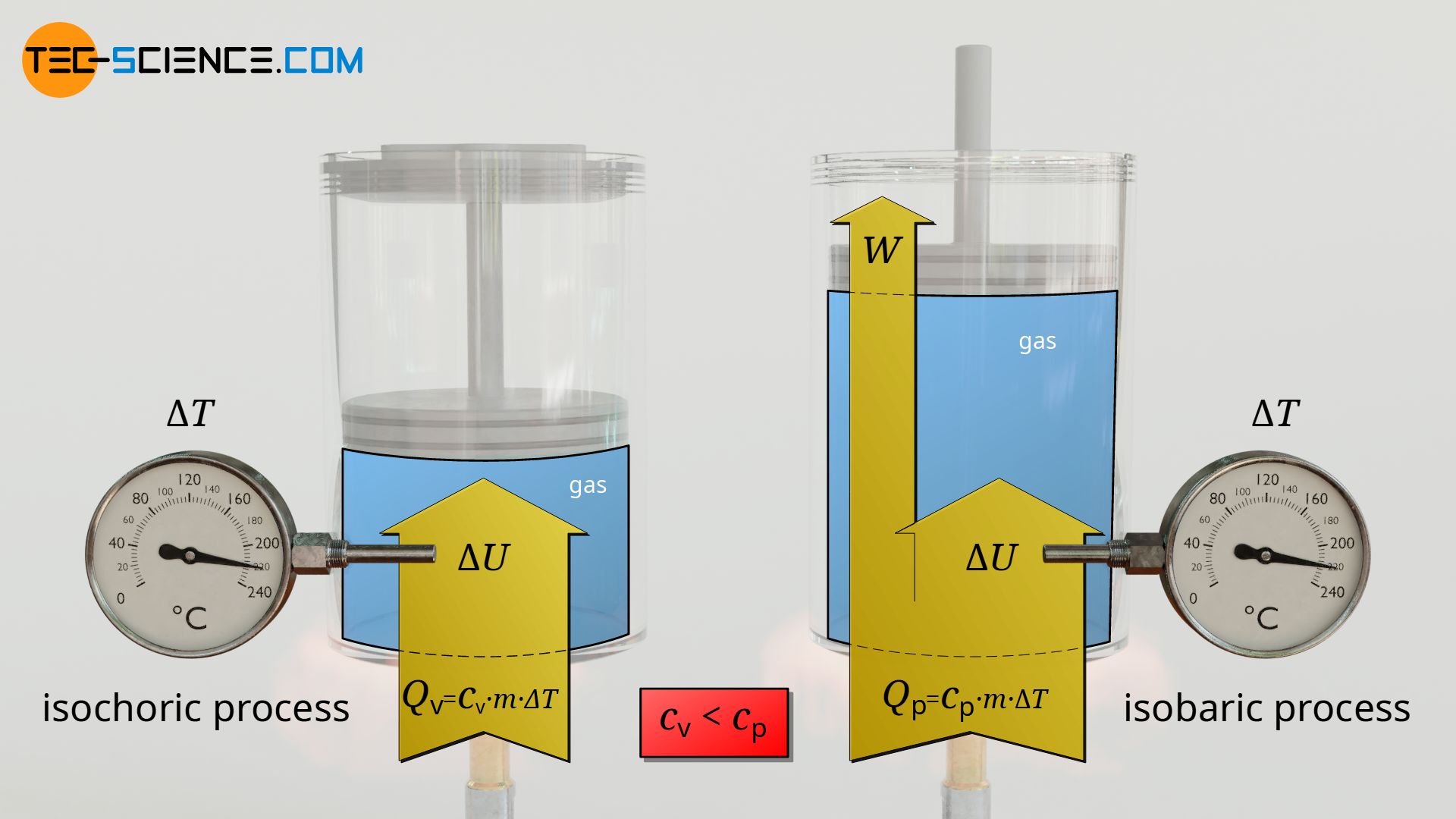
Imagine a strong, rigid, sealed steel tank full of air. A classic example is a scuba tank or a fixed-walled pressure cooker before the safety valve opens. The volume of this tank is fixed. It can't expand or shrink.
What happens if you put a flame under this tank?
- You're adding heat (
Q) to the air inside. - The air molecules absorb this energy and start zipping around much faster, gaining kinetic energy. This means the internal energy (
U) and temperature (T) of the gas increase. - These hyperactive molecules slam into the inner walls of the tank harder and more often. This increased force over the same area means the pressure (
P) inside the tank goes up.
Notice what didn't happen: the walls of the tank didn't move. The volume stayed constant.
Calculating Work for an Isochoric Process
Remember our definition of boundary work? It's the energy spent pushing a boundary. Mathematically, it's the integral of pressure with respect to the change in volume:
In an isochoric process, the volume is constant. This means the change in volume, dV, is zero.
So, the calculation is beautifully simple:
For any constant volume process, the work done is zero. This makes perfect sense: if the boundary doesn't move, no work can be done.
On a P-V diagram, this process is just a straight vertical line. The volume doesn't change, so you just move up (heating) or down (cooling) the chart.
A P-V diagram for an isochoric process. The process from state 1 to state 2 involves an increase in pressure at a constant volume. The area under this vertical line is zero, so W=0.
Calculating Heat for an Isochoric Process
Now let's find the heat transferred (Q). We'll use our master equation, the First Law of Thermodynamics for a closed system:
Since we just proved that W = 0 for this process, the equation simplifies dramatically:
This is a fantastic insight! In a constant volume process, all the heat you add goes directly into increasing the system's internal energy. None of it is "wasted" on doing work.
And from our last lesson, we know how to find the change in internal energy for an ideal gas:
So, for a constant volume process with an ideal gas:
This relationship is precisely why c_v is called the "specific heat at constant volume."
Isochoric Process Summary
| Property | Description | Formula |
|---|---|---|
| Name | Isochoric (or Isometric) | V = constant |
| Work Done (W) | Zero, because volume doesn't change. | W = 0 |
| Heat Transfer (Q) | Equals the change in internal energy. | Q = ΔU = m c_v ΔT |
| P-V Diagram | A vertical line. |
The Second "Play": Constant Pressure (Isobaric) Process
"Isobaric" comes from isos (equal) and baros (weight or pressure). It means "equal pressure."
Intuition First: The Unlocked Piston
Let's go back to our favorite example: a gas in a cylinder with a movable piston on top. Imagine the piston has some weight and is exposed to the atmosphere. The gas inside is supporting the piston's weight plus the atmospheric pressure.
Now, what happens if we gently heat the gas at the bottom?
- The gas molecules get more energetic, pushing harder on the piston.
- This momentarily increases the pressure inside. But since the piston is free to move, this extra push forces the piston upwards.
- As the piston moves up, the volume (
V) of the gas increases. This expansion gives the molecules more room, which brings the pressure back down until it exactly balances the constant external pressure again. - The end result: Heat was added, the temperature (
T) went up, the volume (V) went up, but the pressure (P) stayed the same. The expanding gas did work by lifting the piston.
A perfect real-world example is boiling water in a pot with a loose-fitting lid. As steam is produced, it lifts the lid to escape, keeping the pressure inside roughly equal to the atmospheric pressure outside.
Calculating Work for an Isobaric Process
Let's start again with the work integral:
This time, pressure P is constant. In calculus, you can pull a constant out of an integral.
The integral of dV from V1 to V2 is just the total change in volume, V2 - V1 or ΔV.
For any constant pressure process, the work done is simply the pressure times the change in volume.
On a P-V diagram, this process is a horizontal line. The work, PΔV, is the area of the rectangle under this line.
To see a fantastic step-by-step visual derivation of this, I highly recommend watching this clip.
PV diagrams - part 1: Work and isobaric processes | Chemical Processes | MCAT | Khan Academy
This video from Khan Academy does an excellent job of explaining P-V diagrams and deriving the formula for work in a constant pressure (isobaric) process by relating it to the area under the curve. It uses the same sign convention we are (work done by the gas is positive).
Please watch from 2:30 to 10:34. Pay close attention to how he connects the area of the rectangle on the P-V diagram to the work formula W = PΔV. Don't worry about the final part where he rewrites the first law; we'll do that next.
Calculating Heat for an Isobaric Process
Let's turn to the First Law again:
We can substitute our known expressions for an ideal gas:
This is correct, but we can do better! Remember our friend, enthalpy (H)?
If we look at the change in enthalpy, ΔH:
Since pressure is constant (P1 = P2 = P), we can rearrange this:
Now look at that! The right side of this equation is identical to our expression for Q above.
In a constant pressure process, the heat transferred is equal to the change in enthalpy.
And for an ideal gas, we know ΔH = m c_p ΔT.
So, for a constant pressure process with an ideal gas:
This elegant result shows why c_p is so useful. It accounts for both the change in internal energy and the boundary work done during a constant pressure expansion.
Isobaric Process Summary
| Property | Description | Formula |
|---|---|---|
| Name | Isobaric | P = constant |
| Work Done (W) | Pressure times the change in volume. | W = PΔV |
| Heat Transfer (Q) | Equals the change in enthalpy. | Q = ΔH = m c_p ΔT |
| P-V Diagram | A horizontal line. |
Test your understanding!
Question 1: You have two identical, sealed balloons filled with the same amount of helium. You glue one balloon to the floor so its volume can't change (isochoric). The other is free to expand (isobaric). You add 100 Joules of heat to each. Which balloon's gas will reach a higher final temperature?
Show answer
The balloon glued to the floor (the isochoric one). In the isochoric process, all 100 J of heat goes into increasing the internal energy (Q = ΔU), which directly raises the temperature. In the isobaric process, some of that 100 J has to be used to do work to expand the balloon (Q = ΔU + W), so less energy is left over to raise the temperature.
Question 2: An ideal gas expands at a constant pressure of 200 kPa from 1 m³ to 3 m³. Does the internal energy of the gas increase, decrease, or stay the same?
Show answer
It increases. According to the ideal gas law (PV=mRT), if pressure P is constant and volume V increases, then the temperature T must also increase. Since internal energy for an ideal gas depends only on temperature (ΔU = m c_v ΔT), an increase in temperature means an increase in internal energy.
Worked Numerical Problems
Let's apply these concepts to solve some problems.
Problem 1: Isochoric Heating
A rigid 2 m³ tank contains air at 100 kPa and 22°C. The tank is heated until the pressure rises to 300 kPa. Find:
a) The final temperature of the air.
b) The heat transferred to the air.
(For air, use R = 0.287 kJ/kg·K and c_v = 0.718 kJ/kg·K)
Show step-by-step solution
-
Identify the process: The tank is "rigid," which means this is a constant volume (isochoric) process.
-
List knowns and find the mass:
- State 1:
P1 = 100 kPa,V1 = 2 m³,T1 = 22°C = 295.15 K - State 2:
P2 = 300 kPa,V2 = V1 = 2 m³ - First, find the mass of the air using the ideal gas law at state 1:
P1V1 = mRT1
- State 1:
-
Part (a): Find the final temperature (T2):
For a constant volume process, the ideal gas law gives us a simple relationship:P1/T1 = P2/T2.
(That's about 612°C! Very hot.) -
Part (b): Find the heat transferred (Q):
For an isochoric process,W=0, soQ = ΔU.Answer: The final temperature is 885.45 K, and 1000.4 kJ of heat was added to the air.
Problem 2: Isobaric Expansion
A piston-cylinder device contains 0.5 kg of nitrogen gas at 100 kPa and 27°C. The gas is now heated at constant pressure until its volume doubles. Find:
a) The work done by the gas.
b) The heat transferred to the gas.
(For nitrogen, R = 0.297 kJ/kg·K and c_p = 1.039 kJ/kg·K)
Show step-by-step solution
-
Identify the process: This is a constant pressure (isobaric) process.
-
List knowns and find unknown properties:
- State 1:
P1 = 100 kPa,T1 = 27°C = 300.15 K,m = 0.5 kg - Process:
P = constant,V2 = 2 * V1 - We need
V1andT2. Let's use the ideal gas law. - Find
V1:P1V1 = mRT1
- Since
V2 = 2 * V1, thenV2 = 2 * 0.4457 = 0.8914 m³. - Find
T2: For an isobaric process,V1/T1 = V2/T2. SinceV2 = 2V1, it must be thatT2 = 2T1.
- State 1:
-
Part (a): Find the work done (W):
For an isobaric process,W = PΔV.
(Note: 1 kPa * 1 m³ = 1 kJ) -
Part (b): Find the heat transferred (Q):
For an isobaric process,Q = ΔH.Answer: The work done by the gas is 44.57 kJ, and the heat added is 155.9 kJ. Notice that the heat added is much larger than the work done. The rest of the energy (
155.9 - 44.57 = 111.33 kJ) went into increasing the gas's internal energy.
Conclusion
Excellent work today. We've dissected the two simplest thermodynamic processes and now have a complete toolkit to analyze them. By pinning one property down (volume or pressure), we were able to derive simple, powerful formulas for work and heat.
Key Takeaways:
- Isochoric (Constant Volume):
- Real-world example: Heating a rigid, sealed tank.
- Work
W = 0. - Heat
Q = ΔU = m c_v ΔT. - On a P-V diagram, it's a vertical line.
- Isobaric (Constant Pressure):
- Real-world example: Heating gas in a cylinder with a freely moving piston.
- Work
W = PΔV. - Heat
Q = ΔH = m c_p ΔT. - On a P-V diagram, it's a horizontal line.
Preview of the Next Lesson
We've handled constant volume and constant pressure. What are the other two big possibilities? In our next lesson, we'll explore what happens when we hold temperature constant (an isothermal process). This one is a bit trickier, because as the gas expands, we have to add just the right amount of heat to keep the temperature from dropping. We'll find out how to calculate the work and heat for this slow, controlled process. See you then