Hello again! It's great to see you.
In our last session, we became expert map-readers, learning how to trace the journey of a refrigerant on both T-s and, more importantly, the engineer's choice: the P-h diagram. We saw that the key energy transfers—the heat absorbed in the evaporator and the work put into the compressor—are represented by simple changes in enthalpy () on that diagram.
Today, we put those maps to practical use. Our goal is to analyze the performance of a refrigeration cycle by calculating its coefficient of performance (COP). We're moving from describing the cycle to evaluating it. How "good" is a refrigerator at its job? The COP is the number that tells us exactly that. By the end of our walk today, you'll be able to calculate this crucial metric and understand what it really means.
Let's get started.
What Does "Performance" Mean for a Refrigerator?
Think about efficiency in a car. You measure it in miles per gallon (or km per liter). It's a ratio: how much you get out (distance) for what you put in (fuel).
Refrigerators and air conditioners are a bit different. They aren't creating energy; they are moving it. Their job is to move heat from a cold place (inside the fridge) to a warmer place (your kitchen). We have to "pay" for this service with electricity, which powers the compressor.
So, the "performance" of a refrigerator is a measure of how much heat it can move for a given amount of electrical work. A high-performance refrigerator moves a lot of heat with very little electricity. This ratio is what we call the Coefficient of Performance (COP).
In simple terms:
For a refrigerator, we WANT to remove heat from the cold space. We PAY FOR the work needed to run the compressor.
Defining the Coefficient of Performance for a Refrigerator ()
Let's formalize this idea. The desired output is the heat absorbed from the refrigerated space, which we call (for heat from the low-temperature reservoir). The required input is the net work done on the system, , which is primarily the work consumed by the compressor.
So, the Coefficient of Performance for a refrigerator () is:
Now, let's connect this back to our P-h diagram from the last lesson. We found that:
- The heat absorbed per unit mass () is the change in enthalpy during evaporation: .
- The work input per unit mass () is the change in enthalpy during compression: .
So, we can write the formula for using enthalpy values that we can find from property tables or a P-h chart:
Let's watch a short video that explains this definition clearly.
How Do Refrigerators and Heat Pumps Work? | Thermodynamics | (Solved Examples)
This video from Question Solutions provides a concise explanation of the COP for a refrigerator.
Watch from 2:56 to 4:19. The presenter does a great job of explaining how to define COP as 'desired output' over 'required input' and relates it to the heat transfers Q_L, Q_H, and the work input.
The Big Question: How Can COP Be Greater Than 1?
When you calculate the for a typical household refrigerator, you'll find it's often a number like 2, 3, or even 4. This might seem strange at first. How can you get more energy out than you put in? Doesn't this violate the First Law of Thermodynamics (Conservation of Energy)?
This is a fantastic question and a very common point of confusion. The key is to remember: a refrigerator is a heat mover, not a heat creator.
The work input isn't being converted into the heat . The work is used to power a cycle that pumps a much larger amount of heat from one place to another.
Let's use an analogy from a great explanation on the Physics Stack Exchange.
How can heat pumps be more efficient than electric ...
This discussion forum has a wonderfully simple analogy to clear up the confusion about COP.
Read the short answer by the user 'Chetti' that starts with "You're missing that heat pumps don’t turn electricity into heat...". It uses a grocery analogy.
Just like in the analogy, spending 1 unit of your energy (work) to carry 3 units of groceries (heat) into the house doesn't mean you created 2 units of groceries. You just used a smart process to move them.
The energy balance for the whole cycle still holds true. The heat rejected to the hot kitchen () is the sum of the heat taken from the cold fridge () and the work you put in ():
Energy is perfectly conserved. The COP is just a measure of how effectively the work you put in causes heat to be moved.
Worked Example 1: Calculating COP from a P-h Diagram
Let's put this into practice. Below is a P-h diagram for a refrigeration cycle with all the enthalpy values labeled. Your job is to calculate the COP.
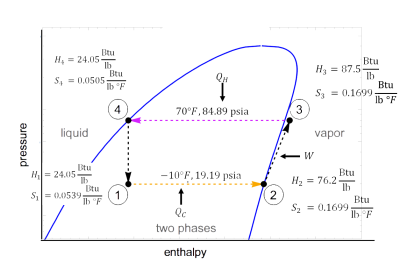
Problem: Using the enthalpy values from the diagram, calculate the Coefficient of Performance () for this refrigeration cycle.
Solution:
-
Identify the enthalpy values from the diagram at the key points:
- (vapor leaving evaporator) = 398 kJ/kg
- (vapor leaving compressor) = 428 kJ/kg
- and (liquid after condenser and after expansion valve). The process from 3 to 4 is throttling, so . From the diagram, kJ/kg.
-
Calculate the refrigerating effect (): This is the heat absorbed in the evaporator (process 4 → 1).
This means every kilogram of refrigerant circulating absorbs 150 kJ of heat from the cold space.
-
Calculate the work input (): This is the work done by the compressor (process 1 → 2).
This means we must supply 30 kJ of work to compress each kilogram of refrigerant.
-
Calculate the : Now we find the ratio of what we want to what we pay for.
Result: The Coefficient of Performance for this refrigerator is 5.0. This means for every 1 kJ of electrical work the compressor uses, it successfully moves 5 kJ of heat out of the refrigerated space.
What About Heat Pumps?
Many homes use heat pumps for heating in the winter. A fascinating thing about a heat pump is that it's physically the same device as an air conditioner, just running with a different objective.
- An air conditioner's goal is to cool the inside of your house. Its desired output is .
- A heat pump's goal is to heat the inside of your house. Its desired output is the heat it rejects to the warm space, .
The input is still the work for the compressor, . So, the Coefficient of Performance for a Heat Pump () is:
Using our enthalpy values:
Let's watch the next segment of the video to solidify this concept.
How Do Refrigerators and Heat Pumps Work? | Thermodynamics | (Solved Examples)
The same video now explains how the COP definition changes when we're talking about a heat pump.
Now, watch from 4:19 to 6:01. Notice how the only thing that changes between the refrigerator and heat pump schematic is the goal: are we interested in QL or QH?
There's a beautiful and simple relationship between the COP of a device used for cooling versus heating.
We know .
If we divide the entire equation by , we get:
Which simplifies to:
This means for the same operating conditions, the COP of a heat pump is always exactly one greater than the COP of the same device used as a refrigerator. This is because the "desired output" for the heat pump () includes both the heat moved from the cold side () and the work energy () that you put in, which also gets converted to heat and dumped into the hot space.
Test your understanding!
-
For the refrigerator in Worked Example 1 with , what would its be if it were used as a heat pump?
Show answer
Using the simple relationship, $COP_{HP} = COP_R + 1 = 5.0 + 1 = 6.0$. This means for every 1 kJ of work put in, 6 kJ of heat would be delivered to the heated space.
-
An engineer is designing two systems. System A has a of 2.5. System B has a of 3.5. Which system is more energy-efficient for cooling, and why?
Show answer
System B is more energy-efficient. A higher COP means that the system can remove more heat ($Q_L$) for the same amount of work input ($W_{in}$). System B removes 3.5 units of heat for every 1 unit of work, while System A only removes 2.5 units.
Worked Example 2: Analyzing a Complete Problem
Let's tackle a problem that's more like what you'd see in an exam. This requires us to use everything we've learned.
Problem: A refrigerator in a food department removes heat from the cooled space at a rate of 3300 kJ/h. It rejects heat to the 30°C environment at a rate of 4800 kJ/h. Determine:
a) The power input required to operate the refrigerator, in kW.
b) The Coefficient of Performance () of the refrigerator.
Solution:
This problem gives us the rates of heat transfer (), which is energy per unit time. We'll use the same logic, but our work input will be power ().
-
Identify the given rates:
- Heat removed from the cold space: kJ/h
- Heat rejected to the hot environment: kJ/h
-
Apply the First Law (Energy Balance): For a cyclic device, the energy coming out must equal the energy going in.
We can rearrange this to find the power input, .
-
Convert power to kW: The question asks for the power in kilowatts (kW). We know that 1 kW = 1 kJ/s. We need to convert hours to seconds.
- 1 hour = 3600 seconds
- 1 kW = 3600 kJ/h
Answer (a): The power input required is 0.417 kW.
-
Calculate the : Now we use the definition of COP with our rate values.
(Note: You can use the values in kJ/h or in kW, as long as they are consistent. The ratio will be the same and is dimensionless.)
Answer (b): The Coefficient of Performance is 2.2.
Final Practice
Here are a couple of questions to solidify your understanding.
-
A window-mounted air conditioner removes 3.5 kJ of heat from a room. To do this, it requires a work input of 1.75 kJ.
- How much heat energy is released to the outside air?
- What is the air conditioner's coefficient of performance ()?
Show answer
* Using the energy balance, $Q_H = Q_L + W_{in} = 3.5 \text{ kJ} + 1.75 \text{ kJ} = 5.25 \text{ kJ}$. So, 5.25 kJ of energy is released outside. * $COP_R = \frac{Q_L}{W_{in}} = \frac{3.5 \text{ kJ}}{1.75 \text{ kJ}} = 2.0$.
-
A room is being heated by a simple 1500 W electric resistance heater (like a space heater). You are considering replacing it with a heat pump that has a of 2.5. How much electrical power would the heat pump need to consume to deliver the same 1500 W of heating to the room? How much power are you saving?
Show answer
* For the heat pump, the desired heating output ($\dot{Q}_H$) is 1500 W. * We know $COP_{HP} = \frac{\dot{Q}_H}{\dot{W}_{in}}$. Rearranging gives $\dot{W}_{in} = \frac{\dot{Q}_H}{COP_{HP}}$. * $\dot{W}_{in} = \frac{1500 \text{ W}}{2.5} = 600 \text{ W}$. * The electric heater uses 1500 W of power. The heat pump uses only 600 W. * Power saved = 1500 W - 600 W = 900 W. This is why heat pumps are much more efficient for heating than simple electric heaters!
Conclusion
Fantastic work today! We've taken the abstract concept of performance and turned it into a concrete number you can calculate and interpret. You now have the primary tool engineers use to evaluate and compare refrigeration and heating systems.
Key Takeaways:
- The Coefficient of Performance (COP) is the key metric for the efficiency of refrigerators and heat pumps, defined as Desired Output / Required Input.
- For a refrigerator, .
- For a heat pump, .
- COP can be greater than 1 because you are moving pre-existing heat, not creating it. The First Law is not violated.
- For any given system, .
Preview of the Next Lesson
We've touched on heat pumps today, but how do they actually work? How can a device pull heat out of the cold winter air to warm your home? In our next and final lesson of this course, we will explain how a heat pump works by reversing the objective of a refrigeration cycle, diving into the clever engineering that makes this possible. See you then