Hello again! I'm glad you're here for our final lesson in this course. It's been quite a journey, and today we'll tie together some crucial concepts about refrigeration and heating.
In our last session, we mastered the idea of the Coefficient of Performance (COP). We learned that for the exact same machine, we can define a for its cooling effect and a for its heating effect. We saw that they are just different ways of measuring the performance of a cycle whose fundamental job is to move heat from a cold place to a warm place.
Today, we answer the big practical question: How does a single device, a heat pump, actually switch from cooling your house in the summer to heating it in the winter? Our goal is to explain how a heat pump works by reversing the objective of a refrigeration cycle. We'll uncover the clever piece of engineering that makes this all possible.
A Quick Recap: Two Goals, One Machine
Let's start with a visual recap. A refrigerator (or air conditioner) and a heat pump are two sides of the same coin. They both run the same thermodynamic cycle, but their "desired effect" is different.

As you can see, in any vapor-compression cycle, you always have two key heat transfers:
- Heat is absorbed at a low temperature in the evaporator.
- Heat is rejected at a high temperature in the condenser.
The entire secret to a dual-purpose heat pump lies in being able to choose whether the evaporator or the condenser is inside your house.
The Heart of the Machine: The Refrigeration Cycle
Before we get to the reversal part, let's quickly review the basic operation. This excellent video from the BBC gives a fantastic intuitive walk-through of the main components.
How heat pumps REALLY work - BBC World Service
This video provides a great, non-technical overview of the components of a heat pump and how they work together to move heat.
Please watch the video from 5:41 to 12:02. Focus on the four key parts the presenter discusses: the evaporator (collecting heat), the compressor (concentrating it), the condenser (releasing it), and the expansion valve (resetting the cycle). This will refresh our intuition for the journey the refrigerant takes.
So, to recap the journey in our own terms:
- Evaporator: A cold, low-pressure liquid refrigerant absorbs heat from its surroundings (e.g., the outside air) and boils into a gas. This is where you get your "cooling effect."
- Compressor: This is the only part that requires significant work input. It squeezes the gas, dramatically increasing its pressure and temperature.
- Condenser: The now very hot, high-pressure gas gives off its heat to its surroundings (e.g., the water in your radiators). As it cools, it condenses back into a liquid. This is where you get your "heating effect."
- Expansion Valve: The high-pressure liquid is forced through a tiny opening. Its pressure plummets, it expands, and becomes very cold, ready to start the cycle over again in the evaporator.
An air conditioner puts the evaporator inside and the condenser outside. A heat pump (in winter) puts the condenser inside and the evaporator outside. So, how do we swap them? Do we have to physically pick up the units and move them? Thankfully, no!
The Trick: The Reversing Valve
Engineers came up with a brilliant and surprisingly simple solution: instead of moving the coils, just reverse the direction of the refrigerant flow.
This is accomplished by a component called a reversing valve or a 4-way valve. Think of it as a railroad switch for the refrigerant. It's a traffic controller that tells the hot gas coming out of the compressor which way to go: to the indoor coil or the outdoor coil.
Let's start with a clear article that explains this.
This article from IEEE Spectrum nicely explains the concept of a dual-purpose heat pump.
Please read the section titled "Double-Duty Heat Pumps". It introduces the reversing valve and includes a diagram of the heating mode.
Now, let's look at a diagram of the valve itself.
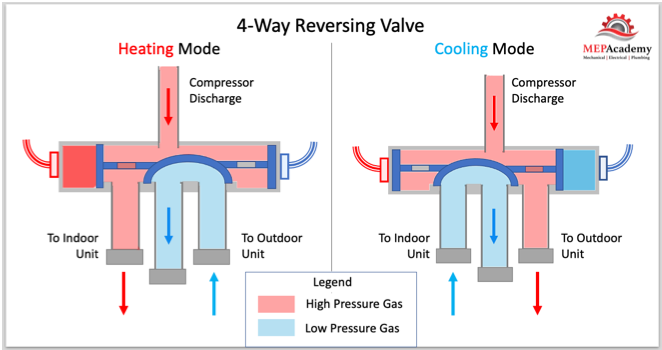
The valve has four connections:
- Hot, high-pressure gas from the compressor discharge.
- Cool, low-pressure gas to the compressor suction.
- A pipe leading to the indoor coil.
- A pipe leading to the outdoor coil.
By sliding a small part internally, the valve can connect the compressor discharge to either the indoor or outdoor coil, completely reversing the system's function.
Tracing the Flow: Heating vs. Cooling
Now let's see this in action. The following video has excellent animations that trace the refrigerant's path in both modes. We'll watch them one by one.
Heat Pumps Explained - How Heat Pumps Work HVAC
This technical video from The Engineering Mindset is perfect for seeing exactly how the reversing valve changes the refrigerant's path. We'll look at cooling mode first, which you're already familiar with.
Watch the segment from 4:09 to 5:27. This shows the system operating in cooling mode (like a standard air conditioner).
Cooling Mode (Summer)
As you just saw, when you want to cool your house:
- The reversing valve directs the hot gas from the compressor to the outdoor coil.
- The outdoor coil acts as the condenser, rejecting heat () to the outside world.
- The cooled liquid refrigerant then flows to the expansion valve and into the indoor coil.
- The indoor coil acts as the evaporator, absorbing heat () from your room's air, making it feel cool.
- The refrigerant, now a gas again, flows back to the compressor to repeat the cycle.
This is exactly the refrigeration cycle we've been studying.
Now for the magic. Let's see what happens when we flip the switch for winter.
Heat Pumps Explained - How Heat Pumps Work HVAC
Now, let's watch the path for heating mode. Pay close attention to how the reversing valve has rerouted the hot gas.
Watch the segment from 1:49 to 4:09. This details the refrigerant flow when the heat pump is providing heat.
Heating Mode (Winter)
When you want to heat your house:
- The reversing valve flips! It now directs the hot gas from the compressor to the indoor coil.
- The indoor coil acts as the condenser, rejecting heat () into your room, warming it up.
- The cooled liquid refrigerant then flows to the expansion valve and into the outdoor coil.
- The outdoor coil acts as the evaporator. Even on a cold day, the refrigerant is even colder, so it absorbs heat () from the outside air.
- The refrigerant, now a gas, flows back to the compressor.
It's the same four steps of the cycle—compress, condense, expand, evaporate—but the reversing valve has brilliantly swapped the locations of the condenser and evaporator.
Test your understanding!
- When your heat pump is heating your home on a chilly day, is the coil in the outdoor unit acting as the evaporator or the condenser?
Show answer
It's acting as the **evaporator**. Its job is to absorb heat from the cold outside air. The coil inside your house is the condenser.
- An engineer says that a heat pump "reverses the refrigeration cycle." Is this phrasing perfectly accurate?
Show answer
It's a common way to say it, but it's more precise to say it **reverses the refrigerant flow**. The thermodynamic cycle itself (compression, condensation, expansion, evaporation) still proceeds in the same order. What changes is *where* the condensation and evaporation physically happen (indoors vs. outdoors).
- A heat pump's reversing valve gets stuck in the "heating mode" position. What would happen if you tried to use it as an air conditioner on a hot summer day?
Show answer
It would continue to operate as a heater. It would try to absorb heat from the already hot outdoor air and dump even more heat into your house, making the problem worse! The indoor unit would blow hot air.
Conclusion and Course Wrap-up
And there you have it. The secret to a heat pump's dual nature isn't some complex thermodynamic trick; it's a wonderfully clever piece of mechanical engineering—the reversing valve. By simply redirecting the flow of the working fluid, a single machine can efficiently provide both heating and cooling.
This lesson marks the end of our journey together through the world of engineering thermodynamics. Think back to where we started, asking the simple question, "What is energy?". From that basic starting point, you have built a formidable intellectual structure.
You've mastered the fundamental laws, learned to distinguish between properties like temperature and pressure and processes like heat and work. You navigated the states of matter, learned to read property tables like a pro, and sketched the journey of substances on P-V, T-s, and P-h diagrams. You analyzed the vapor-compression cycle that cools our food and the great power cycles—Otto, Diesel, Brayton, and Rankine—that drive our cars, planes, and civilization.
You have truly learned to think like an engineer about energy. My hope is that this is not an end, but a beginning. The principles we've discussed are everywhere: in the weather, in every engine, in the biological processes of your own body. I encourage you to keep looking for them, to keep asking "why," and to continue building on the solid foundation you've established.
It has been a pleasure being your guide. Congratulations on your hard work and accomplishment