Hello! It's great to have you back.
In our last session, we had a pretty deep conversation about why things happen. We saw that the First Law is like a perfect accountant, making sure all the energy is tracked, but it has no idea about the "arrow of time." It can't explain why your coffee cools down but never spontaneously heats up. We discovered that we need a new rule, the Second Law of Thermodynamics, to explain the natural direction of every process in the universe.
Today, we're going to take that idea and make it practical. If heat naturally wants to flow from a hot place to a cold place, can we harness that flow to do something useful, like power a city or move a car? The answer is a resounding yes, and the device that does it is called a heat engine.
This lesson is all about understanding the fundamental machinery that powers our modern world. We'll describe what a thermal energy reservoir is and then explore the basic components of a heat engine. By the end, you'll have a clear mental picture of how we can turn a simple flow of heat into useful work.
The Great Energy Waterfall: Thermal Reservoirs
Before we can build an engine, we need to understand the "landscape" it operates in.
Imagine a giant waterfall. Water sits in a large lake at the top of a cliff (high potential energy), and it crashes down into another large lake at the bottom (low potential energy). The flow of water between these two levels is what allows us to generate power. If you stick a water wheel in the middle of the waterfall, the flowing water will turn it, and you can get useful work.
Heat behaves in a very similar way. It naturally flows from a place of high temperature to a place of low temperature. To get work from heat, we need two things:
- A "high lake" of heat—a hot source.
- A "low lake" for the heat to flow into—a cold sink.
In thermodynamics, we call these sources and sinks thermal energy reservoirs.
A thermal energy reservoir is a body with such a large thermal mass (meaning it can store a huge amount of heat) that you can add or remove a significant amount of heat from it without noticeably changing its temperature.
Think about it:
- If you light a match and throw it into the ocean, does the ocean's temperature change? Nope. The ocean is a massive heat sink.
- Does the sun get colder every time its light warms the Earth? Not in any way we can measure on human timescales. The sun acts as a massive heat source.

So, for any engine that runs on heat, we need two reservoirs:
- A High-Temperature Reservoir (Source): This provides the heat energy. Examples include a furnace burning coal, a nuclear reactor, or concentrated solar panels.
- A Low-Temperature Reservoir (Sink): This absorbs the "waste" heat. Examples include the atmosphere, a river, or the ocean.
The temperature difference between the source and the sink is the "height of the waterfall." It's this difference that makes the whole process possible.
The Heat Engine: The Water Wheel for Heat
Now that we have our hot source and our cold sink, we can place a device between them to extract work. This device is the heat engine.
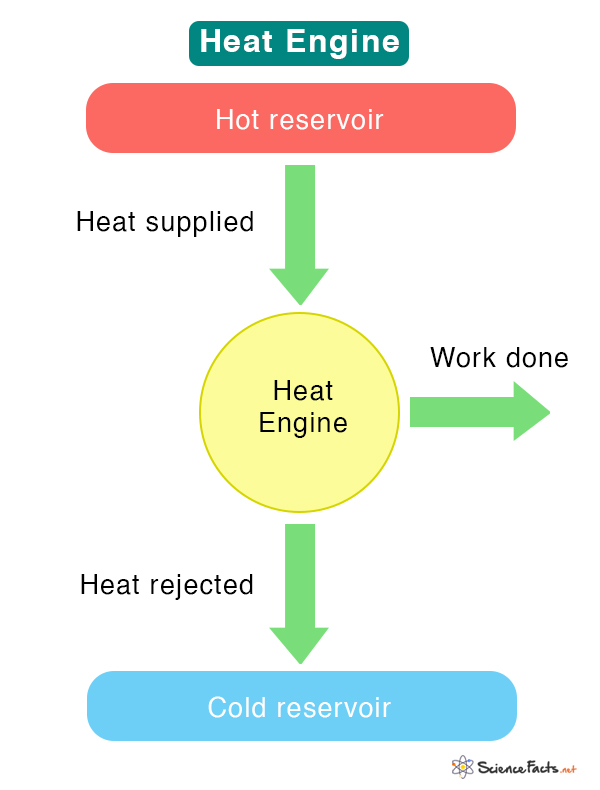
A heat engine is any device that takes heat, converts part of it into work, and rejects the rest. All heat engines, whether in a car or a power plant, share three fundamental characteristics:
- They receive heat from a high-temperature source (like a furnace).
- They convert a portion of this heat into work (like turning a shaft).
- They reject the remaining "waste" heat to a low-temperature sink (like the atmosphere).
And critically, they operate in a cycle. This means the working substance inside the engine returns to its initial state at the end of each cycle, ready to start over.
To formalize this a bit, let's watch a short clip that introduces the key terminology.
Heat Engines - 2nd Law of Thermodynamics | Thermodynamics | (Solved examples)
This video from Question Solutions will help us attach some labels to the heat flows we just discussed. It clearly defines the heat coming from the hot reservoir and the heat going to the cold reservoir.
Watch from timestamp 4:52 to 6:25. Pay close attention to the labels: T_H (High Temperature), T_L (Low Temperature), Q_H (Heat from Hot), and Q_L (Heat to Low). Remember that Q_H and Q_L here represent the magnitudes (amounts) of heat, so they are always positive values.
So, to recap the diagram and the video:
T_His the temperature of the hot source.T_Lis the temperature of the cold sink.Q_His the amount of heat the engine takes in from the hot source.W_netis the net work the engine produces.Q_Lis the amount of waste heat the engine rejects to the cold sink.
The First Law (our energy accountant) tells us that what goes in must equal what comes out. So for one cycle of the engine:
Energy In = Energy Out
This simple equation is the energy balance for every heat engine. The net work we get out is simply the difference between the heat we supplied and the heat we threw away:
Inside the Machine: The Components of a Steam Power Plant
Okay, let's move from the abstract block diagram to a real-world machine. The classic example of a heat engine is a steam power plant, the kind that generates most of the world's electricity.
To move the energy around, the engine uses a working fluid. In a power plant, this is water, which changes back and forth between liquid and steam.
The cycle has four main components. Let's watch a video that shows them in action and then break them down one by one.
Heat Engines, Refrigerators, & Cycles: Crash Course Engineering #11
This clip from CrashCourse Engineering provides an excellent, animated walkthrough of a steam power plant. It clearly shows how the working fluid (water) moves through the four key components to produce work.
Please watch from timestamp 2:35 to 3:34. As you watch, try to identify the four main stages: the boiler, the turbine, the condenser, and the pump. Notice where heat comes in, where work comes out, and where waste heat is rejected.
Did you see the four parts? Let's connect them back to our main heat engine diagram.
-
The Boiler (Heat Input): This is where we connect to the hot reservoir (
T_H). A furnace (burning coal, gas, or using nuclear fission) heats up tubes full of high-pressure water. The water boils and turns into high-pressure, high-temperature steam. This is whereQ_Henters the system. -
The Turbine (Work Output): The high-energy steam is channeled to a turbine, which is essentially a very sophisticated set of windmills or propellers on a shaft. The steam expands and pushes against the turbine blades, causing the shaft to spin at high speed. This spinning shaft is connected to a generator to produce electricity. This is where the engine produces its primary work output,
W_out. -
The Condenser (Heat Rejection): After leaving the turbine, the steam has much lower pressure and temperature, but it's still a gas. We need to turn it back into liquid water to pump it back to the boiler and complete the cycle. The steam flows into a condenser, which is a big heat exchanger. Cold water from a river or cooling tower (
T_L) is pumped through separate tubes inside the condenser. The steam transfers its leftover heat to the cooling water and condenses back into liquid. This is where the engine rejects its waste heat,Q_L, to the cold reservoir. -
The Pump (Work Input): Now we have low-pressure liquid water. The boiler is at a very high pressure, so we need a pump to force the water back into it. The pump requires a small amount of work,
W_in, to do this (usually taken from the work the turbine produces).
And then the cycle begins again! The net work we get is the big work output from the turbine minus the small work input to the pump (W_net = W_out - W_in).
Test your understanding!
- A friend claims they have invented a new car engine that is so efficient it doesn't need a radiator or an exhaust pipe. Using the principles of a heat engine, why is this claim impossible?
- What is the purpose of the condenser in a steam power plant? Why not just vent the used steam from the turbine directly into the atmosphere?
- Imagine a heat engine operating between the hot sand of a desert at 50°C and the surrounding air at 45°C. Imagine another engine operating between the steam from a geyser at 100°C and the same air at 45°C. Which engine has more potential to do useful work, and why?
Show answer
- This claim is impossible because it violates the principles of a heat engine. Every heat engine must reject waste heat (
Q_L) to a low-temperature sink. The radiator and exhaust system are the components that perform this function. An engine with no way to reject heat would be like trying to run a heat engine with only a hot reservoir, which is impossible. - There are two main reasons. First, the cycle is a closed loop. The working fluid (water) is expensive and needs to be reused. Venting it would mean constantly supplying new, purified water. Second, and more importantly from a thermodynamic standpoint, the pump is designed to handle liquid, not vapor. To get the water back to the high pressure of the boiler efficiently, you must first condense the steam back into a liquid state.
- The engine operating between the 100°C geyser and the 45°C air has far more potential. The "potential" for a heat engine to do work comes from the temperature difference (
T_H - T_L) between the hot and cold reservoirs. It's like having a taller waterfall. The geyser engine has a temperature difference of 55°C, while the desert engine only has a difference of 5°C. The larger temperature difference allows for more heat to be converted into work.
Conclusion
Great work today! We've moved from the abstract need for a Second Law to the concrete reality of the machines that are governed by it.
Key Takeaways:
- Thermal Reservoirs are the high-temperature sources and low-temperature sinks that a heat engine operates between. They are so large that their temperature doesn't change as they supply or absorb heat.
- A Heat Engine is a cyclical device that converts part of the heat it receives into work.
- Every heat engine follows the same simple energy flow: It takes in heat
Q_Hfrom a hot source, produces net workW_net, and rejects waste heatQ_Lto a cold sink. - The work produced is the difference between the heat supplied and the heat rejected:
W_net = Q_H - Q_L. - A real-world steam power plant uses four main components to achieve this: the Boiler (heat in), Turbine (work out), Condenser (heat out), and Pump (work in).
Preview of the Next Lesson
We've established that a heat engine must reject some waste heat (Q_L). This implies that you can never convert 100% of the heat you supply (Q_H) into work. But how good can we get? Is there a theoretical maximum efficiency?
In the next lesson, we will formalize this limitation with the Kelvin-Planck statement of the Second Law. This will lead us directly to defining and calculating the thermal efficiency of a heat engine, which is the single most important metric for telling us how well we are converting fuel into useful power.