Hello! Welcome back.
In our last lesson, we mastered using the First Law and steam tables to calculate the energy needed for phase changes, like boiling water. We saw that the First Law is a powerful tool for energy accounting. But as I hinted at the end, it has a major blind spot.
Today, we're going to explore that blind spot. We're going to ask a question that's both deeply philosophical and incredibly practical: Why do things happen in one direction and not the other? A hot cup of coffee always cools down. An egg, once scrambled, never unscrambles itself. Time seems to have a one-way street sign.
The First Law of Thermodynamics, being just an energy accountant, doesn't care about this direction. It would be perfectly happy with heat flowing from the cool air into your coffee to make it boil. As long as the energy numbers add up, the First Law is satisfied. But our daily experience screams that this is wrong.
This lesson is all about understanding why the First Law is not enough and why we need a new, fundamental rule—the Second Law of Thermodynamics—to explain the direction of every process in the universe.
The First Law's Blind Spot
Let's start by really digging into this idea. The First Law says energy cannot be created or destroyed, only converted from one form to another. Think of it as a strict financial budget: money in must equal money out plus money saved. It ensures the books are balanced.
But it tells you nothing about what you can buy. Your budget might allow you to spend $50 on a magic lamp that grants wishes, but that doesn't mean such a lamp exists.
Similarly, the First Law allows for many processes that simply never happen in reality. Let's think about a few:
- A hot cup of coffee in a cool room: The coffee cools down, transferring its heat to the room. The total energy is conserved. The First Law would also allow the reverse: the cool room air could transfer its heat to the coffee, making it hotter. This never happens.
- A spinning paddle wheel in water: If you stir water with a paddle, the water heats up due to friction. You're converting work into internal energy. The First Law would also allow the reverse: the warm water could spontaneously give up its heat to make the paddle wheel start spinning, converting internal energy into work. This never happens.
- An electric current in a wire: Running electricity through a resistor (like in a toaster) generates heat. The First Law would also allow the reverse: simply heating up the toaster's wire could generate an electric current. This never happens.

All these "reverse" processes conserve energy perfectly. So, what's stopping them? Why is there a natural direction to things? To get a feel for this, let's watch a video that explains this beautifully.
First and second laws of thermodynamics | Khan Academy
This video from Khan Academy starts with the exact coffee cup example we've been discussing. It does a fantastic job of showing how the First Law is satisfied in both directions, proving that it can't be the law that determines which way the process actually goes.
Please watch the first 5 minutes and 29 seconds of this video. Focus on the core question: Why can a hot coffee cool down, but a room-temperature coffee can't spontaneously heat up, even though both scenarios are allowed by the First Law?
The "Arrow of Time" and the Need for a New Law
The fact that processes have a preferred direction gives time itself a direction. The physicist Arthur Eddington famously called this the "arrow of time." If you watch a video of a glass falling and shattering, it looks normal. If you watch it in reverse—shards of glass flying off the floor and assembling into a perfect glass on a table—you know instantly that the video is playing backward.
The First Law has no concept of this arrow. The laws of mechanics for a single particle are also time-reversible (a video of a planet orbiting a star looks fine forwards or backward). So, where does this directionality come from on a macroscopic level?
It comes from the Second Law of Thermodynamics.
The Second Law is the missing piece. It's not an equation about balancing energy; it's a principle about direction, quality, and possibility. It dictates which energy transfers and transformations, all allowed by the First Law, can actually occur in nature.
The simplest and most fundamental observation captured by the Second Law is about heat flow.
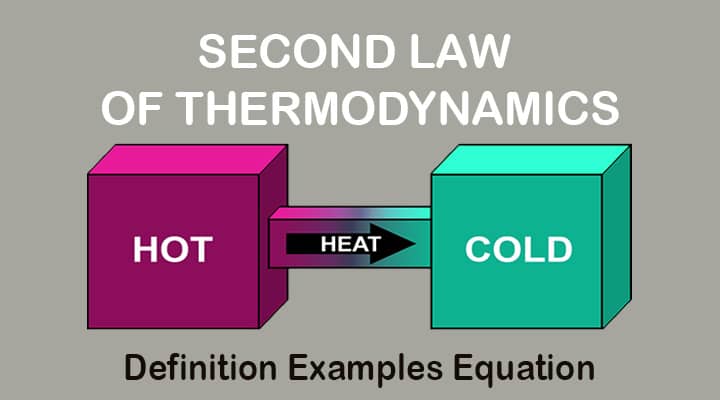
This observation seems obvious, but it's incredibly profound. The First Law would allow the cold block to get colder and the hot block to get hotter, as long as the energy lost by the cold block is gained by the hot one. The Second Law says no, that's not possible spontaneously.
To make heat flow from a cold place to a hot place (which we call "refrigeration"), you have to force it. You need to plug the refrigerator into the wall and supply energy (work). It doesn't happen on its own.
Second Law of Thermodynamics - Heat Energy, Entropy & Spontaneous Processes
This video from The Organic Chemistry Tutor provides another great perspective, using the analogy of a ball rolling down a hill. It will naturally roll down, but it won't naturally roll up. To get it back up, you have to put in work. The same is true for heat.
Watch the first 1 minute and 46 seconds. Notice the clear distinction between a 'spontaneous' process (one that happens on its own) and a 'non-spontaneous' one (one that requires energy input).
So, let's recap where we are:
- We've seen that many processes that conserve energy (obeying the First Law) are impossible in reality.
- We've established that processes have a natural, one-way direction.
- We've identified the Second Law of Thermodynamics as the principle that governs this direction.
But why do processes have this direction? What is the underlying reason?
A Glimpse of Entropy: The Reason for the Direction
The Second Law is often stated in a way that introduces a new and crucial thermodynamic property: entropy. We have a whole module dedicated to entropy later, but it's impossible to explain why the Second Law is necessary without giving you a sneak peek.
You can think of entropy in a few intuitive ways:
- As a measure of energy dispersal.
- As a measure of randomness or disorder.
- As a measure of the number of microscopic possibilities.
Let's stick with the "energy dispersal" idea. Concentrated energy is useful and ordered. Spread-out energy is less useful and more disordered. Think of the heat in your hot coffee—it's concentrated in a small volume. As it cools, that energy spreads out into the millions of trillions of molecules in the room. The total energy is the same, but it has gone from being concentrated (low entropy) to being dispersed (high entropy).
The Second Law of Thermodynamics, in its most general form, states:
For any spontaneous process, the total entropy of the universe (the system plus its surroundings) must increase.
This simple statement is the key to everything. A process is only possible if it results in a net increase in total entropy. The reverse process, which would cause total entropy to decrease, is impossible.
- Hot coffee cools down: Energy spreads from the coffee to the room. The total entropy of the "coffee + room" system increases. This process is possible.
- Cool coffee heats up: Energy would have to spontaneously gather from the room and concentrate itself in the coffee. This would decrease the total entropy. This process is impossible.
This isn't just a rule somebody made up; it's a statistical reality. There are vastly more ways for energy to be spread out among all the molecules in a room than for it to be concentrated in the small volume of your cup. The universe simply trends toward the most probable state, and the most probable state is the one with the highest entropy (the most spread-out energy).
Let's read a short passage that recaps these ideas clearly. This text from the Scheffe Lab at the University of Florida provides an excellent summary of why the First Law is insufficient and how the Second Law introduces the concept of directionality.
Please read the first paragraph of the webpage. It starts with 'So far, we have focused our attention...' and ends with '...sometimes referred to as the increase in entropy principle.' Notice how it explicitly mentions that processes satisfying the First Law can still be impossible and introduces the Second Law as the arbiter of direction.
Test your understanding!
You open a bottle of perfume in a large, sealed room. After a while, you can smell the perfume everywhere.
- Does the process of the perfume molecules spreading throughout the room violate the First Law of Thermodynamics?
- Imagine you came back a day later and found all the perfume molecules had spontaneously gathered themselves back into the tiny bottle. Would this violate the First Law?
- Which law of thermodynamics tells you that the second scenario is effectively impossible, and why?
Show answer
- No. The total energy of the room (air molecules + perfume molecules) remains constant.
- No. The total energy would still be the same. The First Law would be perfectly satisfied.
- The Second Law of Thermodynamics tells you this is impossible. The state where the perfume molecules are spread evenly throughout the room is a high-entropy state (high disorder, high number of possible arrangements). The state where they are all confined to the bottle is a very low-entropy state (highly ordered). Spontaneous processes always proceed in the direction of increasing entropy.
Conclusion
Today, we've tackled a really fundamental concept. We've seen that while the First Law is great for bookkeeping energy, it's completely silent on which way processes actually run.
Key Takeaways:
- The First Law is insufficient: It only deals with energy conservation and cannot predict the direction of a process. It allows for many processes (like heat flowing from cold to hot) that we never observe in reality.
- Processes have a natural direction: In the real world, things are irreversible. Heat flows from hot to cold, gases mix but don't unmix, and things tend towards disorder. This gives us an "arrow of time."
- The Second Law is the Law of Direction: This new law provides the rule that determines which way a process can go. It forbids processes that, while conserving energy, would go against the natural flow of things.
- The driving force is entropy: The underlying reason for this directionality is that all spontaneous processes must cause the total entropy (a measure of energy dispersal or disorder) of the universe to increase.
Preview of the Next Lesson
We've established why we need a Second Law. In the next lesson, we'll start to formalize it. We'll look at the classic historical statements of the Second Law that don't even mention the word "entropy." Instead, they talk about the practical limitations of real-world machines. We'll introduce the concept of a heat engine—a device that converts heat into work (like in a car engine or power plant)—and see how the Second Law puts a fundamental limit on how efficient these devices can ever be.