Hello! Welcome back to our journey through thermodynamics.
In our last session, we mastered the essential skill of using property tables. You learned how to take any two properties of water, act like a detective to figure out its exact state—be it a compressed liquid, a boiling mixture, or a superheated vapor—and then look up any other property you needed.
Today, we're going to put that skill to work to solve some incredibly practical problems. We're moving from looking at a substance at a single moment in time to analyzing what happens when it undergoes a process, especially a phase-change process. You'll learn how to calculate the exact amount of energy needed to take water from a liquid to a vapor, or how much heat is released when steam condenses.
We'll connect the First Law of Thermodynamics () directly to the properties ( and ) in our steam tables. By the end of this lesson, you'll be able to solve problems like "How much heat does it take to boil 1 kg of water in a pressure cooker?" or "How much energy is needed to make superheated steam in a power plant boiler?"
Let's dive in and see how energy and phase changes are beautifully connected.
The Hidden Energy of Phase Change: Latent Heat
Let's start with a simple question you've probably observed in your own kitchen. When you put a pot of water on the stove, its temperature rises steadily. But once it hits 100°C and starts boiling, the temperature just... stops. It stays locked at 100°C, no matter how high you crank the heat. Where is all that extra energy from the stove going?
The energy isn't vanishing. It's doing a different kind of work. Instead of making the water molecules move faster (which is what temperature measures), it's being used to break the bonds that hold the molecules together as a liquid. This "hidden" energy, which causes a phase change without a temperature change, is called latent heat.
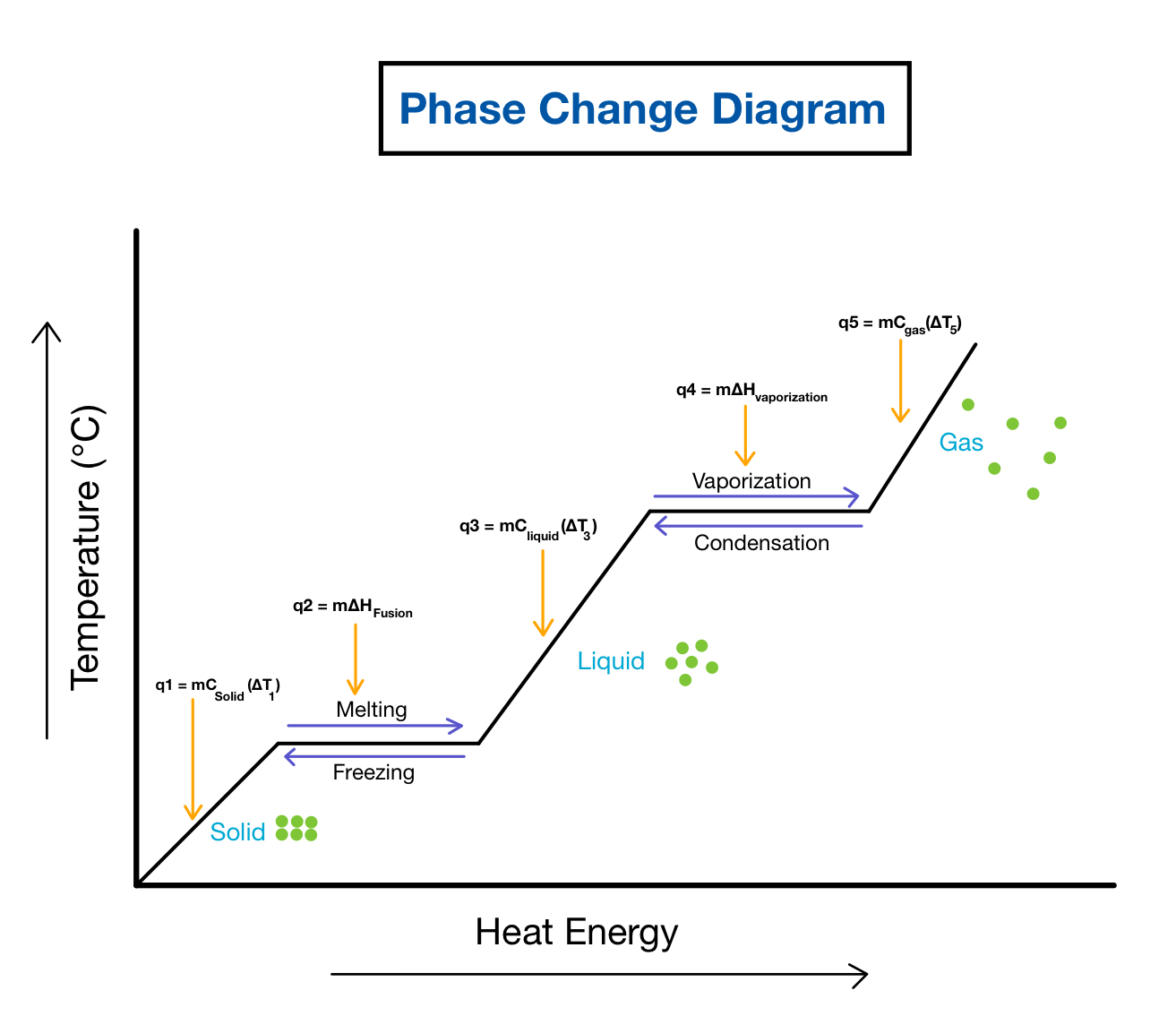
There are two main types of latent heat for our purposes:
- Latent Heat of Fusion (): The energy needed to melt a solid into a liquid.
- Latent Heat of Vaporization (): The energy needed to vaporize a liquid into a gas.
To find the total heat () needed for a phase change, the basic physics formula is simply:
where is the mass and is the relevant latent heat.
This reading from OpenStax Physics provides a great introduction to the concepts of phase change and latent heat. It explains the 'why' behind this phenomenon from a molecular perspective.
Please read the sections titled 'Phase Changes' and the part that introduces the formulas for latent heat. Focus on understanding that this energy is 'hidden' because it's used to break bonds rather than increase temperature.
Now, here's the crucial link to our steam tables. The Latent Heat of Vaporization is exactly what our tables call the Enthalpy of Vaporization, or !
is the latent heat of vaporization per kilogram.
So, the energy required to boil a mass of saturated liquid into a saturated vapor at a constant pressure is simply . You've already been using this value; now you know its deeper physical meaning.
Applying the First Law to Phase-Change Processes
Let's bring back our old friend, the First Law of Thermodynamics for a closed system (like a sealed tank or a piston-cylinder device):
Here, is heat added, is work done by the system, and is the change in the system's internal energy.
It turns out that how we calculate the energy transfer depends on whether the process happens at constant volume or constant pressure. This is a super important distinction.
Let's watch a video that breaks this down beautifully.
ENTHALPY and INTERNAL ENERGY in 12 Minutes!
This video from 'Less Boring Lectures' is one of the clearest explanations you'll find for how the First Law connects to internal energy and enthalpy during phase change. It uses perfect analogies.
Please watch from 0:33 to 5:52. Pay close attention to the two distinct cases: The constant volume process (pressure cooker), where heat transfer equals the change in internal energy (∆U). The constant pressure process (piston-cylinder), where heat transfer equals the change in enthalpy (∆H).
Let's recap the two crucial results from that video.
Case 1: Constant Volume Process (e.g., a Rigid Tank)
Imagine heating water in a sealed, rigid metal tank (like a pressure cooker before the valve opens).
- The volume cannot change, so the boundary work is zero: .
- The First Law simplifies to:
Or, on a per-mass basis:
Intuition: In a rigid container, every bit of heat you add goes directly into raising the internal energy of the substance inside. It doesn't have to do any work to expand.
Case 2: Constant Pressure Process (e.g., Piston-Cylinder)
Imagine boiling water in a cylinder with a weighted piston on top, which is free to move up and down.
- As you add heat, the water boils and expands, pushing the piston up. The system is doing work on the surroundings.
- The work done is boundary work: .
- The First Law is: , so .
- Substituting the work term: .
- Let's rearrange this: .
- We know this combination! . So this becomes:
Or, on a per-mass basis:
Intuition: At constant pressure, the heat you add has to do two jobs: (1) increase the substance's internal energy and (2) provide the energy to do the work of pushing the surroundings back. Enthalpy () conveniently bundles these two things into a single, easy-to-use property.
This is a fundamental concept in thermodynamics:
- Constant Volume Process Energy transfer is related to .
- Constant Pressure Process Energy transfer is related to .
Test your understanding!
You're cooking stew in two ways: (a) in a sealed pressure cooker, and (b) in a regular pot with a loose lid. Both pots contain the same amount of stew and are heated to the same final temperature. Which process requires more heat, and why?
Show answer
The process in the regular pot (b) requires more heat. This is a constant-pressure process where the steam has to do work to lift the lid and push the atmosphere out of the way. The pressure cooker (a) is a constant-volume process (W=0). Since enthalpy () is defined as , and the change in enthalpy is always greater than the change in internal energy for an expansion process, the constant pressure process () will require more heat input than the constant volume process ().
Numerical Problems: Putting It All Together
Let's solve some problems. The method is always the same:
- Draw a simple diagram of the system.
- Identify the process type (constant volume or constant pressure).
- Define State 1 and State 2.
- Use your skills from the last lesson to find the properties at each state ( or ).
- Apply the correct energy balance ( or ) to find the answer.
You will need steam tables for these problems. I'll provide the key values, but you should practice looking them up yourself using an online tool or your textbook.
Problem 1: Heating in a Rigid Tank (Constant Volume)
A rigid tank with a volume of 0.5 m³ contains a saturated liquid-vapor mixture of water at 100 kPa. The quality of the mixture is 40% (). Heat is supplied to the tank until it contains only saturated vapor. Find the total heat transferred.
Show Step-by-Step Solution
1. System and Process:
- System: Water in a rigid tank.
- Process: Constant volume heating (). Therefore, our governing equation is .
2. State 1: Saturated Mixture
- Given: kPa, . The tank volume is m³.
- From the saturated pressure table at 100 kPa:
- m³/kg
- m³/kg
- kJ/kg
- kJ/kg
- Find specific volume at state 1 ():
m³/kg - Find total mass (): The mass doesn't change during the process.
kg - Find specific internal energy at state 1 ():
kJ/kg
3. State 2: Saturated Vapor
- It's a rigid tank, so volume is constant. This means the specific volume is also constant: m³/kg.
- We also know State 2 is saturated vapor, so . This means .
- So we need to find the state in the saturated tables where m³/kg. Looking in the pressure table, we find this falls between 250 kPa and 275 kPa. By interpolating (or using an online calculator for precision), we find:
- kPa
- At this state, the internal energy of saturated vapor is kJ/kg.
4. Calculate Heat Transfer ():
- kJ
The total heat transferred to the water is 947.9 kJ.
Problem 2: Boiling in a Piston-Cylinder (Constant Pressure)
2 kg of water at 200°C and 400 kPa is contained in a piston-cylinder device. Heat is added at constant pressure until the temperature reaches 300°C. Calculate the heat transfer for this process.
Show Step-by-Step Solution
1. System and Process:
- System: Water in a piston-cylinder device.
- Process: Constant pressure heating. Therefore, our governing equation is .
2. State 1: Initial State
- Given: kg, kPa, C.
- First, we must determine the phase. At kPa, the saturation temperature C.
- Since , the water is a superheated vapor.
- Go to the superheated steam table for MPa and find the row for C.
- From the table, the specific enthalpy is kJ/kg.
3. State 2: Final State
- Given: kPa (constant pressure), C.
- This is also a superheated state.
- Go to the same superheated steam table block for MPa and find the row for C.
- From the table, the specific enthalpy is kJ/kg.
4. Calculate Heat Transfer ():
- kJ
The heat transferred during this process is 412.4 kJ.
This video works through another great example of a constant volume process, which can help solidify your understanding.
Pure Substances and Property Tables | Thermodynamics | (Solved Examples)
Here's one more solved example from the 'Question Solutions' channel, showing how to handle energy changes during a phase change in a rigid tank.
Watch the final example from 12:02 to 14:14. Notice how he first finds the properties at state 1 (saturated liquid) and state 2 (saturated vapor) and then uses the change in internal energy, ΔU, to find the energy change.
Conclusion
Excellent work today! We've taken a huge step forward by connecting the abstract First Law to the very concrete numbers in our steam tables. This allows us to quantify the energy involved in some of the most important processes in engineering, from power generation to cooking.
Key Takeaways:
- Phase changes require a large amount of "latent heat" to occur at a constant temperature. This is represented by the enthalpy of vaporization () in our tables.
- The First Law energy balance simplifies beautifully for two common closed-system processes:
- For a constant volume process (rigid tank), the heat added is equal to the change in internal energy: .
- For a constant pressure process (piston-cylinder), the heat added is equal to the change in enthalpy: .
- Solving these problems is a systematic process: identify the process, find properties at the start and end states, and apply the correct simplified First Law equation.
Preview of the Next Lesson
We have become quite powerful with the First Law. We can account for every kilojoule of energy in a system. But the First Law has a limitation: it has no sense of direction. It would be perfectly happy with heat flowing from a cold ice cube to a hot cup of coffee, as long as energy is conserved. But we know this never happens in reality.
Why do processes only happen in one direction? Why does time have an arrow? To answer these profound questions, we need a new physical law: the Second Law of Thermodynamics. In our next lesson, we will explore this new law and see how it governs the direction of all natural processes.