Hello again! It's great to connect for our next lesson.
In our last session, we unlocked the secret to understanding the "in-between" state of boiling water by defining quality (). We learned that quality is the mass fraction of vapor in a saturated mixture, and we used it to calculate properties like specific volume and enthalpy with the formula property = property_f + x * property_fg.
However, in those examples, I was your "magic table," providing you with the necessary values like and . Today, you'll learn to be the master of the tables yourself. We're going to dive into the steam tables, which are essentially the "phonebook" or "database" for all the thermodynamic properties of water.
By the end of this lesson, you will be able to take any two independent properties of water (like temperature and pressure), figure out its exact state—compressed liquid, saturated mixture, or superheated vapor—and then confidently find any other property you need from the correct table. This is a fundamental, hands-on skill for every engineer who works with energy.
Let's get started.
The Master Strategy: How to Find Your Bearings
Before you can look up a property, you have to know what state the water is in. Is it a liquid? Is it boiling? Is it a hot vapor? This is the most important first step.
Imagine you're given two pieces of information, like Pressure = 100 kPa and Temperature = 150°C. Here’s the golden rule:
Always start by checking the saturated steam table. This table is your compass. It tells you the boiling point for any given pressure or temperature.
Let's use our example: kPa, C.
- Go to the saturated table and look up the pressure of 100 kPa (which is very close to atmospheric pressure).
- The table will tell you the saturation temperature () at this pressure. At 100 kPa, water boils at C.
- Now, compare your given temperature (150°C) to the boiling temperature (99.61°C).
- Our water is at 150°C, which is hotter than its boiling point at that pressure.
- This means all the liquid has already boiled away, and we've continued to add heat to the steam.
- Therefore, the water is a superheated vapor.
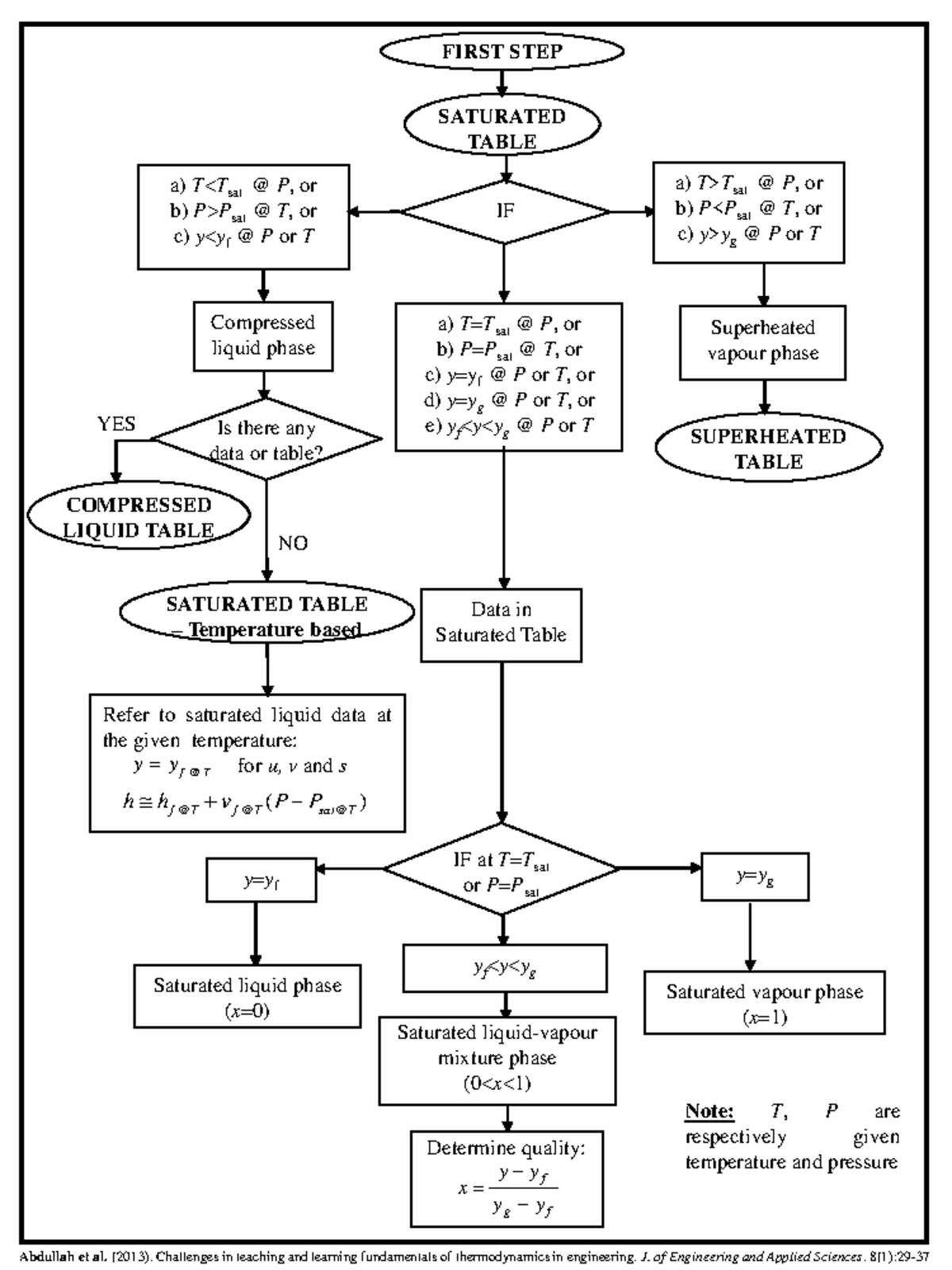
This logic leads to three possible outcomes:
- Compressed Liquid: If your given temperature is less than the saturation temperature ( at that pressure). Think of cold water in a pot.
- Saturated Mixture: If your given temperature is equal to the saturation temperature (). The water is currently boiling.
- Superheated Vapor: If your given temperature is greater than the saturation temperature (). All the water has turned to steam, and it's getting even hotter.

This simple comparison is the key to everything. Now, let's learn how to navigate the specific tables for each region.
The Saturated Steam Tables
These tables are the heart of our work. They contain all the properties for states involving a phase change. As you'll see, they come in two flavors, but they contain the same information.
Professor Knutsen gives a very clear explanation of the two types of saturated tables and how they're organized.
Watch from the beginning to 1:54. Notice how he explains that the 'Temperature Table' and 'Pressure Table' are just two different ways of organizing the same data, for convenience.
As the video explained:
- Temperature Table: The first column is temperature, in nice, round numbers (e.g., 5°C, 10°C, 15°C...). You use this when you're given a temperature.
- Pressure Table: The first column is pressure, in nice, round numbers (e.g., 5 kPa, 10 kPa, 15 kPa...). You use this when you're given a pressure.
Understanding the Columns
Once you're in the right row, you'll see columns for various properties. Let's decode them.
- : Specific volume of the saturated liquid (f for fluid).
- : Specific volume of the saturated vapor (g for gas).
- , , : Specific internal energy for the liquid (), the vaporization process (), and the vapor (). Remember, .
- , , : Specific enthalpy. This works the same way.
- , , : Specific entropy (we'll cover this in a later module, but it's good to know it's there).
This short video reinforces these definitions.
Let's watch another clip from Prof. Knutsen where he clearly explains the meaning of the subscripts f, g, and fg.
Watch from 1:54 to 3:36. The key takeaway is understanding that 'f' means saturated liquid, 'g' means saturated vapor, and 'fg' is the difference between them.
The Superheated Steam Tables
What happens when your initial check shows that ? You have superheated steam. This means you need to go to a different set of tables: the superheated tables.
Let's see how to do this with a step-by-step example.
This is a fantastic, practical demonstration. The video walks through an example where the state is determined to be superheated, and then shows exactly how to find the properties in the correct table.
Watch from 3:36 to 6:20. Follow the logic: 1) They are given P=200 kPa and T=300°C. 2) They check the saturated pressure table at 200 kPa and find T_sat = 120.21°C. 3) Since 300°C > 120.21°C, it's superheated. 4) They then go to the superheated tables, find the section for 0.2 MPa (200 kPa), and read the properties from the 300°C row.
The structure of the superheated tables is different. They are organized in blocks by pressure. Within each pressure block, properties are listed for various temperatures. This makes sense because, unlike in the saturated region, pressure and temperature are now independent. For a given pressure, the steam can be at any temperature above .
The Compressed Liquid Region (and a Powerful Approximation)
Finally, what if your initial check shows that ? You have a compressed liquid (also called a subcooled liquid).
Some textbooks have dedicated tables for compressed liquids, but they are often limited. Luckily, there's a very reliable approximation we can use.
This section from the ENG LibreTexts book explains the standard engineering approximation for compressed liquids.
Read this short paragraph. The key idea is that you can approximate the properties of a compressed liquid (like v, u, and h) by using the properties of the saturated liquid at the same temperature.
Why does this work? Because liquids are nearly incompressible. Squeezing a liquid (increasing its pressure) doesn't change its volume, internal energy, or enthalpy very much. However, changing its temperature does have a significant effect. So, we make the very reasonable assumption that the properties of a compressed liquid are most dependent on its temperature.
Example: Find the specific volume of water at 10 MPa and 100°C.
- Check state: Go to the saturated temperature table at 100°C. The saturation pressure is kPa.
- Our pressure (10 MPa = 10,000 kPa) is much higher than . So, we have a compressed liquid.
- Apply approximation: We will approximate its specific volume by finding the specific volume of a saturated liquid at the given temperature of 100°C.
- Look up value: From the saturated temperature table at 100°C, we find . This is our answer.
The Overall Game Plan
It can feel like a lot of tables, but the process is always the same. This flowchart is your map for every problem.
Test your understanding!
-
You need to find the properties of water at 120°C. You also know its specific internal energy is kJ/kg. What's your very first step?
Show answer
Your first step is to go to the **saturated temperature table** at 120°C and look up the values for $u_f$ (internal energy of saturated liquid) and $u_g$ (internal energy of saturated vapor). You would then compare your given $u$ (2000 kJ/kg) to these values to determine the state. Since $u_f$ at 120°C is 503.6 kJ/kg and $u_g$ is 2529.3 kJ/kg, your value is between them ($u_f < u < u_g$). This tells you it's a saturated liquid-vapor mixture, and your next step would be to calculate the quality, $x$. -
Why do we approximate compressed liquid properties using the saturated liquid value at the given temperature, not the given pressure?
Show answer
Because for a liquid, properties like specific volume and internal energy are very sensitive to changes in temperature but not very sensitive to changes in pressure. A liquid at 20°C and 100 kPa has almost the same volume as a liquid at 20°C and 10,000 kPa. The temperature dominates. Therefore, approximating based on temperature is much more accurate.
Numerical Problems: Putting It All Into Practice
Let's solve some problems from start to finish. You'll need access to steam tables. You can use a textbook appendix or an online calculator like the one provided by TLV. For consistency, I will provide the key values you need to look up.
Problem 1: Superheated Vapor
A 10-liter rigid tank contains water at a pressure of 400 kPa and a temperature of 300°C. Find the mass of the water in the tank.
Show Step-by-Step Solution
1. Determine the State:
- We are given kPa and C.
- First, go to the saturated pressure table at 400 kPa.
- From the table, the saturation temperature is C.
- Since our temperature (C) is greater than (C), the water is a superheated vapor.
2. Find the Specific Volume:
- Now, go to the superheated steam table.
- Find the pressure block for 0.40 MPa (which is 400 kPa).
- In that block, find the row for the temperature of 300°C.
- Read the specific volume () from that row. You will find: .
3. Calculate the Mass:
- We know the total volume of the tank is .
- The relationship between total volume, specific volume, and mass is .
- Rearranging to solve for mass: .
- .
The mass of the water in the tank is approximately 0.0153 kg or 15.3 grams.
Problem 2: Saturated Mixture
A piston-cylinder device contains 2 kg of water at 500 kPa. The total volume is 0.2 m³. Find the specific enthalpy () of the water.
Show Step-by-Step Solution
1. Find the Specific Volume:
- First, let's calculate the specific volume of our mixture.
- .
2. Determine the State:
- We are given kPa and we just calculated .
- Go to the saturated pressure table at 500 kPa.
- Look up the specific volumes for saturated liquid () and saturated vapor ().
- From the table: and .
- Since our specific volume () is between and , we have a saturated liquid-vapor mixture.
3. Calculate the Quality (x):
- Now we use the quality formula we learned in the last lesson.
- .
- The mixture is about 26.5% vapor by mass.
4. Calculate the Specific Enthalpy (h):
- From the same row in the saturated pressure table (500 kPa), look up the enthalpy values: and .
- Now use the enthalpy formula with our calculated quality:
- .
The specific enthalpy of the water is approximately 1198.1 kJ/kg.
Conclusion
Fantastic work today. This lesson was all about rolling up our sleeves and learning a core mechanical skill. It might feel a bit like learning to use a dictionary or a map at first, but with practice, it will become second nature.
Key Takeaways:
- Your compass is the saturated table. Always start there to compare your given state to the saturation point and determine the phase: compressed liquid, saturated mixture, or superheated vapor.
- Saturated Tables come in two flavors (Temperature and Pressure) and are used for boiling/condensing states. You use the quality to find properties inside the vapor dome.
- Superheated Tables are for vapor that's hotter than its boiling point. They are organized by pressure, then temperature.
- Compressed Liquid properties can be accurately approximated by using the saturated liquid properties () at the given temperature.
Preview of the Next Lesson
You are now fully equipped to find the properties of water at any given state. What's next? We will combine this new skill with the First Law of Thermodynamics. You'll be able to analyze processes where water changes from one state to another—for example, water entering a boiler as a compressed liquid and leaving as superheated steam. By finding the properties at the start and end states, you can calculate the total change in energy (, ) and the amount of heat or work involved in the process. This is where thermodynamics really starts to solve powerful, real-world engineering problems.