Welcome back! It's great to have you for our next session.
In our last lesson, we built our thermodynamic "maps"—the T-v, P-v, and P-T diagrams. We learned to identify the regions for compressed liquid, superheated vapor, and the all-important vapor dome, which represents the saturated liquid-vapor mixture.
This left us with a big question: we know how to describe a point on the edge of the dome (saturated liquid or saturated vapor), but what about all the space inside it? How do we pinpoint our location in a mixture of boiling water and steam?
Today, we will answer that question by defining quality, also known as dryness fraction. This single concept is the key that unlocks the ability to describe and calculate properties for any state within the vapor dome. By the end of this lesson, you'll be able to determine the exact properties of a liquid-vapor mixture, a crucial skill for analyzing everything from steam power plants to refrigeration systems.
What is Quality (or Dryness Fraction)?
Imagine you're boiling a pot of water. At the very beginning, it's all liquid. As it boils, more and more of it turns to steam. "Quality" is simply a way to answer the question: "By mass, what percentage of this mixture is steam?"
In the industrial world, this is a very practical concern. The steam coming from a boiler is almost never 100% pure vapor; it always carries some tiny droplets of liquid water with it. This "wet steam" carries less usable energy than "dry steam."
The Importance of the Steam Dryness Fraction
This brief article from TLV, a company specializing in steam engineering, gives a great real-world introduction to why steam dryness is so important.
Read the first two sections, 'Steam Dryness Fraction' and 'Calculating the Total Heat of Wet Steam.' Focus on the practical definition and why it affects the energy content of the steam.
As the article explains, quality is a number that tells us the mass fraction of vapor in a saturated mixture. We represent it with the letter .
The formal definition is:
Where is the mass of the gas (vapor), and is the sum of the liquid mass () and vapor mass ().
This gives us a scale from 0 to 1:
- : Saturated Liquid. The mixture is 0% vapor and 100% liquid. This state is on the far-left edge of the vapor dome (the saturated liquid line).
- : Saturated Vapor. The mixture is 100% vapor and 0% liquid. This state is on the far-right edge of the vapor dome (the saturated vapor line).
- : Saturated Liquid-Vapor Mixture. We are somewhere inside the dome. For example, if , it means that 80% of the mixture's mass is vapor, and the remaining 20% is liquid.
The following short video provides another clear explanation of this concept.
Pure Substances and Property Tables | Thermodynamics | (Solved Examples)
This clip from the channel Question Solutions gives a concise definition of quality.
Watch from 4:34 to 5:23. This will reinforce the definition and the formula.
Using Quality to Find Mixture Properties
Okay, so we can now label a mixture with a quality value. But how does that help us find its specific volume (), internal energy (), or enthalpy ()?
The answer is beautifully simple: the property of a mixture is a weighted average of the liquid and vapor properties. The "weight" is the quality, .
Let's build this idea from first principles using specific volume () as our example.
The total volume () of our mixture is the volume of the liquid part plus the volume of the vapor part:
Since we know that total volume is mass times specific volume (), we can rewrite this as:
Here, is the average specific volume of the whole mixture, is the specific volume of the saturated liquid part, and is the specific volume of the saturated vapor part.
Now, let's divide the entire equation by the total mass, :
Look closely at those fractions. We already defined as the quality, . And since the mixture is only made of liquid and vapor, the mass fraction of the liquid must be .
Substituting these in gives us:
This equation is perfectly correct, but we can rearrange it into a more common and useful form:
The term represents the change in specific volume during vaporization. In property tables (which we'll master in the next lesson), this value is often listed as .
So, our final, powerful formula is:
This tells us that the specific volume of the mixture is the specific volume of the liquid () plus a fraction () of the expansion that occurs during boiling ().
The Universal Formula
This same logic applies to any other specific property, like internal energy (), enthalpy (), and entropy (). The general form is always the same:
- Specific Internal Energy:
- Specific Enthalpy:
- Specific Entropy:
This "weighted average" concept is fundamental. The video you watched earlier continues to explain exactly this.
Pure Substances and Property Tables | Thermodynamics | (Solved Examples)
Let's see this 'weighted average' idea applied to find the average specific volume.
Watch from 5:09 to 5:36. It quickly shows how the quality formula is used to find the average volume.
Test your understanding!
-
A steam-water mixture has a quality of 0.5. Does this mean that 50% of the volume is liquid and 50% is vapor?
Show answer
No, this is a very important distinction! Quality is a **mass** fraction. Since steam (vapor) is far less dense than liquid water, it takes up a much larger volume for the same mass. A mixture with $x=0.5$ would have 50% of its mass as vapor, but that vapor would occupy significantly more than 50% of the total volume. -
If you have a saturated liquid-vapor mixture in a sealed, rigid tank and you add heat, what happens to the pressure, temperature, and quality?
Show answer
Adding heat will cause more liquid to turn into vapor, so the **quality (x) will increase**. Since more vapor is being packed into the same rigid volume, the **pressure and temperature will also increase**, and the state will move up and to the right inside the vapor dome on a P-v diagram.
Let's Work Through Some Examples
Theory is great, but let's see how this works in practice. We'll solve problems by figuring out the state of a substance and then using quality to find its properties.
Example 1: Finding Enthalpy of a Refrigerant
This first example involves Refrigerant-134a, which works just like water but has different property values. The process is identical.
Pure Substances and Property Tables | Thermodynamics | (Solved Examples)
Watch this excellent, step-by-step example of finding the quality and then the specific enthalpy of R-134a in a tank.
Watch from 8:44 to 10:13. The key steps are: 1) calculating the specific volume from total mass and volume, 2) comparing it to the table values (v_f and v_g) to confirm it's a mixture, 3) calculating quality x, and 4) using x to find the enthalpy h.
Example 2: A Conversational Walkthrough with Water
Here's another example, this time for water. The presenter's conversational style is a great match for how we're learning, and he does a fantastic job of explaining the thought process.
Lesson 7: Property Tables and Quality
The Thermo Sage provides a great, intuitive walkthrough of a problem where quality is given.
Watch from 4:52 to 16:36. He first shows how to determine the state (superheated, compressed, or mixture). Then, he starts a problem at 7:15 where the quality is given as 0.82 (82%), and he calculates the specific volume. He finishes by showing how to find the total volume from the specific volume and mass. This covers the whole process.
Numerical Problems: Your Turn!
Now it's time for you to apply these concepts. I'll provide the necessary values from the property tables, since our next lesson will be dedicated to mastering the tables themselves.
Problem 1
This problem is represented by the diagram below. A rigid tank with a volume of 80 liters contains 4 kg of refrigerant R-134a at a pressure of 160 kPa.
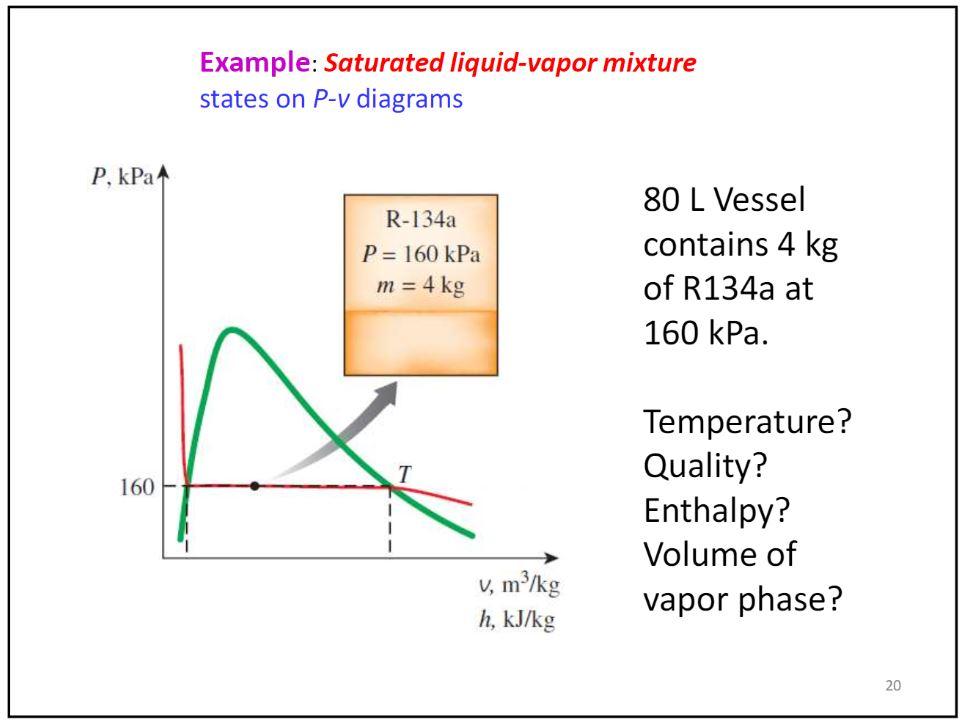
At a pressure of 160 kPa, the property tables for R-134a tell us:
- Saturation Temperature,
- Specific volume of saturated liquid,
- Specific volume of saturated vapor,
- Specific enthalpy of saturated liquid,
- Specific enthalpy of vaporization,
Determine:
(a) The temperature of the refrigerant.
(b) The quality, .
(c) The specific enthalpy of the refrigerant, .
Show Step-by-Step Solution
(a) Determine the Temperature
Since the refrigerant is a mixture of liquid and vapor (as we'll confirm in part b), it must be at its saturation temperature for the given pressure.
From the table values provided:
Temperature .
(b) Determine the Quality, x
First, we need to find the overall specific volume () of the refrigerant in the tank.
Total Volume (since ).
Total Mass .
Specific volume .
Now, we compare our calculated to the table values for and at 160 kPa.
Since (), we can confirm the refrigerant is indeed a saturated liquid-vapor mixture.
Now we can calculate the quality by rearranging our formula:
=>
The quality is , or 15.7% vapor by mass.
(c) Determine the Specific Enthalpy, h
Now that we have the quality, we can use our universal formula to find the specific enthalpy:
Using the table values:
.
Problem 2
A piston-cylinder device contains 0.5 kg of water at a pressure of 200 kPa. The quality of the steam-water mixture is 90% ().
At 200 kPa, the property tables for water tell us:
Find the total internal energy () of the water in the cylinder.
Show Step-by-Step Solution
First, we need to find the specific internal energy () of the mixture using the quality.
The formula is .
We are given , and we have the values for and from the table.
This is the internal energy per kilogram. The question asks for the total internal energy (). To find this, we multiply the specific internal energy by the total mass.
Total Mass .
Total Internal Energy
.
Conclusion
Excellent work today! You've tackled one of the most practical and essential concepts for analyzing pure substances. You can now pinpoint the exact state of a substance boiling or condensing inside the vapor dome.
Key Takeaways:
- Quality (), or dryness fraction, is the mass fraction of vapor in a saturated liquid-vapor mixture.
- It ranges from (saturated liquid) to (saturated vapor).
- Any specific property () of a mixture is a weighted average of the saturated liquid and saturated vapor properties.
- The master formula is
property = property_f + x * property_fg, whereproperty_fg = property_g - property_f. - You can find the quality if you know one other specific property (like ) by rearranging the formula to .
Preview of the Next Lesson
We've been using values like , , and that I've provided for you. But where do these numbers come from? They come from extensive experimental data compiled into large tables. In our next lesson, we will get our hands dirty and learn how to navigate steam tables to find all the properties we need for water and steam in any state: compressed liquid, saturated mixture, or superheated vapor. This will fully equip you to start solving a wide range of real-world thermodynamics problems.