Hello again! Ready to continue our journey into the "why" of thermodynamics?
In our last chat, we built a mental picture of a heat engine. We saw it as a device sitting between a hot source and a cold sink, like a water wheel in a waterfall. It takes in a large amount of heat (Q_H), heroically turns some of it into useful work (W_net), and reluctantly dumps the rest (Q_L) into the cold sink. We even found that the work we get out is simply the difference: W_net = Q_H - Q_L.
This equation leaves us with a huge, tantalizing question. If we want to maximize our work output, we should try to make Q_L as small as possible. So, what if we could make it zero? What if we could build an engine that converts every single joule of heat it takes in directly into work? This would be a perfect engine, with no waste heat, no exhaust, and no cooling towers.
Today, we're going to explore why that beautiful dream is impossible. We'll formalize this impossibility into one of the most fundamental statements in all of physics: the Kelvin-Planck statement of the Second Law of Thermodynamics. This will lead us directly to the concept of thermal efficiency, the universal report card for any heat engine.
The Dream of the "Perfect" Engine
Imagine a power plant that doesn't need a river or cooling towers. Or a car engine that doesn't need a radiator or an exhaust pipe. All the heat from the fuel would be converted directly into motion. This would be a "perfect" heat engine. Its energy flow would look like this:

So, why is the engine on the left impossible?
Remember, a heat engine must operate in a cycle. The working fluid (like the water in a steam plant) has to return to its original state to start the process over again.
Let's revisit our steam power plant:
- Boiler: We add heat (
Q_H) to liquid water, turning it into high-energy steam. - Turbine: The steam expands and does work (
W_net). As it does, it loses energy, so its pressure and temperature drop. - The "Impossible" Step: Now what? We have low-pressure steam. To complete the cycle, we need to get it back to being the high-pressure liquid water we started with. We can't just send the steam back to the boiler—it's at the wrong pressure and state. We can't just magically wish it back to its original state.
To get the steam back to a liquid state so the pump can handle it, we must cool it down. The process of cooling it down involves removing heat. This act of removing heat is precisely the waste heat, Q_L!
Without a cold sink (like a condenser) to dump that waste heat into, the cycle cannot be completed. The engine would run once and then stop. To run continuously, it must reject heat.
The Kelvin-Planck Statement: The Law of No Perfect Engines
This fundamental limitation is formally captured in the Kelvin-Planck statement of the Second Law.
To get a feel for it, let's watch a very short clip that states it clearly.
Heat Engines - 2nd Law of Thermodynamics | Thermodynamics | (Solved examples)
This brief segment from the Question Solutions video we saw before gives a concise statement of the Kelvin-Planck formulation of the Second Law.
Watch from timestamp 6:25 to 7:09. The video will state the law and explain its direct consequence: no heat engine can be 100% efficient.
As the video explained, the Kelvin-Planck statement can be phrased like this:
It is impossible for any device that operates on a cycle to receive heat from a single reservoir and produce a net amount of work.
Let's break that down into plain English:
- "...operates on a cycle..." -> You can't cheat by just doing a one-off expansion. The engine has to run continuously.
- "...receive heat from a single reservoir..." -> This means there is no cold sink. No
Q_L. - "...and produce a net amount of work." -> You can't build a work-producing engine that does this.
An engine that violates this law is sometimes called a "perpetual motion machine of the second kind" (PMM2). It doesn't violate energy conservation (the First Law), but it violates the natural direction of energy flow (the Second Law).
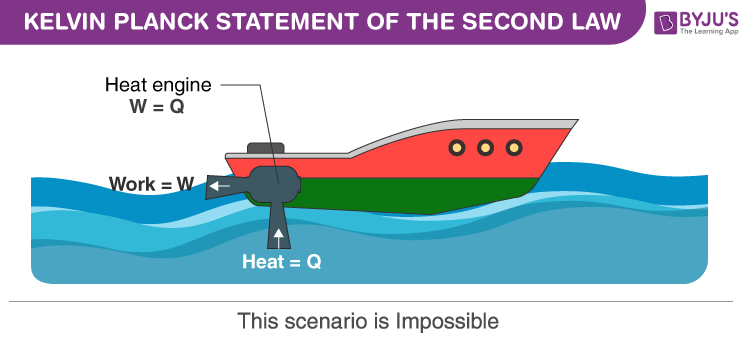
Measuring Reality: Thermal Efficiency (η_th)
Okay, so a perfect 100% efficient engine is off the table. But how good are the engines we can build? 20% efficient? 50%? 90%? To answer this, we need a way to grade them. This grade is called thermal efficiency, and its symbol is η_th (the Greek letter 'eta').
Efficiency, in any context, is always a ratio of what you get out versus what you put in.
- What we get out (the desired output): Net Work,
W_net. - What we put in (the costly input): The heat from the fuel,
Q_H.
So, the definition is simple:
The following video section walks through this definition and connects it back to the heat flows Q_H and Q_L.
Heat Engines - 2nd Law of Thermodynamics | Thermodynamics | (Solved examples)
Let's watch the derivation for the efficiency formula. This video will show how we can express efficiency not just with work, but with the heat transfers alone.
Watch from 4:00 to 6:25. Focus on how the First Law (W_net = Q_H - Q_L) is substituted into the efficiency definition to get a new, very useful version of the formula.
As the video showed, we can take our trusty First Law equation for a cycle, W_net = Q_H - Q_L, and plug it into the efficiency definition:
By splitting the fraction, we get the most common form of the thermal efficiency equation:
This equation is powerful because it reveals the direct implication of the Kelvin-Planck statement. The statement guarantees that Q_L must be greater than zero for any real engine. This means the fraction Q_L / Q_H is always a positive number, which in turn means η_th must always be less than 1 (or 100%).
A 100% efficient engine (η_th = 1) would require Q_L = 0, which is exactly what the Kelvin-Planck statement forbids.
Let's Recap
Before we do some problems, let's pause. We've established two major ideas:
- The Kelvin-Planck Statement: You can't build a continuously running engine that turns heat from a single source completely into work. You must throw some heat away to a cold sink.
- Thermal Efficiency (
η_th): This is the report card for an engine, telling us what fraction of the input heat (Q_H) becomes useful work (W_net). Because you have to throw away some heat (Q_L), this efficiency is always less than 100%.
Now, let's make these ideas concrete with some numbers.
Worked Examples
Let's walk through some practical problems. The following examples are solved in the video LINK from timestamp 7:09 onwards, but we'll solve them step-by-step here.
Problem 1: Steam Power Plant
A steam power plant produces a net power output of 600 MW. The thermal efficiency of the plant is 40%. The plant is cooled by a nearby river. Determine the rate of heat transfer to the river.
1. Understand the Goal:
We need to find the rate of "waste heat" being dumped into the river. In our terms, that's Q_L. The "MW" (megawatts) unit just means the quantities are rates (megajoules per second), so we'll label them with a dot on top: Ẇ_net and Q̇_L.
2. List the Knowns:
- Net power output,
Ẇ_net= 600 MW - Thermal efficiency,
η_th= 40% = 0.40
3. Find the Right Tool (Formula):
We have two main formulas:
a) η_th = Ẇ_net / Q̇_H
b) Ẇ_net = Q̇_H - Q̇_L
4. Step-by-Step Solution:
-
First, let's find the rate of heat input from the furnace,
Q̇_H. We can rearrange formula (a):Q̇_H = Ẇ_net / η_thQ̇_H = 600 MW / 0.40 = 1500 MW
This means the furnace must supply 1500 megawatts of heat to the boiler. -
Now we can use formula (b) to find the waste heat,
Q̇_L. Let's rearrange it:Q̇_L = Q̇_H - Ẇ_netQ̇_L = 1500 MW - 600 MW = 900 MW
Answer: The rate of heat transfer to the river is 900 MW. This means for every 1500 MJ of heat from the fuel, 600 MJ becomes electricity, and 900 MJ is dumped into the river as waste.
Problem 2: Automobile Engine
An automobile engine consumes fuel at a rate of 22 L/h and delivers 55 kW of power to the wheels. The fuel has a heating value of 44,000 kJ/kg and a density of 0.8 kg/L. Determine the efficiency of this engine.
1. Understand the Goal:
We need to find the thermal efficiency, η_th.
2. List the Knowns:
- Net power output,
Ẇ_net= 55 kW (which is 55 kJ/s) - Volume flow rate of fuel = 22 L/h
- Heating value of fuel = 44,000 kJ/kg
- Density of fuel (
ρ) = 0.8 kg/L
3. Find the Right Tool (Formula):
The main formula is η_th = Ẇ_net / Q̇_H. We have Ẇ_net, but we need to calculate Q̇_H, the rate of heat supplied by the burning fuel.
4. Step-by-Step Solution:
-
First, let's figure out how much fuel mass is being burned per hour.
Mass flow rate (ṁ) = Density × Volume flow rateṁ = (0.8 kg/L) × (22 L/h) = 17.6 kg/h
So, the engine burns 17.6 kilograms of fuel every hour. -
Next, let's find the rate of heat supplied by this fuel burn (
Q̇_H).Q̇_H= Mass flow rate × Heating valueQ̇_H = (17.6 kg/h) × (44,000 kJ/kg) = 774,400 kJ/h
This is the total heat energy released per hour. -
Our power
Ẇ_netis in kilowatts (kJ/s), so we needQ̇_Hto be in the same units. Let's convert kJ/h to kJ/s.Q̇_H = 774,400 kJ/h ÷ (3600 s/h) = 215.1 kJ/s = 215.1 kW -
Now we have everything we need to calculate efficiency:
η_th = Ẇ_net / Q̇_Hη_th = 55 kW / 215.1 kW ≈ 0.256
Answer: The thermal efficiency of the engine is about 25.6%. This is a very typical value for a car engine! It means only about a quarter of the energy in the gasoline is actually used to move the car forward.
Test your understanding!
- An inventor proposes a new engine that takes in 100 kJ of heat from a hot source, produces 100 kJ of work, and rejects no heat to a cold sink. Which law of thermodynamics does this engine violate, and why?
- A power plant has a thermal efficiency of 35%. For every 1000 MJ of heat it gets from burning coal, how much energy is converted to electricity, and how much is rejected as waste heat?
- Two engines, A and B, both produce the same amount of net work,
W_net. Engine A has an efficiency of 40%, while Engine B has an efficiency of 30%. Which engine rejects more waste heat (Q_L)? Which engine requires a larger heat input (Q_H)?
Show answer
- This engine violates the Second Law of Thermodynamics (Kelvin-Planck statement). While it doesn't violate the First Law (energy is conserved, 100 kJ in = 100 kJ out), it claims to operate in a cycle while converting heat from a single reservoir completely into work, with no waste heat (
Q_L = 0). The Kelvin-Planck statement declares this to be impossible. -
- Electricity (Work):
W_net = η_th × Q_H = 0.35 × 1000 MJ = 350 MJ. - Waste Heat:
Q_L = Q_H - W_net = 1000 MJ - 350 MJ = 650 MJ.
So, 350 MJ becomes electricity, and 650 MJ is dumped into the environment.
- Electricity (Work):
- Let's reason it out.
- Heat Input (
Q_H): Sinceη = W / Q_H, we haveQ_H = W / η. Because both engines produce the same workW, the one with the lower efficiency (Engine B) must have a larger heat inputQ_H. - Waste Heat (
Q_L): We knowQ_L = Q_H - W. Since Engine B has a largerQ_Hfor the sameW, it must also have a larger waste heatQ_L. The less efficient engine is both more wasteful and requires more fuel for the same job.
- Heat Input (
Conclusion
Fantastic! Today we've moved from a simple observation—that heat engines have exhausts—to a profound physical law.
Key Takeaways:
- The dream of a "perfect" 100% efficient heat engine is impossible because a thermodynamic cycle cannot be completed without rejecting some waste heat.
- The Kelvin-Planck statement formalizes this: It's impossible to build a cyclical engine that produces net work by exchanging heat with only a single reservoir.
- Thermal efficiency (
η_th) is the report card for a heat engine, defined asη_th = W_net / Q_H. - This efficiency can also be expressed as
η_th = 1 - Q_L / Q_H, which mathematically proves that becauseQ_Lmust be greater than zero,η_thmust be less than 1.
Preview of the Next Lesson
We've spent a lot of time on devices that use a natural heat flow (hot to cold) to create work. But what about devices that do the opposite? What about your refrigerator or air conditioner, which seem to magically make a cold space even colder by pumping heat out of it and into the warmer room?
In our next lesson, we'll explore refrigerators and heat pumps. We'll see that they are essentially heat engines running in reverse. This will introduce us to the other major formulation of the Second Law: the Clausius statement, which deals with the impossibility of heat flowing from cold to hot without help. See you then