Hello! Welcome back.
In our last lesson, we stared down one of the most important rules in the universe: the Kelvin-Planck statement. It told us that no heat engine can be perfect. You must waste some heat (Q_L) to complete a cycle. We saw that a heat engine is like a water wheel—it takes advantage of a natural "flow" of energy from a high temperature to a low temperature to produce work.
Today, we're going to look at the other side of the coin. What if we want to force heat to flow in the unnatural direction? What if we want to pull heat out of a cold space and dump it into a warm space? This sounds like it should be impossible, like trying to make water flow uphill.
Yet, you have a machine in your kitchen that does exactly this, every single day: your refrigerator. It pulls heat from the cold interior and dumps it into your warmer kitchen. Your air conditioner does the same for your whole house.
This lesson is all about understanding these "uphill" energy pumps. We will explore the operation of refrigerators and their fascinating cousins, heat pumps. We'll see that they are, in essence, heat engines running in reverse.
Refrigerators: Heat Engines in Reverse
Let's start by recalling our heat engine diagram. Heat Q_H flows from a hot reservoir, some of it is converted to work W_net, and the rest, Q_L, is rejected to a cold reservoir.
Now, imagine we grab all those arrows and flip them around.
- Work is no longer produced; it's an input (
W_in). - Heat is no longer taken from the hot source; it's dumped there (
Q_H). - Heat is no longer dumped into the cold sink; it's pulled from it (
Q_L).
This "reversed" heat engine is the fundamental model for a refrigerator.
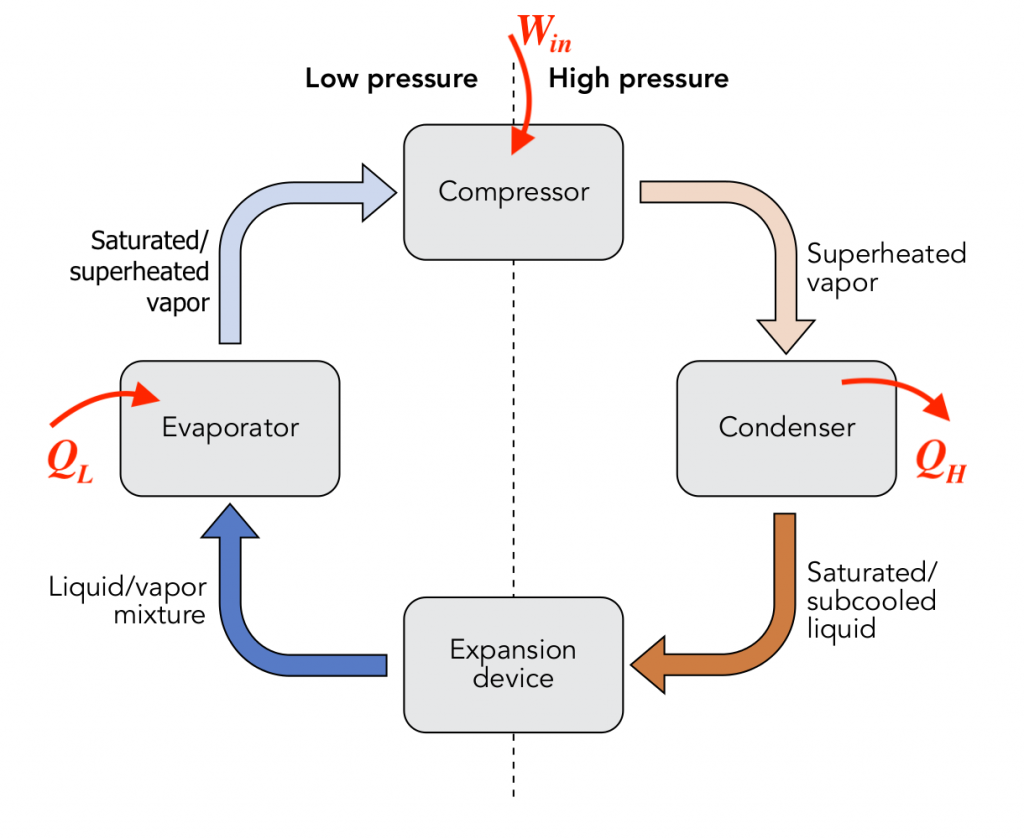
Let's put this in the context of your kitchen fridge:
- Cold Reservoir (
T_L): The inside of your refrigerator. - Heat
Q_L: The heat being removed from your food and the air inside the fridge. This is the desired effect. - Work
W_in: The electricity your fridge consumes, which powers a motor called a compressor. This is the cost you pay. - Hot Reservoir (
T_H): The air in your kitchen. - Heat
Q_H: The heat dumped into your kitchen. You can feel this as warm air coming from the back or bottom of your fridge.
Since energy is always conserved (First Law!), the energy going out must equal the energy coming in. Looking at the reversed diagram, the heat dumped into the kitchen (Q_H) is the sum of the heat taken from the food (Q_L) and the work put in to run the compressor (W_in).
This is why the back of your fridge gets warm! It's not just dumping the heat from inside; it's also dumping the energy from the electricity used to run it.
The following video provides an excellent visual explanation of this "anti-heat engine" concept.
Anti-Heat Engines: Refrigerators, Air Conditioners, and Heat Pumps | Doc Physics
Watch this segment from Doc Physics to see how refrigerators and air conditioners are conceptually the opposite of heat engines.
Watch from 3:56 to 7:28. The video explains how work is used to pump heat from a cold reservoir to a hot one, which is exactly what your fridge and AC do.
As the video mentions, an air conditioner is exactly the same in principle. The "cold reservoir" is the inside of your house, and the "hot reservoir" is the outdoors. It uses work to pump heat from your cool house to the even hotter outside.
Heat Pumps: A Refrigerator with a Different Goal
This is where things get interesting. A refrigerator's purpose is to cool the cold space. A heat pump's purpose is to heat the hot space.
It's the exact same device, just with a different objective.
- Refrigerator/AC: The goal is the heat removed from the cold space,
Q_L. We want to make the inside of the fridge cold. - Heat Pump: The goal is the heat delivered to the hot space,
Q_H. We want to make our house warm.
Imagine it's a chilly winter day, 5°C outside. You want your house to be a cozy 22°C. A heat pump will pull heat from the cold outside air (Q_L) and, by adding work (W_in), pump that heat into your house (Q_H).
This might sound like magic. How can you get heat from cold air? Remember, "cold" is relative. 5°C air still contains a huge amount of thermal energy compared to absolute zero. A heat pump simply uses a clever process to absorb that energy and move it indoors.
The amazing part is the efficiency. Look at the energy balance again: Q_H = Q_L + W_in. The heat you get in your house (Q_H) is the sum of the work you paid for plus the "free" heat you extracted from the outside. This is why heat pumps can be a very efficient way to heat a home compared to a simple electric heater, which just turns electrical work directly into heat (Q_H = W_in).
This article explains the distinction between the two devices very clearly.
Heat pump refrigeration cycle – Function and basic principle
Let's read a short section from the article 'Heat pump refrigeration cycle' by TLK Energy to solidify the idea that a refrigerator and a heat pump are the same technology, just used for different purposes.
Read the section titled 'Refrigeration cycle or heat pump?'. It uses a great analogy of a box that gets cold on one side and hot on the other.
How Does It Actually Work? The Vapor-Compression Cycle
So far, we've talked about these devices as abstract boxes. Now, let's open the box. The overwhelming majority of refrigerators and heat pumps use a process called the vapor-compression refrigeration cycle.
To understand it, you only need to know three simple physical facts, which are beautifully laid out in the tlk-energy.de article.
- Evaporation causes cooling: When a liquid turns into a gas (evaporates), it absorbs a lot of heat from its surroundings. This is why sweating cools you down.
- Condensation causes heating: When a gas turns back into a liquid (condenses), it releases that heat back to its surroundings. This is why steam burns are so severe—the steam releases a large amount of energy as it condenses on your skin.
- Boiling point depends on pressure: You know water boils at 100°C. But on a high mountain where the pressure is lower, it boils at a lower temperature. If you increase the pressure (like in a pressure cooker), water boils at a much higher temperature.
The cycle uses a special fluid called a refrigerant, which has a very low boiling point. The whole magic of the cycle is to manipulate the refrigerant's pressure to make it boil (absorb heat) where we want it to be cold, and condense (release heat) where we want it to be hot.
The cycle has four main components:
- Evaporator (The Cold Part)
- Compressor (The Motor)
- Condenser (The Hot Part)
- Expansion Valve (The Pressure Dropper)
Let's follow a drop of refrigerant through the cycle in a refrigerator:
-
In the Evaporator: The refrigerant enters the evaporator coils (inside the freezer compartment) as a cold, low-pressure liquid. It's colder than the air in the fridge. Because heat flows from hot to cold, heat from your food flows into the refrigerant. This heat causes the refrigerant to boil and turn into a low-pressure gas. This is where
Q_Lis absorbed. -
To the Compressor: This low-pressure gas is sucked into the compressor. The compressor, powered by electricity (
W_in), squeezes the gas, dramatically increasing its pressure and temperature. Think of how a bike pump gets hot when you use it. The refrigerant leaves the compressor as a hot, high-pressure gas. -
In the Condenser: This hot gas flows into the condenser coils (on the back of the fridge). The gas is now much hotter than your kitchen air. So, heat flows from the refrigerant gas into the kitchen. As it loses heat, the refrigerant condenses back into a high-pressure liquid. This is where
Q_His rejected. -
Through the Expansion Valve: This high-pressure liquid is then forced through a very narrow tube or valve. As it emerges on the other side, the pressure plummets. This sudden expansion makes the liquid refrigerant's temperature drop drastically. Now it's a cold, low-pressure liquid again, ready to enter the evaporator and repeat the cycle.
This detailed article and the accompanying diagram walk you through these four steps.
Heat Engines, Heat Pumps, and Refrigerators - Physics
Let's read a more detailed breakdown of the components and the cycle from the textbook by OpenStax.
Read the two sections that describe the components of a heat pump and how air conditioners/refrigerators work. They directly correspond to the four steps we just discussed.
To see this all in motion, the following video provides one of the best animations available. It shows how the refrigerant changes state as it moves through the system. It also introduces the reversing valve, the clever component that allows a heat pump to switch between heating and cooling modes.
Heat Pumps Explained - How Heat Pumps Work HVAC
Let's watch a detailed animation of the vapor-compression cycle from The Engineering Mindset. This will bring all four components to life.
Watch the segment from 1:49 to 5:38. The first part (until 4:09) shows the system in 'heating mode' (acting as a heat pump). The second part shows 'cooling mode' (acting as an air conditioner). Pay close attention to where the refrigerant is a liquid, a gas, and where it's hot or cold.
The video also touches on other types of heat pumps (ground source, water source) that pull heat from the ground or a body of water instead of the air. The core principle remains exactly the same.
Test your understanding!
- A friend claims they have a "magic box" that cools their drink without being plugged in and without getting warm anywhere. Why is this impossible according to the principles we've discussed?
- In a standard kitchen refrigerator, where are the following components physically located?
- The Evaporator
- The Condenser
- The Compressor
- When a heat pump is heating your house on a cold day, is the outdoor coil acting as an evaporator or a condenser? What about the indoor coil?
- Why does a compressor require work input? What two things does it do to the refrigerant?
Show answer
- The "magic box" violates the principles of the Second Law. To move heat out of the cold drink (
Q_L) into the warmer room (Q_H), there must be a work input (W_in), which means it needs to be plugged in or powered somehow. The total heat rejected (Q_H) must be the sum ofQ_LandW_in, so some part of the box must get warm. -
- Evaporator: Inside the freezer/refrigerator compartment. These are the coils where the cooling actually happens.
- Condenser: Typically on the back of the refrigerator or in the base. These are the coils that feel warm to the touch.
- Compressor: The black, dome-shaped motor, usually at the bottom back of the fridge. It's the part that hums.
- On a cold day, the heat pump needs to absorb heat from the cold outside air. Therefore, the outdoor coil is the evaporator. It needs to release heat into the warm house, so the indoor coil is the condenser. (In summer/cooling mode, their roles reverse!).
- The compressor requires work input to take a low-pressure gas and squeeze it into a smaller volume. In doing so, it increases the refrigerant's pressure and increases its temperature. This high temperature is crucial for the refrigerant to be able to reject heat to the "hot" surroundings in the condenser.
Conclusion
Great work today! We've taken the abstract idea of a "heat engine in reverse" and connected it to the real-world machines that keep our food cold and our homes comfortable.
Key Takeaways:
- Refrigerators and heat pumps are devices that use a work input (
W_in) to move heat (Q_L) from a cold place to a hot place, which is the opposite of the natural direction of heat flow. - They are the same technology; their name just depends on the goal. A refrigerator's goal is cooling (
Q_L), while a heat pump's goal is heating (Q_H). - The workhorse behind these devices is the vapor-compression cycle, which uses a refrigerant that undergoes repeated evaporation and condensation.
- The four key components are the Evaporator (absorbs heat), Compressor (adds work to raise pressure/temp), Condenser (rejects heat), and Expansion Valve (drops pressure/temp).
Preview of the Next Lesson
We now know how these devices work. But how well do they work? For heat engines, we used "thermal efficiency" as a report card. For refrigerators and heat pumps, we use a different metric called the Coefficient of Performance (COP).
In our next lesson, we will formally define the COP and learn how to calculate it. We'll also introduce the Clausius statement of the Second Law, which is the twin to the Kelvin-Planck statement and applies directly to the impossibility of moving heat from cold to hot without a work input.