Hello! Welcome back to our journey through thermodynamics.
In our last lesson, we dove into the clever engineering behind refrigerators and heat pumps. We saw how they use a special fluid and a four-step cycle (evaporation, compression, condensation, expansion) to achieve something amazing: pumping heat from a cold place to a warm place. We learned how a fridge works.
Today, we're going to explore the fundamental law of nature that explains why it must work that way. We saw with heat engines that the Kelvin-Planck statement forbids a "perfect" engine. There's a similar, equally powerful rule for refrigerators, and it's called the Clausius statement of the Second Law of Thermodynamics.
By the end of this lesson, you'll understand this statement and its crucial implication: you can't get something for nothing, especially when it comes to cooling.
The Natural Flow of Things
Let's start with a simple observation you've made your entire life: heat flows from hot to cold.
- A hot mug of coffee left on the table will cool down, warming the air around it.
- An ice cube in your hand will melt, making your hand feel cold.
Heat never, ever flows on its own from the cold air to the hot coffee to make it even hotter. That would be weird, right? But why? The First Law (conservation of energy) wouldn't forbid it. The energy would still be conserved.
The reason is one of statistics and probability. A state where energy is spread out is simply vastly more likely than a state where it's concentrated. Think of a drop of ink in a glass of water. The ink molecules will spontaneously spread out (disperse) until the water is uniformly colored. It's not impossible for all the ink molecules to spontaneously gather back into a single drop, but it's so astronomically improbable that it never happens. Heat energy behaves in the same way; it tends to spread out from hot (concentrated) areas to cold (less concentrated) areas. This "spreading out" is the natural direction of things.
Forcing Heat Uphill: The Second Law Steps In
Refrigerators and heat pumps are designed to defy this natural flow. They force heat to move "uphill" from cold to hot. Because this is an unnatural process, the universe demands a price.
This idea is captured by the Clausius statement. Let's watch a short, intuitive video that introduces this very concept.
2nd Law of thermodynamics - Principles of Refrigeration
This video from SeeTheChangeUSA sets the stage perfectly by explaining that to move heat from cold to warm, work is required.
Watch from 0:35 to 1:27. This will give you the core idea before we look at the formal statement.
The video gets right to the point: to pump heat against its natural flow, work is required. This is the heart of the matter.
The Clausius Statement
The idea we just saw is formalized in the Clausius statement, named after the German physicist Rudolf Clausius. It's one of the official ways to state the Second Law of Thermodynamics.
4 | the second law of thermodynamics
Let's read the formal definition from the OpenStax University Physics textbook. Pay close attention to the wording.
Read the paragraph that starts 'We know from common personal experience...' and includes the box defining the 'Second Law of Thermodynamics (Clausius statement)'.
As you just read, the statement is:
"Heat never flows spontaneously from a colder object to a hotter object."
A more formal version, which you'll also see, is:
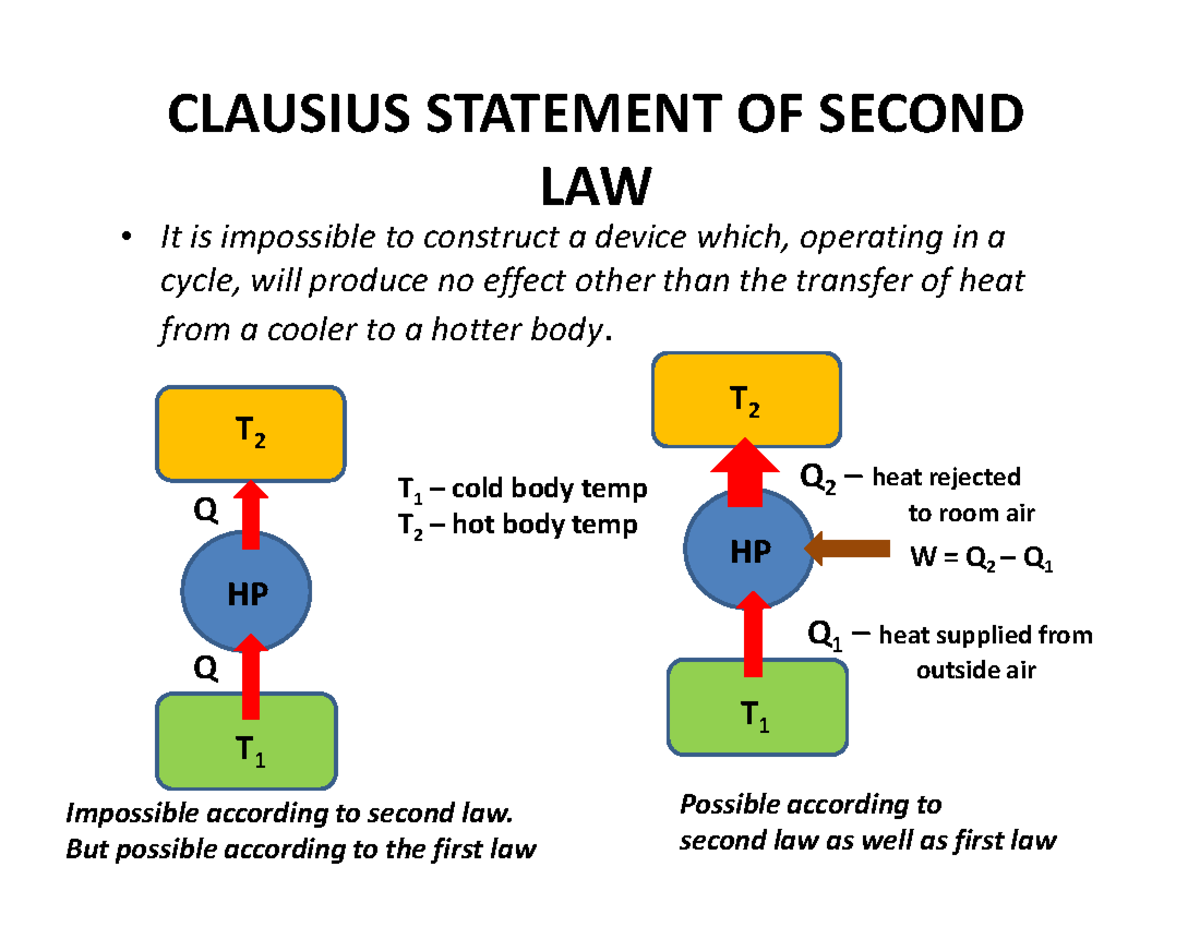
"It is impossible to construct a device that operates in a cycle and produces no effect other than the transfer of heat from a cooler body to a warmer body."
Let's break down the key phrases of this formal version:
- "...operates in a cycle...": This is crucial. It means the device (the refrigerator) must return to its initial state to run continuously. You can't just have a one-shot process.
- "...no effect other than...": This is the kicker. It says you can't only move the heat. If you could, you'd have a "perfect refrigerator." The "other effect" that makes it possible is the work input.
This image perfectly illustrates the concept. The process on the left is impossible; the one on the right is what happens in reality.
The Implication: Why You Must Plug In Your Fridge
The Clausius statement is the fundamental reason your refrigerator needs to be plugged into the wall. The electricity it draws is used to do work (via the compressor), which is the "other effect" that makes the heat transfer possible.
This leads to a classic thermodynamics puzzle: Can you cool your kitchen by opening the refrigerator door?
The answer is no. In fact, you will make your kitchen warmer. Here's why:
- Your fridge pumps heat (
Q_L) from inside itself into the kitchen. - To do this, the compressor does work (
W_in), which it gets from electricity. This work energy is also converted into heat and dumped into the kitchen. - The total heat dumped into your kitchen is
Q_H. From the First Law (energy conservation), we know:Q_H = Q_L + W_in.
So, for every unit of heat the fridge removes from its own air, it dumps that unit plus the work energy back into the kitchen. The net effect is a warmer room.
Test your understanding!
- An inventor claims they've built a small, portable air conditioner that doesn't need to be plugged in and doesn't have an exhaust hose to vent hot air outside. They say it just makes the air around it colder. Why is this impossible?
- Looking at the Clausius statement, what is the "other effect" in a real-world heat pump that's heating your home?
- Both the Kelvin-Planck and Clausius statements are expressions of the Second Law. In simple terms, what does the Kelvin-Planck statement forbid, and what does the Clausius statement forbid?
Show answer
- This device violates the Clausius statement. To move heat from the "cold" area (the output of the AC) to the "hot" area (the room), it must have a work input (so it needs a power source) and it must reject that heat somewhere else. A real portable AC has a hose to dump the
Q_Houtside. This fictional device has no power input (W_in=0) and no place to dump the heat, so it claims to be a "perfect refrigerator," which is impossible. - The "other effect" is the work (
W_in) supplied to the heat pump's compressor, usually in the form of electricity. This work is necessary to pump heat from the cold outdoors (Q_L) into the warm house (Q_H). - The Kelvin-Planck statement forbids a perfect heat engine (a device that turns heat from a single source 100% into work). The Clausius statement forbids a perfect refrigerator (a device that transfers heat from cold to hot with no work input). They are the two sides of the Second Law coin.
Let's Recap
So, what have we established?
- Heat's natural, spontaneous direction of flow is always from a hotter body to a colder one.
- The Clausius statement of the Second Law declares that you cannot build a device that continuously moves heat from cold to hot without some other effect.
- This "other effect" is a work input. This is the fundamental reason why refrigerators, air conditioners, and heat pumps require energy to operate.
- The total heat rejected to the hot reservoir (
Q_H) is always greater than the heat absorbed from the cold reservoir (Q_L), because it also includes the work input (W_in).
Now, let's put this into practice with a few questions.
Practice Problems
Conceptual Questions
- You have two identical cups of water at room temperature. You place one inside a running refrigerator and the other on the kitchen counter. Describe the direction of heat flow for both cups. Which process is spontaneous and which is forced?
- If a "perfect refrigerator" (violating Clausius) could exist, you could combine it with a real heat engine to create a "perfect heat engine" (violating Kelvin-Planck). Briefly explain how this combination would work.
- A heat pump is used to heat a building. Where is the cold reservoir and where is the hot reservoir?
Numerical Problems
-
Problem: A freezer removes heat from its contents at a rate of 95 Watts. The freezer's compressor consumes 40 Watts of electrical power. At what rate is heat being rejected into the room?
Solution:- Identify the givens:
- Heat removed from the cold space,
Q_L= 95 W (or 95 J/s). - Work input,
W_in= 40 W.
- Heat removed from the cold space,
- Identify the goal: Find the heat rejected to the hot space,
Q_H. - Apply the energy balance: The Clausius statement implies work is needed, and the First Law tells us energy is conserved. So, the energy going out (
Q_H) must equal the energy coming in (Q_L+W_in).
- Calculate:
- Answer: The freezer rejects heat into the room at a rate of 135 Watts.
- Identify the givens:
-
Problem: An air conditioning unit rejects heat to the outside air at a rate of 5 kW. It cools the inside of a car by removing heat at a rate of 3.5 kW. How much power must the car's engine provide to run the AC compressor?
Solution:- Identify the givens:
- Heat rejected to the hot reservoir (outside),
Q_H= 5 kW. - Heat removed from the cold reservoir (inside),
Q_L= 3.5 kW.
- Heat rejected to the hot reservoir (outside),
- Identify the goal: Find the work input,
W_in. - Apply the energy balance (rearranged):
- Calculate:
- Answer: The car's engine must supply 1.5 kW of power to the compressor.
- Identify the givens:
Conclusion
Fantastic! Today we've formalized a concept that you already intuitively knew: you can't cool something down for free. We now know this rule as the Clausius statement of the Second Law of Thermodynamics.
We've seen that this simple statement is the reason refrigerators and heat pumps need a power source, and it dictates the energy balance that governs their operation. Along with the Kelvin-Planck statement for heat engines, we now have a complete picture of the Second Law's two major declarations. They are the ultimate traffic cops for energy, telling us which way it can and cannot flow.
Preview of the Next Lesson
We know that refrigerators need a work input. But are all refrigerators created equal? If you have one fridge that uses 100 W of work to remove a certain amount of heat, and another that only needs 50 W to do the same job, the second one is clearly "better."
In our next lesson, we will quantify this "goodness." We will define and learn to calculate the Coefficient of Performance (COP), which is the official report card for refrigerators and heat pumps.