Hello! Welcome back.
In our last lesson, we took a huge conceptual step and established the Increase of Entropy Principle. We learned that for any real process, the total entropy of the universe (our system plus its surroundings) must increase. This increase, which we called entropy generation (), is the thermodynamic signature of irreversibility—the stamp of reality on any process.
That's the why. But to apply this powerful principle to solve real engineering problems—to determine if a process is possible or to measure its inefficiency—we need a way to calculate the change in entropy of the system itself ().
Today, we get down to business. We're going to learn how to calculate the entropy change for pure substances like water. The great news is, you won't need to be wrestling with integrals or imagining complex reversible paths. Instead, we'll use a tool you're already familiar with: property tables. We'll see that entropy, s, is just another property of a substance, listed right alongside pressure, temperature, and volume. Our main job will be to learn how to find it.
Entropy as Just Another Property
Remember back when we first studied pure substances? We said that if you know two independent properties of a substance, its state is fixed. That means all its other properties are also fixed. You know the pressure and temperature? Then you can find the specific volume (v), the internal energy (u), the enthalpy (h), and now, the specific entropy (s).
Entropy is a real, measurable property, even if we can't see it directly. The values you see in property tables have been carefully calculated from experimental data. The units for specific entropy are typically kJ/kg·K. This should feel familiar—it's energy per unit mass per unit temperature (), just as our definition from two lessons ago suggested!
Take a look at this image. On the left is a standard property table for saturated water. On the right are some calculations. Notice the columns for entropy.

Just like with other properties, we have special notation for entropy at the saturation lines:
- is the specific entropy of saturated liquid (the "f" stands for fluid). This is the entropy of 1 kg of water that is just about to boil.
- is the specific entropy of saturated vapor (the "g" stands for gas). This is the entropy of 1 kg of steam that has just finished boiling.
- is the entropy of vaporization. It's the change in entropy during the phase change from liquid to vapor, so .
A Quick Conceptual Bridge
Think back to how we defined entropy change: for a reversible, constant-temperature process. Boiling water at a constant pressure is exactly that!
The heat added during boiling is the latent heat of vaporization, . The process happens at a constant temperature, the saturation temperature (in Kelvin!).
So, the change in entropy during boiling is:
This simple equation is the physical link between the enthalpy values in the table and the entropy values. It's why entropy increases when you boil water: you are adding a lot of energy () to it.
The Three-Step Recipe for Finding Entropy Change
Calculating the change in entropy, , is a procedural task. It always follows the same three steps:
- Fix State 1: Use two given independent properties to determine the phase (compressed liquid, saturated mixture, or superheated vapor) and find the specific entropy, .
- Fix State 2: Use two known properties of the final state to find its phase and specific entropy, .
- Calculate the Change: . If you need the total entropy change, , just multiply by the mass: .
Let's walk through how to do Step 1 and 2 for each of the three possible regions.
Step 1: Determine the State
This is the same skill you learned in Module 6. To determine the state of a substance given two properties (say, pressure P and temperature T), you go to the saturated property table:
- Look up the saturation temperature, , at the given pressure
P. - If : You have a compressed liquid.
- If : You have a superheated vapor.
- If : You have a saturated substance. It could be saturated liquid, saturated vapor, or a mix. You'd need another property (like
voru) to know for sure.
Now, let's find the entropy in each case.
Step 2 (Case A): Compressed Liquid Region
If your substance is a compressed liquid, the most accurate method is to use the compressed liquid tables. You find the table for your given pressure and then look for the row with your given temperature to read off s.
However, dedicated compressed liquid tables are not always available. In that case, we use a very good approximation. Liquid properties don't change much with pressure. They are much more sensitive to temperature.
Approximation for Compressed Liquid: The entropy of a compressed liquid is approximately equal to the entropy of the saturated liquid at the same temperature.
This is a very common and useful approximation in thermodynamics.
Step 2 (Case B): Superheated Vapor Region
This is the most straightforward case. If your substance is a superheated vapor (e.g., steam at a temperature higher than its boiling point for that pressure), you simply go to the superheated vapor tables.
- Find the block of data for your pressure.
- Find the row for your temperature.
- Read the value of
sdirectly from the table.
Step 2 (Case C): Saturated Mixture Region
This is where most of the action happens. If your substance is inside the vapor dome—a mix of liquid and vapor—you need to know its quality, x. Remember, quality is the mass fraction of the substance that is in the vapor phase. for a saturated liquid, and for a saturated vapor.
If you are given properties other than quality (like specific volume v), you must first calculate x:
...where v, v_f, and v_fg are all found at the given saturation pressure or temperature.
Once you know the quality x, you can find the specific entropy using the same exact formula pattern you used for v, u, and h:
Or, since , you can also write it as:
This formula is just a weighted average. If you have a mixture that is 20% vapor (), its entropy is 20% of the way from the liquid entropy () to the vapor entropy ().
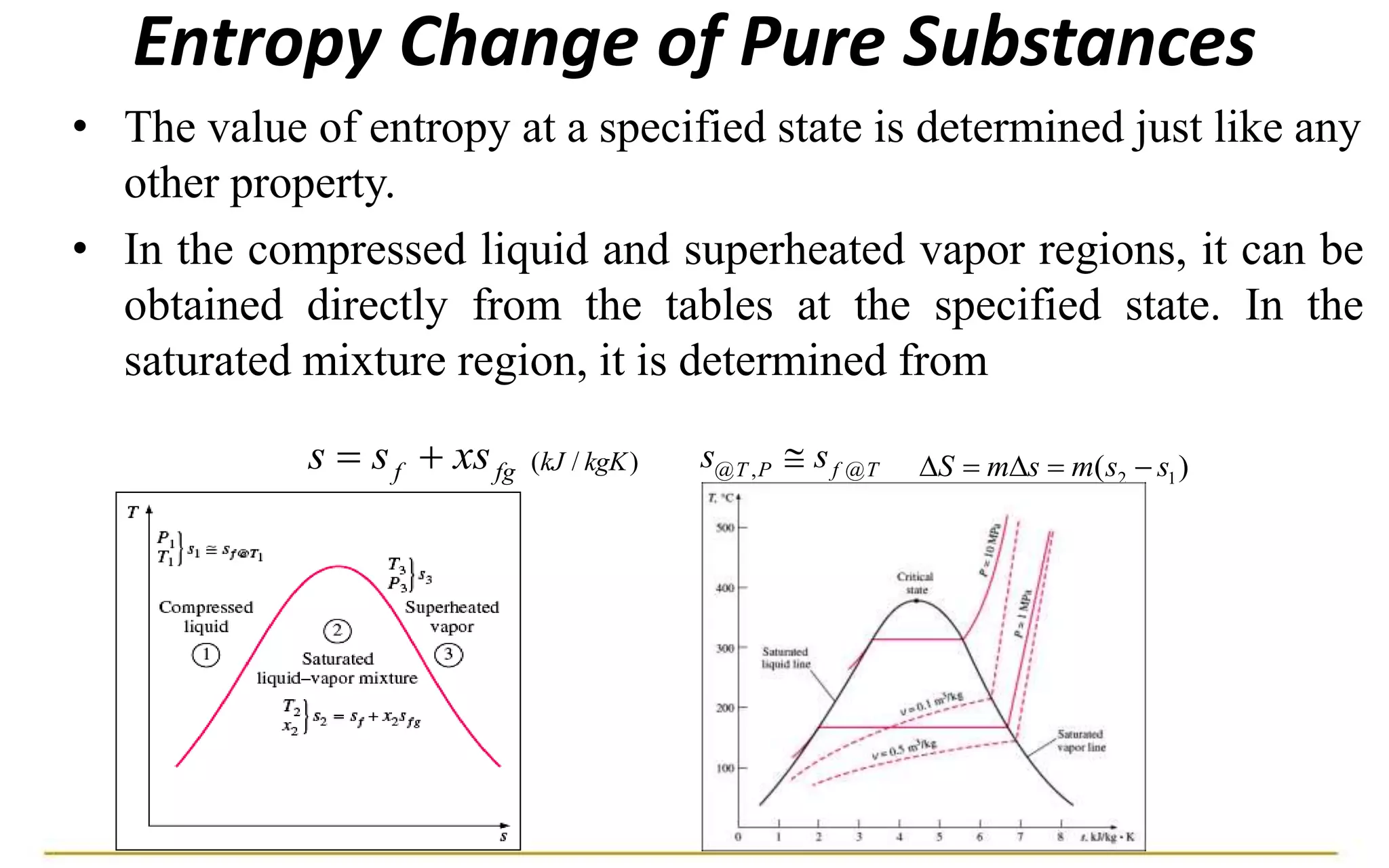
Let's Do This: Worked Problems
Time to put this procedure into practice. We'll need property tables for these. You can use the tables in your textbook or an online resource. The values may differ slightly depending on the source, but the process is identical.
Worked Problem 1: Constant Pressure Heating
Problem: A piston-cylinder device contains 0.5 kg of water initially at 1 MPa and 100°C. It is heated at constant pressure until the temperature reaches 350°C. Find the total change in entropy of the water.
Solution:
Our strategy is to find and and then calculate .
State 1: Find
- Given: , .
- Determine State: First, we go to the saturated water pressure table and look up (which is 1000 kPa). The table tells us the saturation temperature is .
- Since our temperature is less than , we have a compressed liquid.
- Find Entropy: We use the approximation: at . We go to the saturated water temperature table, look up , and find .
- From the tables, at , . So, .
State 2: Find
- Given: The process is constant pressure, so . The final temperature is .
- Determine State: At , the saturation temperature is still .
- Since our temperature is greater than , we have superheated vapor.
- Find Entropy: We go to the superheated water tables. We look for the block for and find the row for .
- From the tables, at 1 MPa and 350°C, we read .
Calculate the Change in Entropy:
The entropy of the water increased significantly, which makes sense as it was heated from a liquid to a hot vapor.
Worked Problem 2: Cooling in a Rigid Tank
Problem: A rigid tank contains 1.5 kg of saturated water vapor at 400 kPa. The tank is cooled until the pressure drops to 150 kPa. Find the change in specific entropy () and the final quality ().
Solution:
A rigid tank means the volume is constant, and therefore the specific volume is constant (). This is our key insight for the process.
State 1: Find and
- Given: , and it's "saturated water vapor".
- Determine State: The problem tells us it's saturated vapor, so we know .
- Find Properties: We go to the saturated pressure table at .
- We look up the specific entropy for saturated vapor: .
- We also need the specific volume to define state 2: .
State 2: Find and
-
Given: . The process is in a rigid tank, so .
-
Determine State: We go to the saturated pressure table at and look up the specific volumes for liquid and vapor.
- At 150 kPa: and .
-
Since our specific volume is between and (), we have a saturated liquid-vapor mixture.
-
Find Quality (): Now we can calculate the quality at state 2.
- We'll need at 150 kPa: .
- So, the final mixture is about 39.8% vapor by mass.
-
Find Entropy (): Now that we have the quality, we can find . First, get and from the table at 150 kPa.
- At 150 kPa: and .
Calculate the Change in Specific Entropy:
The entropy decreased, which makes perfect sense because the tank was cooled and some of the vapor condensed back into liquid, a more ordered state.
Test your understanding!
Conceptual Question 1:
You have a pot of water boiling on the stove at atmospheric pressure (101.3 kPa). You add more heat. What happens to the water's temperature? What happens to its specific entropy?
Show answer
As long as there is still liquid water in the pot, the temperature will remain constant at the boiling point (). However, because you are adding heat to turn more liquid into vapor, the quality x is increasing. Since , and x is increasing, the specific entropy of the water in the pot is increasing.
Test your understanding!
Conceptual Question 2:
1 kg of saturated liquid water is at . 1 kg of saturated liquid water is at . Which one has higher specific entropy? Why?
Show answer
The water at has the higher specific entropy. Although both are in the same phase (saturated liquid), the water has more thermal energy. To get from 50°C to 200°C, you have to add heat, and adding heat always increases the entropy of the substance you are heating. You can confirm this by looking up at 50°C and 200°C in the tables.
Key Takeaways
Excellent work today. We've bridged the gap from the abstract theory of entropy to a concrete calculation method.
- Specific entropy (
s) is a property listed in the thermodynamic tables for pure substances, just likev,u, andh. - To find the change in entropy for a process, you follow a simple procedure: find
sfor state 1, findsfor state 2, and take the difference. - The method for finding
sdepends on the phase of the substance:- Compressed Liquid: Approximate at the given temperature
T. - Superheated Vapor: Look up
sdirectly in the superheated tables. - Saturated Mixture: First find the quality
x, then use the formula .
- Compressed Liquid: Approximate at the given temperature
Preview of the Next Lesson
We have now mastered using property tables to find entropy for substances like water and refrigerants, which frequently undergo phase changes in engineering devices.
But what about gases like air, oxygen, or helium, especially when they are far away from their condensation points? Using tables for them can be cumbersome. Fortunately, for many situations, we can treat them as ideal gases. In our next lesson, we will derive and learn how to use a set of convenient equations to calculate the entropy change for ideal gases. This will complete our toolkit for calculating for the most common substances in thermodynamics.