Hello! Welcome back.
In our last lesson, we established the formal mathematical definition of entropy change: . We saw that this was a powerful calculation tool, but it came with a big condition: we had to imagine a perfect, reversible process to use it.
But let's be honest, the real world isn't perfect. Friction exists. Heat leaks across walls. When you mix cream into your coffee, you can't un-mix it. These are all irreversible processes. So, what happens to entropy in the real world? How does the Second Law of Thermodynamics account for reality?
Today, we're going to answer that question by introducing the Increase of Entropy Principle. This is one of the most profound and powerful ideas in all of physics. It's the ultimate rule that tells us which way time flows and which processes are possible, impossible, or just plain ideal. We'll see how every real process, from a car engine running to an ice cube melting, has a "signature" of irreversibility—an amount of entropy it generates.
The Telltale Sign of Reality: Irreversible Heat Transfer
Let's go back to the most fundamental process we know: heat flowing from a hot object to a cold one. In the last lesson, we saw that for this to happen, the entropy increase of the cold object must be greater than the entropy decrease of the hot one. Let's put some numbers on this to make it concrete.
Imagine we have a hot reservoir at 600 K (like a furnace) and a cold reservoir at 300 K (like the air on a cool day). Let's transfer 1200 J of heat from the hot one to the cold one.
Case 1: The "Perfect" Reversible Transfer (Impossible in reality)
To do this reversibly, we'd need to use a Carnot heat engine that absorbs 1200 J from the hot reservoir, produces some work, and rejects the rest of the heat to the cold reservoir. As we saw when we derived the definition of entropy, for a reversible cycle, the total entropy change of the universe (engine + reservoirs) is exactly zero.
Case 2: The Real-World Irreversible Transfer
Now, let's just put the hot and cold objects in contact and let 1200 J of heat flow directly. This is a spontaneous, irreversible process. What's the total entropy change now?
-
Change in Entropy of the Hot Reservoir ():
It loses 1200 J of heat. So, J.
Its entropy decreased, which makes sense. -
Change in Entropy of the Cold Reservoir ():
It gains 1200 J of heat. So, J.
Its entropy increased. -
Total Entropy Change ():
Now let's add them up to find the change for the whole universe (our two reservoirs).
Look at that! The total entropy of the universe increased. This increase of 2.0 J/K is the thermodynamic "scar" left by the irreversible process. It's a permanent change. This isn't just a special case; it's a universal rule.
To dig a little deeper into this exact idea, have a read through the following text.
Entropy and the Second Law of Thermodynamics: Disorder ...
This article from Lumen Learning, 'Entropy and the Second Law of Thermodynamics', contains a perfectly worked-out example of what we just did. It reinforces the idea that irreversible processes always result in a net increase in total entropy.
Please read the section that starts right after the definition of entropy, beginning with 'This result, which has general validity...'. Pay close attention to 'Example 1. Entropy Increases in an Irreversible (Real) Process' and its discussion. It walks through the same calculation we just performed.
The Increase of Entropy Principle and Entropy Generation
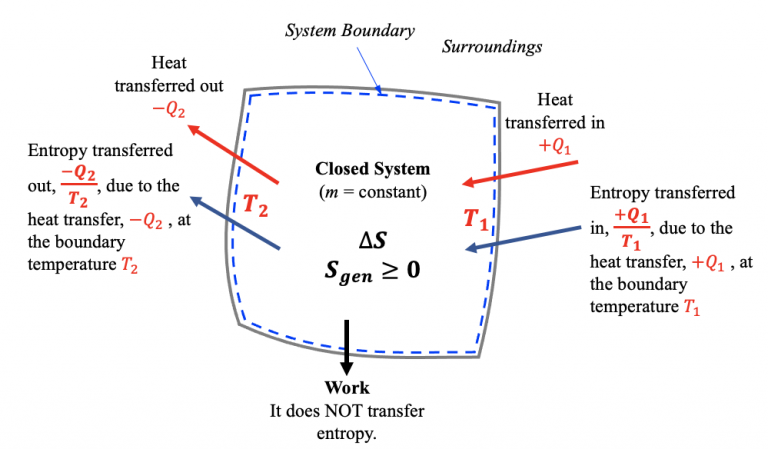
This brings us to the formal statement of the Second Law in terms of entropy, known as the Increase of Entropy Principle. It is the absolute, unbreakable law for any process.
Let's break the universe into two parts: the system we care about (like our piston-cylinder) and the surroundings (everything else). The total change in entropy is:
The Increase of Entropy Principle states that this total change can never be negative. It is always greater than or equal to zero. We call this total entropy change the entropy generation, .
So, we can write the principle as:
This simple inequality tells us everything we need to know:
- If , the process is irreversible and can happen in the real world.
- If , the process is reversible (a perfect, ideal process).
- If , the process is impossible. It violates the Second Law of Thermodynamics.
This is it. This is the ultimate test. The First Law says you can't create or destroy energy (). The Second Law says you can't destroy entropy; you can only create it ().
What Causes Irreversibility?
Entropy generation is the signature of irreversibility. So, what are these irreversible processes? You see them every day.
Thermodynamic Irreversibility → Term
This article on 'Thermodynamic Irreversibility' provides a very clear, non-mathematical explanation of what makes a process irreversible, with great examples.
Read the 'Fundamentals' and 'Simple Examples of Irreversibility' sections. Notice how friction, heat transfer, and mixing are all one-way streets thermodynamically.
The key sources of irreversibility are:
- Friction: When you brake your car, the kinetic energy turns into heat in the brake pads. You can't cool the brake pads down to make the car move backward. The process is irreversible, and entropy was generated.
- Unrestrained Expansion: If you puncture a tire, the high-pressure air rushes out. It will never spontaneously go back in. Entropy was generated.
- Mixing: Once you stir milk into your tea, they will not separate on their own. Entropy was generated.
- Heat Transfer across a Finite Temperature Difference: This is the example we started with. Any time heat flows without a perfect Carnot engine, entropy is generated.
This natural tendency toward irreversibility and increased entropy is a fundamental aspect of our universe.
Second Law of Thermodynamics - Heat Energy, Entropy & Spontaneous Processes
For some great everyday analogies about this natural tendency towards irreversibility, let's watch this video from The Organic Chemistry Tutor.
Watch from the beginning to 4:12. The speaker uses simple analogies like a ball rolling downhill, a messy room, and a broken glass to explain that natural processes are spontaneous and increase entropy. This is the essence of the Increase of Entropy Principle in action.
Can Entropy Ever Decrease?
This is a very important question. Does the Increase of Entropy Principle mean the entropy of a system can never go down? No!
Think about putting water in your freezer to make ice cubes.
- The system is the water. As it freezes into a more ordered crystal structure, its entropy decreases ().
- But your freezer is not an isolated system. It has a refrigeration cycle that pumps heat out of the water and dumps that heat (plus the work energy used to run the compressor) into your kitchen.
- This heat dumping causes a large entropy increase in the surroundings (the air in your kitchen), so .
The Second Law guarantees that the increase in the surroundings' entropy is always greater than the decrease in the system's entropy.
So, you can create a local pocket of order (ice cubes) as long as you create even more disorder (or energy dispersal) in the universe as a whole.
This is a critical point that is often misunderstood, especially when people try to argue about things like the evolution of life.
What is the Second Law of Thermodynamics?
This short clip from The Royal Institution addresses this exact point. It explains how things like living organisms or refrigerators don't violate the Second Law.
Watch from 1:54 to 3:00. The key idea is that humans, refrigerators, and planets are not closed systems. They decrease their own entropy by increasing the entropy of their environment by an even larger amount.
A Quick Summary So Far
Let's take a breath. This is a big idea.
- Real-world processes are irreversible.
- Irreversible processes always generate entropy ().
- The total entropy of the universe (system + surroundings) can therefore only increase or, in the ideal case of a reversible process, stay the same. It can never decrease.
- A system's entropy can decrease, but only if the surroundings' entropy increases by a larger amount.

Let's Solve Some Problems
Let's apply this principle to see if a process is possible.
Worked Problem 1: Is this claim possible?
Problem: An inventor claims to have a device that takes in air at 300 K and, using a series of paddles and chambers, separates it into a stream of hot air at 400 K and a stream of cold air at 200 K. The device operates in a steady state and has no heat or work interactions with the surroundings. Does this device violate the Second Law? (Assume air is an ideal gas with kJ/kg·K).
Solution:
- Analyze the process: We have one stream of air coming in, and two streams going out. The device itself is our system. It's an isolated system because there is no heat or work transfer with the surroundings.
- Apply the Increase of Entropy Principle: For an isolated system, . Therefore, the principle becomes . If we calculate the change in entropy of the air passing through and find it's negative, the device is impossible.
- Calculate the entropy change: The entropy change for an ideal gas at constant pressure (or with pressure changes we can account for, but let's simplify for now) is primarily due to the temperature change. For 1 kg of air entering, let's say 0.5 kg leaves hot and 0.5 kg leaves cold (to conserve mass).
- Change for the hot stream: kJ/K.
- Change for the cold stream: kJ/K.
- Find the total entropy generation:
- Conclusion: The total entropy change (entropy generation) is negative. This is a violation of the Second Law of Thermodynamics. The inventor's claim is impossible. You cannot "unmix" temperatures like this without an external energy input.
Worked Problem 2: Friction in a Piston**
Problem: 0.2 kg of an ideal gas in a piston-cylinder is compressed slowly from state 1 to state 2. During the process, the temperature is kept constant at 350 K by removing heat. The change in specific entropy of the gas is measured to be kJ/kg·K. The heat removed is measured to be 25 kJ. Is this process reversible or irreversible?
Solution:
- Identify the system and surroundings: The system is the gas inside the piston. The surroundings are whatever is receiving the 25 kJ of heat (let's assume it's a thermal reservoir also at 350 K to make the calculation direct).
- Calculate :
The entropy of the gas decreased as it was compressed, which makes sense. - Calculate :
The surroundings gained 25 kJ of heat.
- Calculate the entropy generation:
- Conclusion: Since is positive, the process is irreversible. The extra entropy was likely generated by friction between the piston and the cylinder walls. If the process had been perfectly reversible, the heat transfer would have been exactly kJ. The fact that 25 kJ had to be removed means an extra 4 kJ of energy from the compression work was converted into thermal energy by friction and had to be removed as heat.
Test your understanding!
Conceptual Question 1: You stir a cup of coffee to mix in the sugar. Is this process reversible or irreversible? Where was entropy generated?
Show answer
The process is irreversible. You can't un-stir the coffee to get the sugar to collect at the bottom again. Entropy was generated in two ways:
- Mixing: The sugar and coffee molecules mixing represents an increase in entropy.
- Friction: The spoon moving through the liquid creates viscous friction, which dissipates the work you did stirring as thermal energy (slightly heating up the coffee). This is an irreversible conversion of work to heat.
Test your understanding!
Conceptual Question 2: A perfect, frictionless piston-cylinder contains an ideal gas. The cylinder is perfectly insulated. The gas is allowed to expand very, very slowly (a quasi-equilibrium process). What is the entropy generation for this process?
Show answer
The entropy generation is zero.
The process is described as being done slowly (reversibly) and is perfectly insulated (adiabatic). A process that is both reversible and adiabatic has .
Therefore, .
Since it's insulated, there is no heat transfer to the surroundings, so .
Total entropy generation is .
This is the definition of a reversible process. As we'll see later, we give this special process (reversible and adiabatic) its own name: isentropic.
Key Takeaways for Today
This was a huge conceptual leap, so let's summarize the main points:
- The Increase of Entropy Principle states that the total entropy of an isolated system (or the universe: system + surroundings) can never decrease.
- We define Entropy Generation, .
- For any real process, (irreversible). For an ideal process, (reversible). A process with is impossible.
- Irreversibility is caused by real-world effects like friction, mixing, and heat transfer across a temperature difference. The value of is a measure of how irreversible a process is.
- The entropy of a system can decrease, as long as the entropy of its surroundings increases by an equal or greater amount.
Preview of the Next Lesson
We now have the complete theoretical framework for entropy. We know what it is () and we know its governing law ().
The next logical step is to make this practical. How do we actually calculate the entropy change, , for common substances like water and air without having to imagine a reversible process every single time?
In our next lesson, we will learn how to:
- Use property tables (like the steam tables) to simply look up the entropy of a pure substance like water.
- Use simple equations to calculate the entropy change for an ideal gas undergoing various processes.
This will give us the power to analyze real devices and cycles using the powerful tool of entropy. See you then