Hello again! It's great to have you back.
In our last conversation, we took a deep dive into the idea of entropy. We tossed out the simplistic "disorder" analogy and replaced it with two much more powerful concepts:
- Probability: Entropy is a measure of how many microscopic ways (microstates) you can arrange molecules to get the same macroscopic state (the pressure and temperature we measure). Systems naturally fall into the most probable state, which is the one with the highest entropy.
- Energy Dispersal: Entropy is a measure of how spread out energy is. Spontaneous processes, like heat flowing from hot to cold, happen because they allow energy to disperse.
That was all about the "what" and the "why." Today, we shift gears to the "how much." If entropy is a real, measurable property, then we need a way to put a number on it. How much does entropy increase when ice melts? How much does it decrease when steam condenses?
Our goal today is to define entropy change mathematically. We'll derive its famous formula, see why it's defined the way it is, and connect it directly back to the intuitive ideas of energy dispersal we've already discussed.
Starting with the Best: The Carnot Cycle
Let's circle back to our hero of efficiency, the Carnot cycle. Remember, it's a completely reversible cycle, and it sets the universal speed limit for any heat engine.
We found two different ways to express its efficiency:
-
From the definition of any heat engine's efficiency:
Where is the heat added from the hot reservoir and is the heat rejected to the cold reservoir. -
From the special properties of the Carnot cycle, we proved that its efficiency depends only on the absolute temperatures of the reservoirs:
Since the Carnot cycle is the engine that achieves this ideal efficiency, we can set these two expressions equal to each other:
A little bit of algebra gives us:
And rearranging this, we get a fascinating result:
Let's think about what this means for the entire cycle. We use the standard sign convention: heat entering the system is positive (), and heat leaving the system is negative (). So, we can write as . The relationship is then:
If we sum these quantities around the cycle, using our sign convention, we get:
Or, more generally, for any reversible cycle:
This is a huge deal! Whenever we have a quantity whose net change is zero over a complete cycle, it means we're dealing with a property, or a state function. Think back to internal energy (). No matter what you do, if you end up back in the same state, the change in internal energy, , is always zero.
Work () and heat () are not properties; their values depend on the path you take. But this special quantity, , acts like a property. This gives us the motivation to define a new property. We call it Entropy, and we give it the symbol .
The Mathematical Definition of Entropy Change
Based on the discovery from the Carnot cycle, the Austrian physicist Rudolf Clausius defined the change in entropy for a system as follows.
For a process that happens at a constant temperature (isothermal), the change in entropy is:
Where is the heat transferred during a reversible process, and is the absolute temperature in Kelvin.
But what if the temperature changes during the process? Since you're comfortable with calculus, you'll see this is a natural extension. We just look at an infinitesimally small step of the process, where the temperature is essentially constant. The tiny change in entropy, , is:
(We use instead of as a reminder that heat is a path function, not a property.)
To find the total entropy change for a process from state 1 to state 2, we just add up all these little changes by taking the integral:
This short video gives a great, clear summary of this definition.
Entropy and Second Law of Thermodynamics
Let's watch this clip from 'Andrey K' to see the formal mathematical definition laid out clearly for both constant and variable temperature processes.
Watch from 0:30 to 2:40. This video cleanly presents the integral form of the entropy change definition, which is the cornerstone of our calculations.
The units of entropy are energy per temperature, so in the SI system, that's Joules per Kelvin (J/K) or kilojoules per Kelvin (kJ/K). More often, we'll talk about specific entropy (entropy per unit mass), which has units of kJ/kg·K.
But Why Reversible?
This is the most critical and often confusing part of the definition. The subscript "rev" is not optional. The entropy change between two states is a fixed value (because it's a property), but to calculate it using this formula, you MUST use the heat transfer that would occur during an imaginary reversible path between those states.
Why? Because only for a reversible process is the quantity guaranteed to be a property that returns to zero over a cycle.
Let's build the intuition for this.
Why is Entropy Defined This Way?
This video from 'NanoRooms' provides a brilliant explanation for why the 'reversible' part of the definition is essential. It uses the gas compression example we've seen before to make the point crystal clear.
Watch from 0:11 to 6:24. Pay close attention to the P-V diagrams. Notice how for the irreversible path, the work done to compress is different from the work you get back. This means the heat transfer is also different, and the sum of Q/T for the cycle is NOT zero. Only for the ideal, reversible path does it work out perfectly.
This is the key takeaway: Entropy change is path-independent, but its calculation using heat transfer is path-dependent.
Think of it like calculating the change in your elevation when hiking between two points on a mountain. The change in elevation () is fixed—it only depends on your start and end points. But if you tried to calculate it by measuring the length of your path, the answer would be different if you took a winding trail versus a steep, direct one. The formula for entropy is like this: it only gives the right "elevation change" if you use the specific "path" of a reversible process.
Tying the Math Back to Energy Dispersal
Okay, so we have a formula: . How does this strange-looking fraction connect to our beautiful, intuitive idea of "energy dispersal"?
This is where the in the denominator becomes the star of the show.
Teaching Entropy Is Simple — If You Discard "Disorder"
Let's read a few key sections from the article 'Teaching Entropy Is Simple' by Frank Lambert. It does an excellent job of explaining the physical meaning of this equation.
Read the sections titled 'Entropy change is a measure...' and the 'Recapping our basic understanding...' at the end. These sections directly explain what the Q/T relationship means in physical terms.
Let's break it down with an analogy. Imagine you're in a completely silent library. If someone whispers (), it's a huge disturbance. The change in the "acoustic environment" is massive. The "dispersal" of that sound is very noticeable. This is like adding heat to a very cold system (low ). The entropy change is large.
Now, imagine you're at a loud rock concert. If someone whispers that same whisper (), you won't even notice. The change is negligible compared to the existing noise. This is like adding the same amount of heat to a very hot system (high ). The molecules are already buzzing like crazy. The entropy change is small.
This simple idea explains the Second Law! It tells us why heat spontaneously flows from hot to cold.
- When a quantity of heat leaves a hot object (), the object's entropy decreases by .
- When that same heat enters a cold object (), the object's entropy increases by .
Since , the fraction is bigger than . The entropy gain of the cold object is greater than the entropy loss of the hot object. The total entropy of the universe has increased. The energy has become more dispersed overall, and our mathematical definition perfectly captures this.
The T-S Diagram: A New Tool
Our definition can be rearranged to .
Integrating this gives us:
This gives us an amazing graphical tool. Just like the area under the curve on a P-V diagram represents work, the area under the curve on a Temperature-Entropy (T-S) diagram represents the heat transferred during a reversible process.
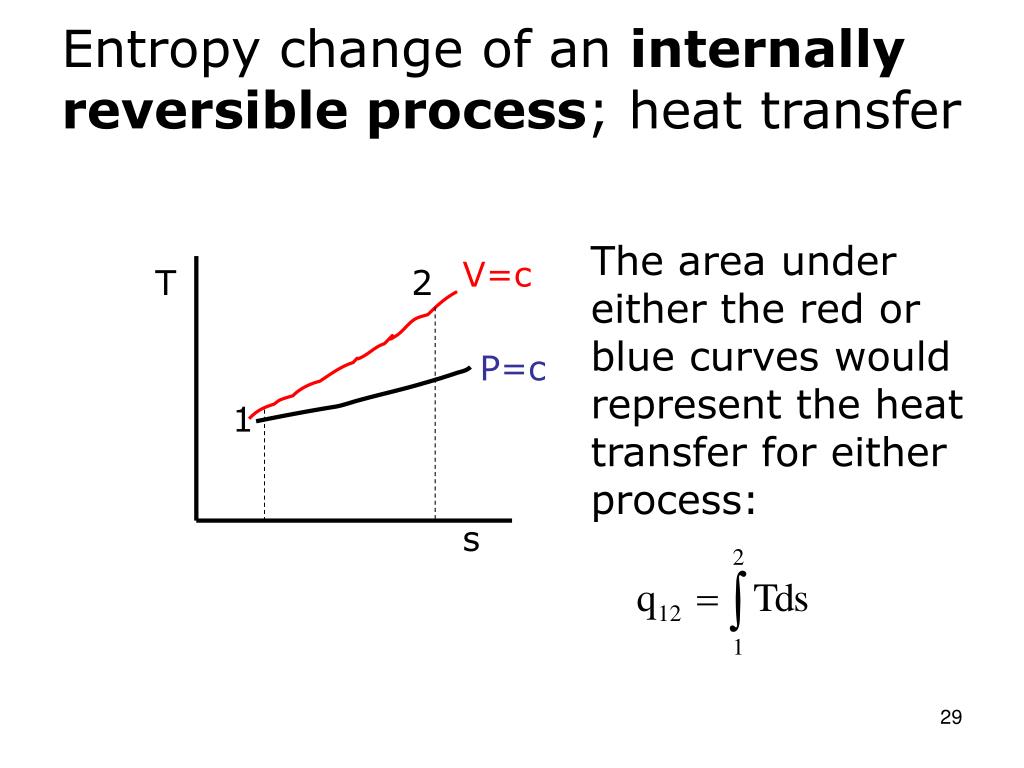
This is an incredibly useful way to visualize heat transfer in cycles, as we'll see many times in the future.
- An isothermal (constant temperature) process is a horizontal line on a T-S diagram.
- An adiabatic and reversible (no heat transfer) process has , which means . This is a vertical line on a T-S diagram. We call this special process isentropic (constant entropy).
Let's Do Some Calculations
Time to make this concrete with some problems.
Worked Problem 1: Melting Ice
Problem: Calculate the change in specific entropy when 1 kg of ice at 0°C melts into water at 0°C. The latent heat of fusion of water is 333.7 kJ/kg.
Solution:
- Identify the process: This is a phase change from solid to liquid at a constant temperature. We can model it as a reversible isothermal process.
- Identify the given values:
- Heat transferred, : This is the latent heat required to melt the ice, which is 333.7 kJ for 1 kg. Since heat is added to the system, is positive.
- Temperature, : The process occurs at 0°C. We MUST use absolute temperature, so K.
- Apply the formula: Since the temperature is constant, we can use the simple form of the equation. We are calculating specific entropy change (), so we use heat transfer per kg ().
- Calculate:
Interpretation: The entropy of the water increased. This makes perfect sense! The water molecules in a liquid are far more mobile and can be arranged in many more ways (more microstates) than in a rigid solid crystal. Energy has become more dispersed.
Worked Problem 2: Cooling Steam
Problem: A piston-cylinder device contains steam. It is cooled at a constant pressure of 101.3 kPa, which corresponds to a saturation temperature of 100°C. During the process, 2257 kJ of heat is removed, causing all the steam to condense into liquid water at 100°C. What is the entropy change of the water?
Solution:
- Identify the process: This is a phase change from vapor to liquid at constant temperature (100°C) and pressure. This is also a reversible isothermal process.
- Identify the given values:
- Heat transferred, : Heat is removed from the system, so kJ.
- Temperature, : The process occurs at 100°C. In absolute temperature, K.
- Apply the formula:
- Calculate:
Interpretation: The entropy of the water decreased significantly. This also makes sense. We went from a highly energetic, spread-out gas (steam) to a more constrained liquid. Energy was removed from the system, making it less dispersed.
Test your understanding!
Conceptual Question 1: You are camping. You have a small cup of hot chocolate at 80°C and a large pot of lukewarm soup at 30°C. If you leave both out in the cool night air, they will each lose 50 J of heat in the first minute. Which one experiences a larger magnitude of entropy change during that minute?
Show answer
The hot chocolate at 80°C (353.15 K) will experience a smaller magnitude of entropy change. The soup at 30°C (303.15 K) will experience a larger one.
The formula is . Since (-50 J) is the same for both, the one with the smaller temperature in the denominator will have a larger absolute value for .
- For the chocolate: J/K.
- For the soup: J/K.
This again reinforces that heat transfer has a bigger "entropic impact" at lower temperatures.
Test your understanding!
Conceptual Question 2: An ideal gas expands isothermally, doing work on a piston. Since the process is isothermal, the internal energy of the ideal gas doesn't change (). According to the First Law (), this means . The gas does positive work, so it must absorb an equal amount of heat. What happens to the entropy of the gas?
Show answer
The entropy of the gas increases.
Since the gas absorbs heat ( is positive) and the temperature is positive, the entropy change must be positive. Even though the energy content of the gas () didn't change, the gas expanded to a larger volume. Its energy became more dispersed (spread out over a larger volume), corresponding to an increase in entropy.
Key Takeaways
Let's pause and recap. This was a math-heavy but crucial step.
- We discovered from the Carnot cycle that for any reversible cycle, the sum of is zero. This motivated the definition of a new property: Entropy ().
- The mathematical definition for the change in entropy is .
- This formula is a calculation tool. Entropy is a property, so its change between two states is fixed. We use an imaginary reversible path to calculate that change.
- The in the denominator is key: adding heat to a cold system increases entropy more than adding the same heat to a hot system. This is the mathematical reason heat flows from hot to cold.
- On a T-S diagram, the area under the curve of a reversible process represents the heat transferred.
Preview of the Next Lesson
We've successfully defined and calculated the entropy change for a system. But what about the entropy change of the surroundings? And most importantly, what happens to the total entropy of the universe (system + surroundings) when we deal with real, irreversible processes like friction, or heat transfer across a finite temperature difference?
In our next lesson, we will answer that question by introducing the Increase of Entropy Principle. This powerful principle is the ultimate statement of the Second Law of Thermodynamics and will finally give us the tool to determine whether a process is possible, impossible, or ideal. See you then