Hello! Welcome back.
In our last conversation, we established a crucial idea: the isentropic process is the "perfect," theoretical benchmark for real-world devices. We saw on h-s diagrams that due to real-world messiness like friction and turbulence (what we call irreversibilities), a real turbine always produces less work than its perfect, isentropic counterpart.
This naturally leads to the question: "How much less?"
If an engineer designs a turbine for a power plant, they can't just say, "it will produce less work than ideal." They need a number. They need to quantify its performance. Today, we're going to learn how to do just that.
Our goal is to define and calculate the isentropic efficiency of a turbine. This single number is one of the most important metrics in engineering, as it tells us exactly how good a real turbine is at its job compared to the absolute best it could possibly be under the laws of thermodynamics.
What is Isentropic Efficiency? A Performance Score
Imagine you're judging a weightlifting competition. The theoretical maximum weight a human could possibly lift (based on biomechanics, etc.) is, say, 500 kg. A lifter comes up and successfully lifts 450 kg. How would you "score" their performance? A natural way would be to create a ratio:
Score = (What they actually lifted) / (The maximum possible lift) = 450 / 500 = 0.9 or 90%.
That 90% immediately tells you how close they got to perfection.
Isentropic efficiency for a turbine works the exact same way. It's a performance score. We compare the work we actually get out of a real turbine to the work we could have gotten from a perfect, isentropic turbine operating under the same conditions.
So, the definition is simple:
Here, (the Greek letter 'eta' with a subscript 'T' for turbine) is the isentropic efficiency. Because the actual work is always less than the ideal work (thanks to the Second Law), this value will always be less than 1 (or 100%). A typical efficiency for a large, modern steam turbine might be around 90% ().
From Work to Enthalpy: The Calculation Formula
This definition is great conceptually, but how do we calculate it? We need to find expressions for the actual and isentropic work.
Let's recall the First Law for an open system (our turbine). Assuming it's well-insulated (adiabatic) and changes in kinetic and potential energy are negligible, the work output per unit of mass () is simply the drop in specific enthalpy ():
We can apply this to both our real and our ideal cases:
- Actual Work: The fluid enters at state 1 and exits at the actual state 2a. So, .
- Isentropic Work: The fluid enters at state 1 and exits at the ideal isentropic state 2s. So, .
Now, we just plug these back into our efficiency definition:
This is our main tool for this lesson! Let's visualize what's happening on the h-s diagram we saw last time.
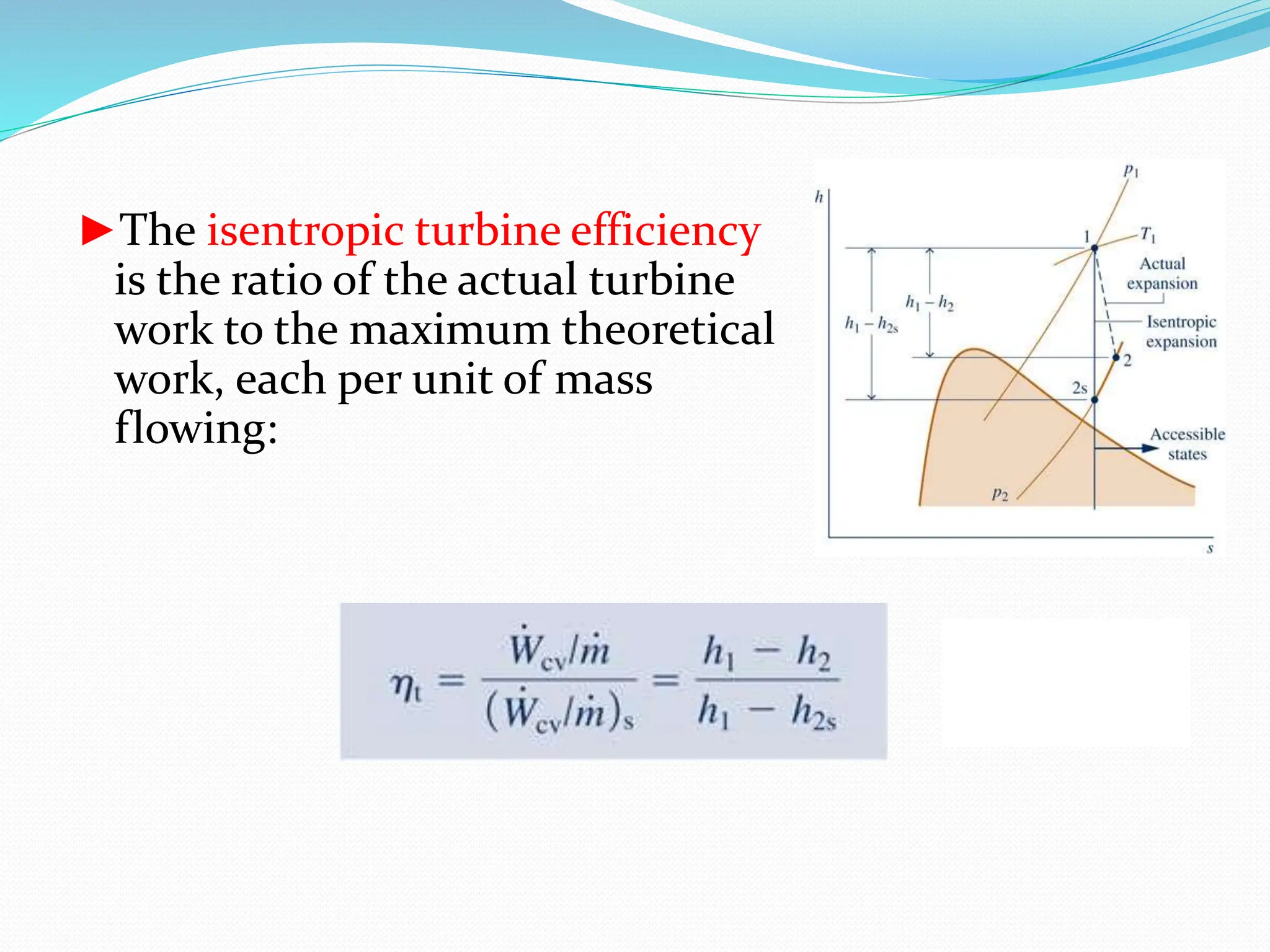
As you can see:
- The denominator, , is the ideal work—the largest possible drop in enthalpy.
- The numerator, , is the actual work—the smaller drop we get in reality.
- The difference, , represents the "lost work" that was converted into additional internal energy by friction, making the exhaust fluid hotter than it would have been ideally.
To really solidify this concept, let's watch a short video that walks through this derivation and visualization.
Turbines, Compressors, and Pumps - ISENTROPIC EFFICIENCY in 8 Minutes!
This video, from the 'Less Boring Lectures' channel, provides a concise and clear explanation of turbine isentropic efficiency, including the h-s diagram we just discussed.
Please watch from 0:21 to 2:53. The first part gives the definition, and the second part uses the h-s diagram to derive the enthalpy formula. Notice how the logic perfectly matches what we've just laid out.
The Step-by-Step Method for Solving Problems
Now let's turn this into a practical, repeatable method. Most often, you'll be given the turbine's efficiency and asked to find the actual work it produces. Here's how to do it:
- Fix State 1 (Inlet): You'll have the inlet pressure () and temperature (). Use these to find the specific enthalpy and specific entropy from your property tables (e.g., steam tables).
- Find the Ideal Exit State (2s): You'll know the exit pressure (). For the ideal process, you also know that . With these two properties ( and ), you can find the ideal exit enthalpy, .
- Calculate the Isentropic Work (): Now that you have both enthalpies for the ideal case, calculate the maximum possible work: .
- Calculate the Actual Work (): Use the given isentropic efficiency () to find the actual work. Rearrange the efficiency formula: .
- (Optional but useful) Find the Actual Exit State (2a): You can now find the actual exit enthalpy using . With and , you can find other properties of the actual exhaust, like its temperature.
Let's put this method to the test.
Worked Numerical Problems
Problem 1: An Ideal Gas Turbine
Let's tackle a problem involving an ideal gas. This example comes directly from the video we just referenced.
Problem Statement: Argon gas enters an adiabatic turbine at 750°C and 1.6 MPa. It exits at 180 kPa. The mass flow rate is 75 kg/min, and the actual power generated by the turbine is 330 kW. What is its isentropic efficiency?
(For Argon, you can use a specific heat at constant pressure kJ/kg·K and a specific heat ratio .)
Step-by-Step Solution
This problem is a bit different from our 5-step guide because it gives us the actual work and asks for the efficiency. The logic is the same, though. We need to find the ideal work and compare it to the given actual work.
1. Define Knowns and Goal:
- Inlet (State 1): K, .
- Exit (State 2): .
- Actual Power: .
- Mass flow rate: .
- Goal: Find .
2. Find the Ideal Exit Temperature ():
For an isentropic process with an ideal gas, we can use the temperature-pressure relation we learned previously:
Let's calculate the exponent first: .
Now, solve for :
3. Calculate the Isentropic Power Output ():
For an ideal gas with constant specific heats, the change in enthalpy is . The isentropic work per unit mass is:
To get the total isentropic power, we multiply by the mass flow rate:
This is the maximum power this turbine could possibly produce.
4. Calculate the Isentropic Efficiency ():
Now we just use the definition:
So, the isentropic efficiency of the turbine is 85.2%.
Problem 2: A Steam Turbine
Now for a more common scenario: a turbine in a steam power plant. Here, we must use steam tables instead of ideal gas equations.
Problem Statement: Superheated steam enters an adiabatic turbine at 8 MPa and 500°C. The steam exits the turbine at a pressure of 30 kPa. The isentropic efficiency of the turbine is given as 88%. Find the actual work output per unit mass (kJ/kg).
Step-by-Step Solution
Let's follow our 5-step guide exactly.
1. Fix State 1 (Inlet):
- We are given and .
- We go to the superheated steam tables. At , we look for the row corresponding to .
- From the tables, we find:
2. Find the Ideal Exit State (2s):
- We know the exit pressure is .
- For the ideal isentropic process, .
- Now we go to the saturated steam tables at . We look up the entropy values for saturated liquid () and saturated vapor ().
- Since our entropy is between and (), we know the ideal exit state is a saturated liquid-vapor mixture. We must find its quality, .
- Now we can find the ideal exit enthalpy, , using this quality. From the same table row at 30 kPa, we find kJ/kg and kJ/kg.
3. Calculate the Isentropic Work ():
This is the absolute maximum work we could get from 1 kg of steam under these conditions.
4. Calculate the Actual Work ():
- We are given the efficiency, .
The actual work output of the turbine is 996.0 kJ/kg.
Test your understanding!
Using the results from Problem 2, what is the actual enthalpy of the steam leaving the turbine ()? Will the actual steam leaving the turbine be "wetter" (lower quality) or "drier" (higher quality) than the ideal steam?
Show answer
First, let's find the actual enthalpy, . We know , so:
Now, let's find the actual quality, , using this enthalpy at the exit pressure of 30 kPa.
The actual quality is , while the ideal quality was .
Therefore, the actual steam leaving the turbine is drier (has a higher quality, meaning less liquid water droplets) than the ideal steam would have been. This makes sense: the "lost work" stayed in the steam as thermal energy, vaporizing more of the liquid.
Conceptual Questions
Let's pause and think about the core concepts.
1. Two turbines (A and B) operate with identical steam entering at the same state and exiting to the same pressure. Turbine A has an isentropic efficiency of 92%, and Turbine B has an efficiency of 85%.
- (a) Which turbine produces more actual work?
- (b) Which turbine has a higher temperature at its exit?
Answer:
- (a) Turbine A produces more work. A higher efficiency means it converts a larger fraction of the ideal work into actual work.
- (b) Turbine B has a higher exit temperature. Lower efficiency means more of the potential work was lost to irreversibilities (friction). This "lost work" becomes internal energy, resulting in a higher enthalpy and thus a higher temperature (or quality) at the exit.
2. An inventor shows you a design for a new adiabatic turbine. They claim it can achieve an isentropic efficiency of 102%. Should you invest in their company?
Answer:
No, you should not invest. An isentropic efficiency greater than 100% means the device produces more work than is theoretically possible (). This would violate the Second Law of Thermodynamics. It's the energy equivalent of claiming you built a car that gets better-than-perfect mileage.
3. Why do we want the numerator of the turbine efficiency formula to be and the denominator to be ?
Answer:
The goal of an efficiency metric is to be a number less than or equal to 1 that represents performance. For a work-producing device like a turbine, the ideal case produces more work than the actual case. To keep the ratio less than 1, we must put the smaller quantity (actual work) on top of the larger quantity (ideal work). This gives us a meaningful percentage of perfection.
Key Takeaways for Today
Fantastic! We've put a real number on the performance of real turbines.
- Isentropic Efficiency () is a performance score for a turbine, defined as the ratio of the actual work it produces to the ideal (isentropic) work it could produce.
- The formula is .
- In terms of properties we can look up, this becomes .
- On an h-s diagram, this is the ratio of the actual enthalpy drop to the ideal (vertical) enthalpy drop.
- Because of irreversibilities, is always less than 1. The lost work ends up as extra heat in the exhaust fluid.
Preview of the Next Lesson
We've mastered how to grade a work-producing device (a turbine). What about a work-consuming device, like a compressor or a pump? The goal there isn't to get work out, but to put in as little work as possible. How do we define an efficiency for that?
In our next lesson, we will do just that. We will define and calculate the isentropic efficiency for compressors and pumps. The logic will be almost identical, but with one tiny, crucial twist in the formula. See you then