Hello! Welcome to the final lesson in our module on limits and continuity.
In our last session, we established a formal definition for continuity. We learned that a function is continuous at a point if the limit exists, the function is defined at that point, and the limit equals the function's value: . We also saw that functions can fail to meet this condition in several ways, resulting in "breaks," "jumps," or "holes" in their graphs.
Today, our goal is to formally classify these different types of discontinuities. By the end of this lesson, you will be able to identify and distinguish between removable, jump, and infinite discontinuities, both from a graph and from a function's equation. This will wrap up our study of continuity and prepare us for the next major topic in calculus.
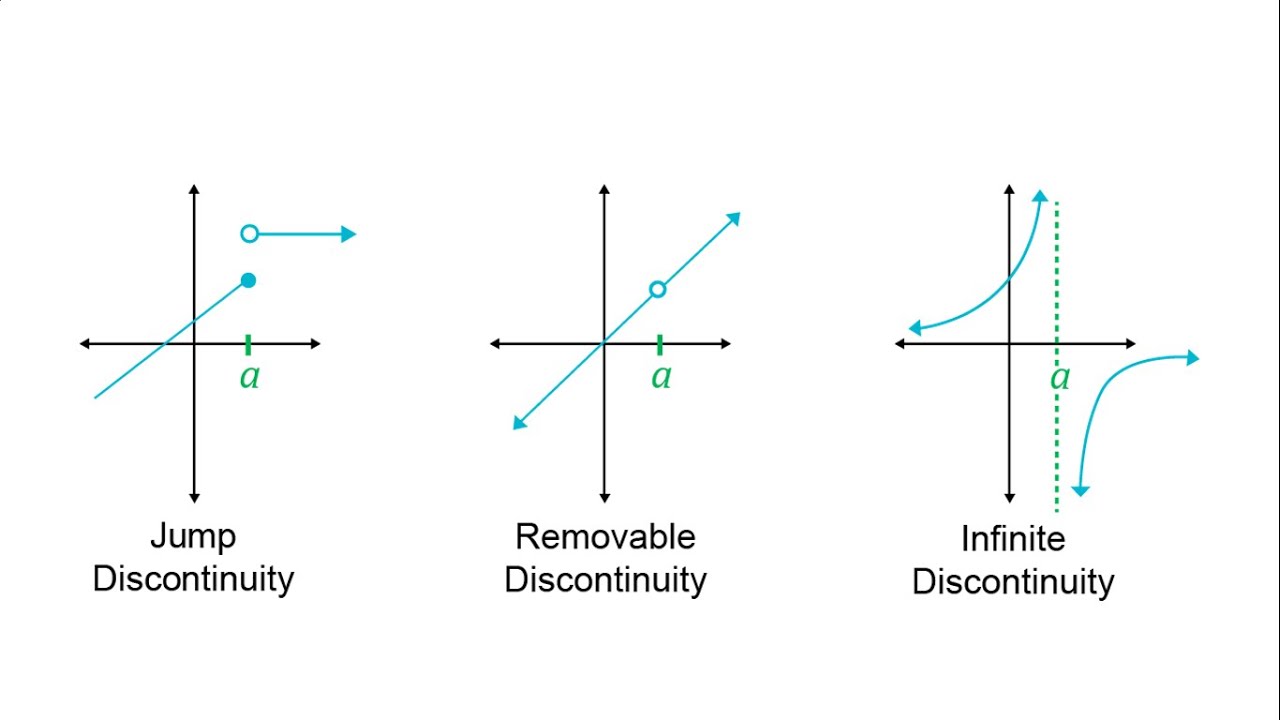
Let's begin with a quick visual overview of the three main types of discontinuities we'll be discussing.
1. An Intuitive Overview of Discontinuities
Before diving into the formal definitions, it's helpful to get a clear visual and intuitive feel for each type of discontinuity.
Let's watch a short video that provides a quick, clear introduction to these three categories.
Continuity Basic Introduction, Point, Infinite, & Jump Discontinuity, Removable & Nonremovable
This video from The Organic Chemistry Tutor provides a straightforward introduction to the three main types of discontinuities. It clearly distinguishes between removable and non-removable types.
Please watch the first 1 minute and 27 seconds of the video. Focus on the visual differences between a 'hole', a 'jump', and an 'infinite' discontinuity.
As the video explains, we classify discontinuities into three main types. They are also grouped into two broader categories:
- Removable Discontinuity: This is the "hole" in the graph. It's called removable because we could, in theory, "plug the hole" by defining or redefining the function's value at that single point to make it continuous. In some texts, this is also called a point discontinuity.
- Non-Removable Discontinuities: These are more severe breaks that cannot be fixed by changing a single point. This category includes:
- Jump Discontinuity: The function "jumps" from one value to another.
- Infinite Discontinuity: The function shoots off towards positive or negative infinity. This happens at a vertical asymptote.
2. Formal Definitions: Connecting Discontinuities to Limits
Now, let's connect these intuitive ideas back to the formal, limit-based definition of continuity we learned in the last lesson. A function is discontinuous at because the condition fails. The way it fails determines the type of discontinuity.
The OpenStax resource below provides the formal definitions. We will then use a video from Khan Academy to explore the reasoning behind them.
2.4 Continuity - Calculus Volume 1
The 'Calculus Volume 1' textbook from OpenStax gives precise, limit-based definitions for each type of discontinuity. This provides the formal mathematical foundation for what we are learning.
Read the section titled 'Types of Discontinuities,' focusing on the formal definitions provided for removable, jump, and infinite discontinuities. Don't worry about the examples yet; we will cover those.
Now, let's watch a video that explains how these definitions arise from the three conditions for continuity.
Types of discontinuities | Limits and continuity | AP Calculus AB | Khan Academy
This Khan Academy video does an excellent job of explaining why each type of discontinuity violates the definition of continuity. It connects the visual graph to the behaviour of the limits.
Watch from the start until 7:14. Pay close attention to how each type of discontinuity relates to the existence of the two-sided limit and the value of the function.
Let's summarise the key ideas from these resources:
-
Removable (Point) Discontinuity:
- What happens: The two-sided limit exists (it's a finite number).
- Why it's discontinuous: This limit is not equal to the function's value . This could be because is undefined, or because has a different value entirely.
- It's "removable" because the function is heading towards a specific point; the hole is the only problem.
-
Jump Discontinuity:
- What happens: The one-sided limits, and , both exist as finite numbers, but they are not equal.
- Why it's discontinuous: Because the left-hand and right-hand limits differ, the overall two-sided limit does not exist.
- The function "jumps" because it approaches two different values from the left and the right.
-
Infinite Discontinuity:
- What happens: At least one of the one-sided limits is infinite. That is, or .
- Why it's discontinuous: The limit does not exist as a real number; the function is unbounded.
- This occurs at a vertical asymptote.
3. How to Find and Classify Discontinuities from an Equation
We now have the theoretical tools. Let's move on to the practical skill of identifying and classifying discontinuities directly from a function's formula. This is particularly relevant for the types of functions you've worked with before, like rational and piecewise functions.
Let's return to the video from The Organic Chemistry Tutor, as it provides excellent, straightforward examples of this process.
Continuity Basic Introduction, Point, Infinite, & Jump Discontinuity, Removable & Nonremovable
This part of the video demonstrates the practical steps for finding discontinuities in rational and piecewise functions.
Watch from 1:27 to 7:13. Pay attention to the different algebraic techniques used for rational functions (factorising and cancelling) versus piecewise functions (checking the 'break points').
Here's a summary of the methods for different function types:
For Rational Functions
- Find potential discontinuities: Set the denominator equal to zero and solve for . These are the only points where the function might be discontinuous.
- Factorise everything: Factorise both the numerator and the denominator .
- Classify the discontinuities:
- If a factor in the denominator is cancelled out by a matching factor in the numerator, there is a removable discontinuity (a hole) at .
- If a factor remains in the denominator after simplification, there is an infinite discontinuity (a vertical asymptote) at .
For Piecewise Functions
- Check the individual pieces: Look at the formula for each piece of the function. If any piece is a rational function, check it for discontinuities using the method above. Make sure any such discontinuity falls within the domain specified for that piece.
- Check the "break points": The most likely places for discontinuities are the -values where the function's definition changes. For a break point at :
- Calculate the left-hand limit: (by plugging into the formula for ).
- Calculate the right-hand limit: (by plugging into the formula for ).
- If the limits are finite but not equal, you have a jump discontinuity.
- If the limits are equal, check the function's actual value, . If is different from the limit or undefined, you have a removable discontinuity.
Test your understanding!
Find all points of discontinuity for the following functions and classify each one as removable, jump, or infinite.
Show answer
-
For :
- Potential discontinuities: Set the denominator to zero: .
- Factorise: . The potential discontinuities are at and .
- Factorise the whole function: .
- Classify:
- The factor cancels. Therefore, there is a removable discontinuity at .
- The factor remains in the denominator. Therefore, there is an infinite discontinuity at .
-
For :
- Check the pieces: The pieces and are polynomials, so they are continuous everywhere. The only place a discontinuity can occur is at the break point.
- Check the break point at :
- Left-hand limit: .
- Right-hand limit: .
- Classify: The left and right-hand limits both exist but are not equal (). Therefore, there is a jump discontinuity at .
Conclusion
This lesson concludes our introduction to limits and continuity. By building on the formal definition of continuity, we have created a robust system for classifying the different ways a function can fail to be continuous.
Key Takeaways:
- Discontinuities are classified based on the behaviour of the limits around the point in question.
- A removable discontinuity (or point discontinuity) occurs when the two-sided limit exists but is not equal to the function's value. These are the "holes" in a graph.
- A jump discontinuity occurs when the left- and right-hand limits both exist as finite numbers but are not equal.
- An infinite discontinuity occurs when at least one of the one-sided limits approaches or . This corresponds to a vertical asymptote.
- We can use algebraic techniques like factorising (factoring) for rational functions and comparing one-sided limits for piecewise functions to identify and classify these discontinuities.
You have now built a solid foundation in the concepts of limits and continuity. These ideas are the bedrock upon which calculus is built. In our next module, we will take our first major step into differential calculus by defining the derivative. You will see how limits are used to define the gradient (slope) of a tangent line to a curve, opening up a powerful new way to analyse (analyze) the rate at which functions change.