Hello! Welcome to the start of a new and exciting module. In our previous work, we delved deep into the concept of limits, culminating in classifying different types of discontinuities in functions. You saw how limits describe a function's behaviour near a point. We are now going to use that powerful idea to answer a fundamental question that has puzzled mathematicians for centuries: how do we find the gradient (or slope) of a curve?
For a straight line, the gradient is constant. But for a curve, the steepness changes at every single point. Today's lesson will equip you with the foundational tool of calculus to solve this problem. Our learning outcome is to define the derivative as the limit of a difference quotient. This definition, also known as "differentiation from first principles," is the bedrock upon which all of differential calculus is built.
1. The Gradient of a Secant Line
Before we can find the gradient at a single point on a curve, let's start with something we can calculate: the gradient between two points. A line that passes through two points on a curve is called a secant line.
Finding the gradient of this secant line is a standard "rise over run" calculation. The challenge is to express this in the language of functions, which will allow us to generalise it.
To see how this is done, let's watch a video that builds the formula from the ground up.
Prologue to Calculus (3 of 5: The difference quotient)
In this video, 'Prologue to Calculus (3 of 5: The difference quotient),' Eddie Woo provides a clear, step-by-step construction of the formula for the gradient of a secant line.
Watch from the beginning to 4:58. Pay close attention to how he labels two general points on a curve, (x, f(x)) and (x+h, f(x+h)), and uses them to derive the 'rise over run' formula. He calls this the 'difference quotient'.
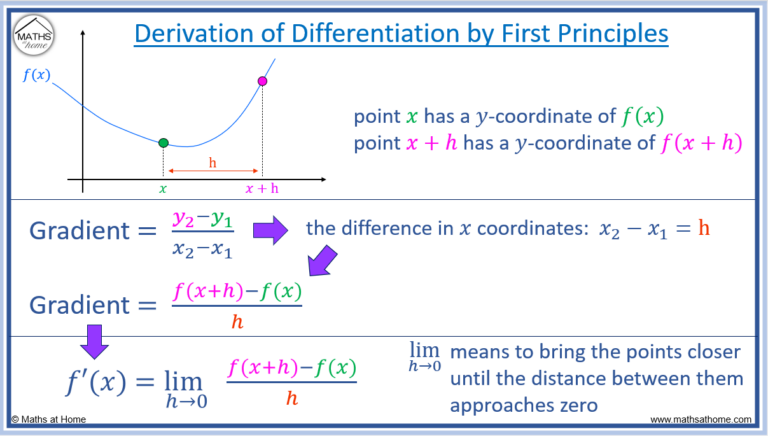
As the video explains, if we have two points on the graph of a function :
- Point 1:
- Point 2: , where is a small change in .
The gradient of the secant line connecting them is:
This expression, , is fundamental to calculus and is called the difference quotient. It represents the average rate of change of the function between the points and .
2. From Secant to Tangent: The Limit
The difference quotient gives us the gradient of a secant line through two points. But our goal is to find the gradient of the curve at a single point. This is the gradient of the tangent line—a line that just touches the curve at that one point.
How can we get from the secant to the tangent? Imagine moving the second point closer and closer to the first point. As the two points merge into one, the secant line pivoting through them will become the tangent line.
In our formula, moving the points closer together means making the distance between them, , smaller and smaller. This is precisely what the concept of a limit is for!
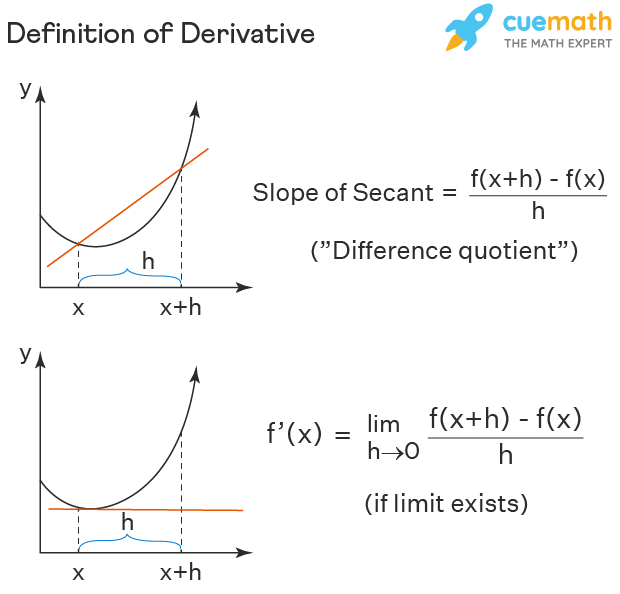
By taking the limit of the difference quotient as approaches zero, we find the exact gradient of the tangent line at the point . This limit has a special name: the derivative.
This process is formally called differentiation from first principles.
1.4.1 Differentiation from first principles | OpenLearn
This page from OpenLearn, 'Differentiation from first principles,' provides a concise summary of the method.
Please read the section titled 'Differentiation from first principles'. Focus on the summary box that presents the formal definition of the derivative using limit notation.
As stated in the resource, the derivative of a function , denoted (read as "f prime of x" or "f dash of x"), is defined as:
This formula defines the derivative as the limit of the difference quotient. It gives us a function, , that tells us the gradient of the original function, , for any value of .
3. Calculating a Derivative from First Principles
Now, let's use this definition to actually calculate a derivative. The classic first example is the parabola . We will substitute this function into the limit definition and use algebra to evaluate it.
The process involves four main steps:
- Substitute: Write down the difference quotient for the specific function.
- Expand and Simplify: Expand any brackets and simplify the numerator. You should find that the
f(x)term cancels out. - Factorise and Cancel: Factorise out of the numerator and cancel it with the in the denominator.
- Evaluate the Limit: Substitute into the simplified expression.
Let's watch a detailed walkthrough of this calculation.
Applying First Principles to x² (1 of 2: Finding the Derivative)
In this video, 'Applying First Principles to x²,' Eddie Woo masterfully demonstrates the algebraic process of finding the derivative of f(x) = x².
Watch the video from the beginning to 9:30. The first part (to 3:16) reviews the definition. The main calculation happens from 3:16 onwards. Pay close attention to his explanation (starting around 6:15) of why we are allowed to cancel the 'h' terms—it connects directly back to our work on limits!
Let's recap the steps for :
-
Substitute:
-
Expand and Simplify:
-
Factorise and Cancel:
As Eddie Woo explained, we can cancel because in a limit, gets infinitesimally close to 0 but is never actually equal to 0. -
Evaluate the Limit:
So, the derivative of is . This is a remarkable result! It gives us a formula to find the gradient of the parabola at any point. For instance, at , the gradient is . At , the gradient is .
Test your understanding!
Let's apply the "first principles" method to a linear function, .
Use the four-step process to find the derivative, . What do you notice about the result? Does it match what you already know about the gradient of a straight line?
Show answer
-
Substitute:
-
Expand and Simplify:
-
Factorise and Cancel:
-
Evaluate the Limit:
The derivative is 5. This makes perfect sense! The function is a straight line, and from your prior algebra knowledge, you know its gradient is always 5. The derivative correctly gives us this constant gradient.
Conclusion
In this lesson, you have taken your first and most important step into differential calculus. We have bridged the gap between the geometry of lines and the analysis of functions using limits.
Key Takeaways:
- The gradient of a secant line passing through two points on a function is given by the difference quotient: .
- The derivative, , is defined as the limit of the difference quotient as approaches 0. It represents the gradient of the tangent line at a single point .
- The formal definition is: .
- The process of finding a derivative using this definition is called differentiating from first principles.
This "first principles" method is foundational, but as you might guess, it can be lengthy for more complex functions. In the lessons to come, we will first explore the physical meaning of the derivative as an instantaneous rate of change. Then, we will develop a set of powerful rules and shortcuts that allow us to find derivatives much more efficiently, without having to evaluate a limit every time.