Hello! Welcome to our next lesson in calculus.
In our last few lessons, we've focused on the concept of a limit, which describes how a function behaves as its input approaches a certain value. We've used limits to handle indeterminate forms and to understand the end behaviour of functions. Today, we'll use this powerful tool to give a precise mathematical definition to a very intuitive idea: continuity.
You probably have a sense of what a "continuous" process is—something that happens smoothly, without any abrupt jumps, breaks, or gaps. In mathematics, we often describe a continuous function as one whose graph you can draw without lifting your pen from the paper. In this lesson, we will formalise that idea. Our goal is to define continuity at a specific point and then extend that definition to cover an entire interval.
This concept is a cornerstone of calculus, forming the foundation for many of the major theorems we will encounter later.
1. What Does It Mean for a Function to be Continuous at a Point?
Let's start with the intuitive "no-lift-pencil" rule. If a function's graph has no holes or jumps at a particular point, we feel it should be continuous there. But how do we capture this with the precision of mathematics?
For a function to be continuous at a point where , three conditions must be met:
- The function must be defined at the point. In other words, must exist. You can't have continuity at a location where the function doesn't even have a value.
- The limit of the function must exist at the point. That is, must exist. This means the function must be approaching the same value from both the left and the right.
- The limit and the function value must be the same. The value the function is approaching must be the same as the value it actually has at that point.
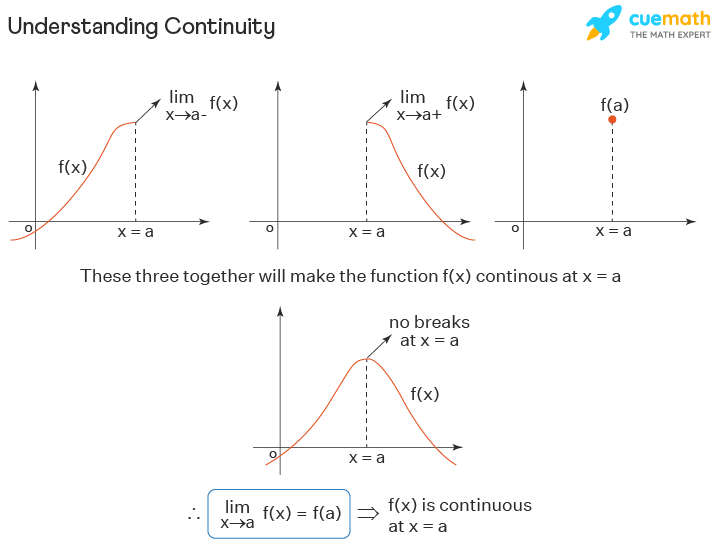
Putting it all together gives us the formal definition:
A function is continuous at a point if:
This single equation elegantly packs all three conditions into one. The existence of the right-hand side, , implies condition 1. The existence of the left-hand side, the limit, implies condition 2. And the equality itself is condition 3.
The image below breaks this down visually.
To see this definition in action, let's watch a video that explores what happens when a function meets these conditions, and more importantly, what happens when it fails.
Continuity at a point | Limits and continuity | AP Calculus AB | Khan Academy
This video from Khan Academy provides a great intuitive start and then walks through the formal definition of continuity at a point. It uses graphical examples to show a continuous function, a function with a 'hole' (a removable discontinuity), and a function with a 'jump' discontinuity.
Watch the entire video. Pay attention to how each of the three examples either satisfies or violates the formal definition of continuity.
As the video showed, a function can fail to be continuous in several ways:
- A "hole" occurs if the limit exists but is not equal to the function's value, or if the function is not defined at that point.
- A "jump" occurs if the limit from the left and the limit from the right are different, meaning the two-sided limit does not exist.
Test your understanding!
Consider the function shown in the graph below. Is continuous at ? Explain why or why not using the three conditions for continuity.

Show answer
The function is not continuous at . Let's check the three conditions:
- Is defined? Yes, the filled circle shows that .
- Does exist? To check this, we need the one-sided limits:
- From the left:
- From the right:
Since the left-hand limit and the right-hand limit are not equal, the two-sided limit does not exist.
- Since condition 2 fails, we don't even need to check condition 3. The function is not continuous at . This is an example of a jump discontinuity.
2. Continuity on an Interval
Now that we can define continuity at a single point, we can extend the idea to an entire interval.
Open Intervals
This is the straightforward case. A function is continuous on an open interval (like ) if it is continuous at every single point in that interval.
Closed Intervals
This is a bit more subtle. For a closed interval (like ), we need the function to be continuous at every point inside the interval, but what about at the endpoints, and ?
At the left endpoint , we can't evaluate a full two-sided limit because the function isn't defined to the left of . We only care about how it behaves as we approach from the right. This leads to the idea of continuity from the right.
A function is continuous from the right at if:
Similarly, at the right endpoint , we only care about the approach from the left.
A function is continuous from the left at if:
Putting this all together, we get the full definition for continuity on a closed interval.
A function is continuous on a closed interval if:
- is continuous on the open interval .
- is continuous from the right at .
- is continuous from the left at .
The following reading provides a well-structured summary of these definitions.
Continuity Over an Interval: Explanation, Example, Equation
The article 'Continuity Over an Interval' from StudySmarter clearly lays out the definitions for continuity from the left and right, and then provides a systematic definition for continuity on an interval. It's a good textual reference for the concepts we are discussing.
Please read the section titled 'Continuity of a Function Over an Interval'. Focus on the definitions of continuity from the right and left, and how they are combined with the definition of continuity on an open interval to define continuity on a closed interval.
This next video does an excellent job of illustrating these ideas with graphs, which can make the distinction between open and closed intervals much clearer.
Continuity over an interval | Limits and continuity | AP Calculus AB | Khan Academy
This Khan Academy video builds directly on the last one, explaining continuity over both open and closed intervals. It highlights why we need the concept of one-sided continuity for the endpoints of closed intervals.
Watch the entire video. Pay close attention to the distinction between how continuity is handled for an open interval versus a closed interval, especially in the examples starting around the 6:30 mark.
3. Intervals of Continuity
Often, our goal is not just to check one interval, but to describe all the intervals on which a function is continuous. This essentially means finding the function's domain and then checking for any points within that domain where a discontinuity might occur (like jumps or holes).
For many of the functions you're familiar with, this is quite straightforward.
- Polynomials are continuous everywhere, on the interval .
- Rational functions (a polynomial divided by another polynomial) are continuous everywhere except at the roots of the denominator, where division by zero occurs.
Let's look at a quick example.
Where is the function continuous?
This is a rational function, so it is continuous everywhere on its domain. Its domain is all real numbers except where the denominator is zero. To find these points, we solve the equation:
Factorising (factoring) the quadratic gives:
The roots are and .
Therefore, the function is discontinuous at and . The intervals of continuity are , , and .
Conclusion
In this lesson, we have moved from an intuitive understanding of continuity to a rigorous, limit-based definition. This precision is essential for the concepts that follow in calculus.
Key Takeaways:
- A function is continuous at a point if the limit as approaches exists, the function value exists, and these two values are equal: .
- A function is continuous on an open interval if it's continuous at every point in the interval.
- A function is continuous on a closed interval if it's continuous on AND continuous from the right at and from the left at .
- Many familiar functions, like polynomials and rational functions, are continuous on their entire domains.
In the next lesson, we will take a closer look at the different ways a function can fail to be continuous. We will give formal names to the "holes" and "jumps" we saw today and learn how to classify different types of discontinuities.