Hello! Welcome to our next lesson in calculus.
In the previous lesson, we developed a powerful toolkit of algebraic methods—like factorising (factoring) and rationalising—to solve limits that resulted in the indeterminate form . Those techniques were all focused on what happens as approaches a specific, finite number, .
Today, we're going to ask a different kind of question: what happens to the value of a function as the input grows without any bound? This lesson will focus on evaluating limits involving infinity and identifying horizontal asymptotes. We'll explore the "end behaviour" of functions and discover how limits provide a precise way to describe it. This concept is fundamental to understanding the large-scale behaviour of graphs and has practical applications in fields from engineering to computer science, where we often need to know the long-term or steady-state outcome of a system.
1. The Concept of a Limit at Infinity
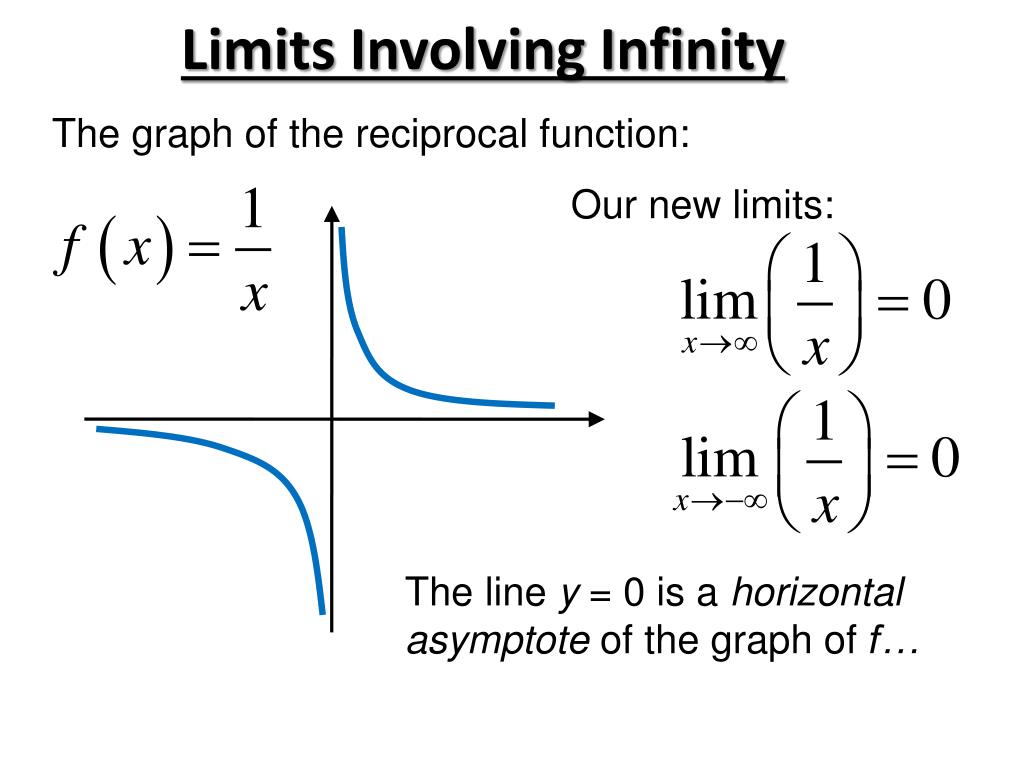
Let's start with a simple, intuitive idea. Consider the function . What happens to the value of as gets bigger and bigger?
- If ,
- If ,
- If ,
As increases, gets closer and closer to 0. We say that the limit of as approaches infinity is 0, and we write this as:
The same thing happens as becomes a very large negative number:
Graphically, this means the curve of the function gets closer and closer to the horizontal line (the x-axis) as we look far to the right or far to the left. This line is called a horizontal asymptote.
Let's get a more formal definition of this connection.
Limits at Infinity and Asymptotes: Meaning
The article 'Limits at Infinity and Asymptotes: Meaning' from StudySmarter provides a clear definition of limits at infinity and their direct relationship to horizontal asymptotes.
Please read the sections titled 'Limits at Infinity and Asymptotes meaning', 'Connection between limits at infinity and Horizontal Asymptotes', 'Limits at Infinity and Asymptotes - Key takeaways', and the 'Frequently Asked Questions'. Focus on understanding that a horizontal asymptote is simply a graphical representation of a finite limit as x approaches positive or negative infinity.
Definition: The line is a horizontal asymptote of the graph of a function if either
2. Evaluating Limits of Rational Functions at Infinity
For a simple function like , the limit is obvious. But what about a more complex rational function, like ?
The key algebraic technique is to divide both the numerator and the denominator by the highest power of that appears in the denominator. This helps us because it creates many terms of the form , which we know go to 0 as approaches infinity.
Let's solve :
- The highest power of in the denominator is .
- Divide every term in the expression by :
- Now, we apply the limit. As , both and approach 0.
So, . This tells us that the function has a horizontal asymptote at .
The following video walks through this formal process for different types of rational functions.
Limits at Infinity & Horizontal Asymptotes
This video from The Organic Chemistry Tutor, 'Limits at Infinity & Horizontal Asymptotes,' provides a methodical, step-by-step guide to this division technique.
Watch from 2:59 to 9:23. The first part (2:59 - 5:33) covers a 'bottom-heavy' function, where the limit is 0. The second part (5:33 - 9:23) covers functions where the degrees are equal, confirming the method we just used.
The Shortcut: Comparing Degrees
The division method always works, but it leads to a convenient shortcut for rational functions. All you need to do is compare the degree (the highest index or power) of the polynomial in the numerator () with the degree of the polynomial in the denominator ().
- If (bottom-heavy): The denominator grows faster than the numerator. The limit is 0.
- Example:
- If (balanced): The numerator and denominator grow at the same rate. The limit is the ratio of the leading coefficients.
- Example:
- If (top-heavy): The numerator grows faster than the denominator. The limit is or (the limit does not exist as a finite number). There is no horizontal asymptote.
- Example:
This next video explains these rules very efficiently.
Calculus AB/BC – 1.15 Limits at Infinity and Horizontal Asymptotes
The Algebros channel presents these rules in a very direct way, focusing on comparing the growth rates of the numerator and denominator.
Watch from 1:33 to 2:27 and from 4:07 to 6:04. This will solidify the three rules for rational functions and show you several examples in quick succession.
Test your understanding!
Find the limit and identify the horizontal asymptote for the function as .
Show answer
The degree of the numerator is 3, and the degree of the denominator is 3. Since the degrees are equal, the limit is the ratio of the leading coefficients.
The leading coefficient of the numerator is 8.
The leading coefficient of the denominator is -2.
The horizontal asymptote is the line .
3. More Complex Cases
Functions with Square Roots
When dealing with square roots, we use the same division technique, but with a twist. To divide a term inside a square root by , you must bring it inside the root as . For example, .
Things get particularly interesting when . Remember that for negative , . This sign difference is crucial.
- When (i.e., ), .
- When (i.e., ), .
This can lead to a function having two different horizontal asymptotes: one for and another for .
Calculus AB/BC – 1.15 Limits at Infinity and Horizontal Asymptotes
Let's return to The Algebros video, which has an excellent segment on this exact issue.
Watch carefully from 6:04 to 9:26. Pay close attention to example #8, where the limit as x approaches positive infinity is different from the limit as x approaches negative infinity due to the square root.
Other Function Types
- Exponential Functions: The limit of as is , but as it's 0. The opposite is true for .
- Trigonometric Functions: Functions like and oscillate and do not approach any single value as . Therefore, does not exist. However, if it's part of a fraction like , the limit becomes 0. This is because the numerator is "squeezed" or "sandwiched" between -1 and 1 while the denominator grows to infinity.
Test your understanding!
Evaluate the following limit:
Show answer
- The highest power of in the denominator is . We divide the numerator and denominator by .
- Because , we have , so .
- Now, we can evaluate the limit. As , the terms and both go to 0.
Conclusion
Today, we've extended our understanding of limits to encompass the infinite. By analysing the end behaviour of functions, we can determine their long-term trends and identify the horizontal asymptotes that guide their graphs.
Key Takeaways:
- Limits at infinity describe the value a function approaches as grows infinitely large or small.
- If , then the line is a horizontal asymptote.
- For rational functions, the limit at infinity is determined by comparing the degrees of the numerator and denominator.
- The shortcut for rational functions is:
- Bottom-heavy: Limit is 0.
- Balanced: Limit is the ratio of leading coefficients.
- Top-heavy: Limit is or (no horizontal asymptote).
- Be especially careful with functions involving square roots when evaluating limits at , as the sign can change.
In our next lesson, we will use our complete understanding of limits to define one of the most important concepts in calculus: continuity. We'll finally give a precise mathematical meaning to the idea of a function whose graph can be drawn without lifting your pen from the paper.