Hello! Welcome back.
In our last lesson, we established the limit laws and saw their most powerful consequence: the Direct Substitution Property. For many common, well-behaved functions, finding the limit is as easy as plugging the value into the function. However, we ended with a question: what happens when direct substitution yields the meaningless expression ?
This lesson tackles that exact problem. Our learning outcome is to evaluate limits of functions using algebraic techniques, such as factorising (factoring) and rationalising. We will treat not as an error, but as a signal that we need to do some algebraic manipulation before we can find the limit.
1. The Indeterminate Form:
When direct substitution gives you , this is known as an indeterminate form. It's crucial to understand that this is not the answer. It doesn't mean the limit is 0, 1, or that it doesn't exist. It simply means the method of direct substitution failed, and we need a more clever approach.
Think of it as a "race to zero" between the numerator and the denominator. The final value of the limit depends on how the two expressions approach zero relative to each other. To find the answer, we must simplify the function to resolve this ambiguity.
The following reading provides a formal introduction to this concept.
Lesson Explainer: Evaluating Limits Using Algebraic Techniques
Let's start by reading a formal explanation of the indeterminate form from Nagwa's 'Lesson Explainer: Evaluating Limits Using Algebraic Techniques'. This will clarify why we can't stop when we see 0/0.
Read the first part of this explainer, up to but not including 'Example 1'. Focus on the distinction between a limit that does not exist (like a non-zero number over zero) and an indeterminate form (0/0), which requires more work.
2. Technique 1: Factorising and Cancelling
This is your primary tool for dealing with indeterminate forms in rational functions (one polynomial divided by another).
The logic is rooted in the Factor Theorem, which you've encountered before. If substituting into a polynomial gives you zero, then must be a factor of that polynomial. So, if both the numerator and denominator of a rational function become zero at , they must share a common factor of . This common factor is the source of our problem.
Our strategy is:
- Factorise the numerator and denominator.
- Cancel the common factor .
- Evaluate the limit of the simplified function using direct substitution.
This works because the simplified function is identical to the original at every point except at , and the limit doesn't care about the value precisely at that point.
The following video provides excellent examples of this technique.
Calculus 1 - Introduction to Limits
This video from The Organic Chemistry Tutor demonstrates how to evaluate limits by factoring. It covers a basic example with a difference of squares and a more advanced one with a difference of cubes.
Watch the sections from 0:00 to 3:22 and 4:04 to 5:58. Notice how in each case, cancelling the problematic factor makes direct substitution possible.
Example: Find .
- Direct Substitution: . Indeterminate form.
- Factorise: The numerator is a difference of two squares, , which factors to .
- Cancel: We cancel the common factor .
- Evaluate: Now, use direct substitution on the simplified expression.
So, .
As a quick refresher, here are some common factorisation patterns.
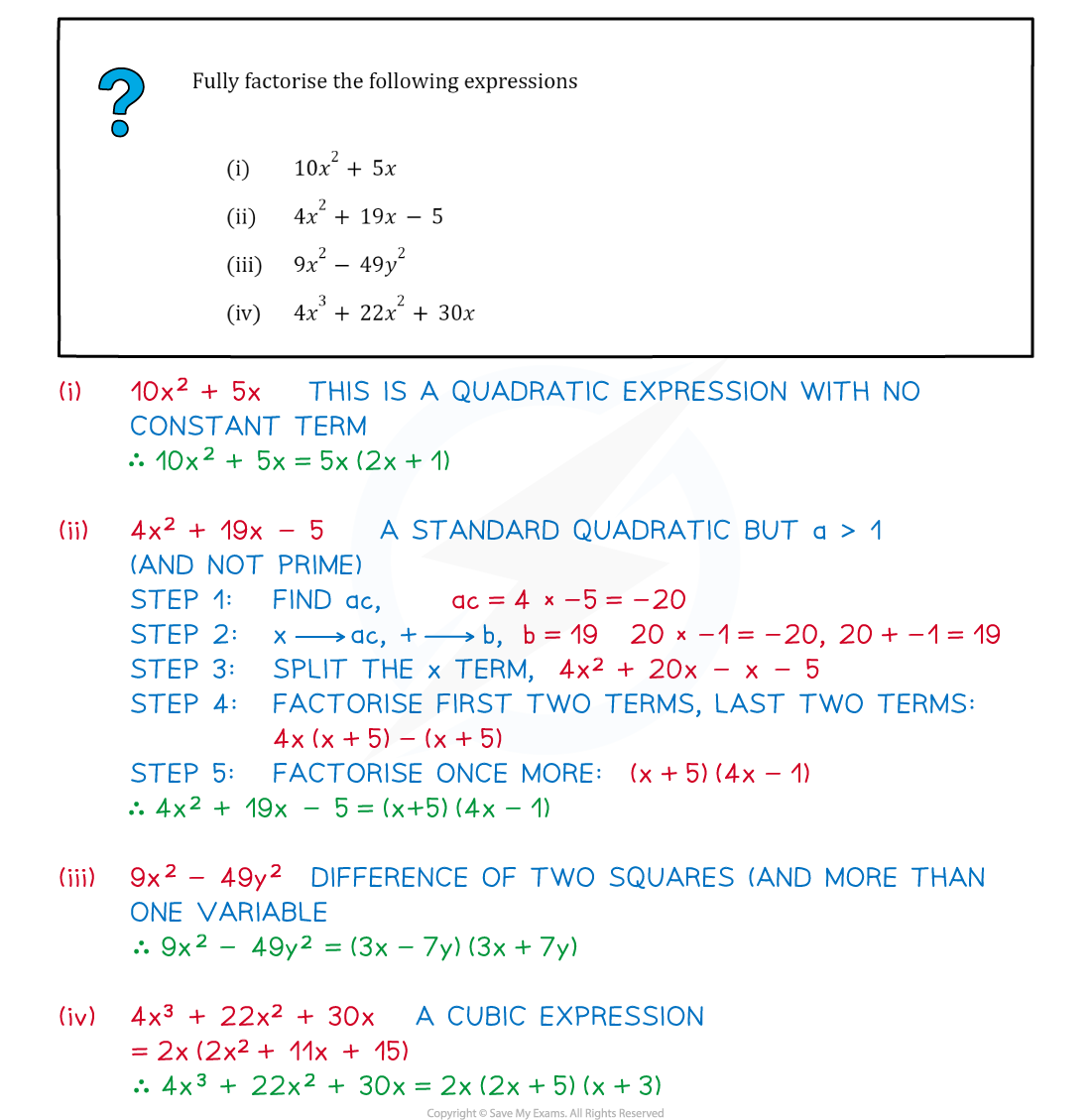
Test your understanding!
Evaluate the limit:
Show answer
- Direct Substitution: . Indeterminate.
- Factorise: The quadratic numerator factors into .
- Cancel: Cancel the common factor .
- Evaluate: Using direct substitution, we get .
3. Technique 2: Rationalising with the Conjugate
When you encounter an indeterminate form involving a square root, factorising is often not an option. Instead, we use a technique called rationalising. This involves multiplying the numerator and denominator by the conjugate of the expression containing the root.
The conjugate of an expression like is . The magic of this is that when you multiply them, you get , which eliminates the square root.
The strategy is:
- Identify the expression with the square root that is causing the zero (e.g., ).
- Multiply both the numerator and the denominator by its conjugate (e.g., ).
- Simplify the expression. A common factor should appear.
- Cancel the common factor and evaluate the new limit by direct substitution.
Let's watch this technique in action.
Calculus 1 - Introduction to Limits
Let's return to the video from The Organic Chemistry Tutor. This segment shows how to use the conjugate to solve a limit problem with a square root.
Watch the section from 8:10 to 10:12. Pay close attention to how multiplying by the conjugate transforms the numerator, which then allows for cancellation.
Here is a static image showing a complete worked example of this process.

Test your understanding!
Evaluate the limit:
Show answer
- Direct Substitution: . Indeterminate.
- Rationalise: The conjugate of the numerator is . We multiply the numerator and denominator by this.
- Simplify:
- Cancel: Cancel the common factor .
- Evaluate: Now use direct substitution.
4. Technique 3: Simplifying Complex Fractions
Sometimes an indeterminate form arises from a complex fraction (a fraction that has fractions in its numerator or denominator).
The strategy here is to first simplify the fraction into a standard rational form:
- Find the least common denominator (LCD) of the "mini-fractions".
- Combine the mini-fractions into a single fraction.
- The expression should now be a standard rational function, where you can often use factorising and cancelling to find the limit.
The same video we've been using demonstrates this technique well.
Calculus 1 - Introduction to Limits
Finally, let's watch one more clip from the same video, this time focusing on complex fractions. This will round out our algebraic toolkit.
Watch the section from 5:58 to 8:10. Observe how multiplying by the common denominator of the 'mini-fractions' simplifies the entire expression.
Conclusion
Today we built a systematic strategy for solving limits that result in the indeterminate form . Instead of giving up, we now have a powerful set of algebraic tools to resolve the ambiguity.
Key Takeaways:
- Always start with direct substitution. If it gives a real number, you are done.
- If you get , it's an indeterminate form, which is a signal to do more work.
- Your algebraic toolkit includes:
- Factorising and Cancelling: Your go-to for rational functions.
- Rationalising with the Conjugate: Used for expressions involving square roots.
- Simplifying Complex Fractions: Used to turn a fraction-within-a-fraction into a simpler form.
- After applying one of these techniques, the goal is always to create a new, equivalent expression where direct substitution now works.
In the next lesson, we will explore another type of limit: limits that involve infinity. We will investigate what happens to functions as grows infinitely large or small and introduce the concept of horizontal asymptotes, which you may have seen when studying rational functions.