Hello! Welcome back to our journey into calculus.
In our last lesson, we developed an intuition for the concept of a limit. We saw how to estimate a limit by building tables of values (the numerical approach) and by inspecting a function's graph (the graphical approach). While these methods are great for understanding the idea of a limit, they aren't always precise.
Today, we move from estimating to calculating. The learning outcome for this lesson is to apply the limit laws to compute limits of combinations of functions. These laws are the formal rules of the road for limits. They provide a systematic, algebraic toolkit that allows us to break down complex functions and find their limits with perfect accuracy. This systematic approach is the foundation for much of calculus and should feel familiar given your background in IT and logical systems.
1. The Basic Toolkit: The Limit Laws
The core idea behind the limit laws is simple: if we know the limits of individual functions, we can easily find the limits of their sums, differences, products, and so on.
This image provides a concise summary of the fundamental laws we will be working with today.
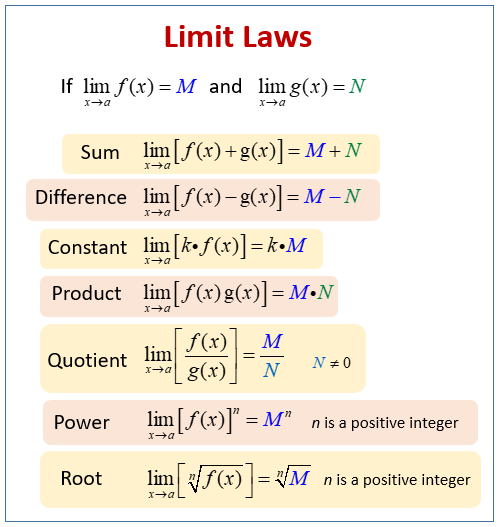
To get a more intuitive feel for what these laws mean and why they work, the following video explains them one by one. The presenter refers to them as the "granddaddies" because they form the basis for everything else.
Learn Calculus Limit Laws - The Key to Solving Problems | Step-by-Step
Please watch the first part of the video 'Learn Calculus Limit Laws' from the Math and Science channel. This will introduce the five most common limit laws.
Watch from the beginning until the timestamp 6:25. Focus on understanding the Sum, Constant Multiple, Difference, Product, and Quotient Rules. Notice how these rules formalise the intuitive idea of 'plugging in' values that we've discussed before.
Let's formally state these primary laws. Suppose we know that and , where and are real numbers.
- Sum Rule: The limit of a sum is the sum of the limits.
- Difference Rule: The limit of a difference is the difference of the limits.
- Constant Multiple Rule: We can "pull out" a constant from a limit.
- Product Rule: The limit of a product is the product of the limits.
- Quotient Rule: The limit of a quotient is the quotient of the limits, with one crucial condition.
The condition on the Quotient Rule is vital. If the limit of the denominator is zero, you cannot use this rule. This is a situation we will explore in detail in our next lesson.
Test your understanding!
Suppose you are given the following information:
Use the limit laws to find .
Show answer
We can break this down using the rules:
\begin{align*}
\lim_{x \to 5} [3f(x) - g(x)] &= \lim_{x \to 5} [3f(x)] - \lim_{x \to 5} [g(x)] \quad (\text{Difference Rule}) \
&= 3 \cdot \lim_{x \to 5} [f(x)] - \lim_{x \to 5} [g(x)] \quad (\text{Constant Multiple Rule}) \
&= 3 \cdot (10) - (-2) \
&= 30 + 2 = 32
\end{align*}
2. Extending the Toolkit: Powers and Roots
The five main laws can be extended to handle functions with powers (indices) and roots. These additional rules follow directly from the Product Rule.
Let's return to the same video to see these explained.
Learn Calculus Limit Laws - The Key to Solving Problems | Step-by-Step
Now, let's watch the next segment of the 'Learn Calculus Limit Laws' video. This part covers powers, roots, and some fundamental building-block limits.
Watch from the timestamp 7:46 to 13:09. Pay attention to how the Power Rule (for powers/indices) and Root Rule are just extensions of what we've already learned. Also note the three very simple but important limits: the limit of a constant, the limit of x, and the limit of x to a power.
Here is a summary of these additional laws:
- Power Rule: The limit of a function raised to a power is the limit of the function, raised to that same power.
- Root Rule: The limit of an -th root of a function is the -th root of its limit.
(We must be careful here. If is even, we require ).
These laws depend on two simple, foundational limits:
- (The limit of a constant is just the constant itself).
- (The limit of as it approaches is, unsurprisingly, ).
An Important Caveat: All these laws only work if the individual limits and actually exist as finite numbers. If does not exist, you cannot use the Product Rule to claim that is "". You would have to investigate the combined function itself.
3. The Big Payoff: Direct Substitution
Now for the most practical result of all these laws. When you combine them, you discover a powerful shortcut for a huge category of functions. For any polynomial function, like , calculating the limit is as simple as evaluating the function at the point.
This idea extends beyond polynomials to what we can call "nice enough" functions. The following reading from Paul's Online Math Notes explains this shortcut and lists the types of functions for which it works.
The real power of the limit laws is that they justify a simple method of 'direct substitution' for many common functions. This reading explains this crucial consequence.
Read the sections 'Example 1', the first 'Fact' (about polynomials), the second 'Fact' (about 'nice enough' functions), and the list of 'nice enough' functions that follows. Focus on how the step-by-step application of limit laws in Example 1 leads to the simple conclusion that you can just plug in the value. The list of functions is your guide for when this shortcut is valid.
To summarise that key point from the reading:
The Direct Substitution Property
For many common functions (including polynomials, rational functions where the denominator isn't zero, trigonometric functions, root functions, exponential, and logarithmic functions), if the point is in the domain of the function, then:
This is the main method you will use to compute limits from now on. The limit laws are the rigorous proof that this simple method works.
4. Practice with the Laws
Let's see these laws in action. The following video provides several clear, worked examples where the limits of the basic functions are given, and the goal is to find the limit of a combination.
This video from The Organic Chemistry Tutor demonstrates how to apply the limit properties in a step-by-step fashion to solve typical problems.
Watch from the beginning to the timestamp 4:47. Observe how each problem is broken down using the limit laws before the final values are substituted.
Now let's try one ourselves using the Direct Substitution Property.
Example: Calculate .
- Identify the function type: This is a rational function (a polynomial divided by a polynomial).
- Check the domain: The function is defined for all except where the denominator is zero, i.e., . Since we are interested in the limit as , and 2 is in the domain, the function is "nice enough" at this point.
- Apply Direct Substitution: We can simply plug in .
It's that straightforward! The limit laws do all the heavy lifting in the background to guarantee this result.
Test your understanding!
Given that and , calculate the following limit:
Show answer
We apply the limit laws step by step:
\begin{align*}
\lim_{x \to 4} \frac{\sqrt{f(x)}}{g(x) + 7} &= \frac{\lim_{x \to 4} \sqrt{f(x)}}{\lim_{x \to 4} (g(x) + 7)} \quad (\text{Quotient Rule}) \
&= \frac{\sqrt{\lim_{x \to 4} f(x)}}{\lim_{x \to 4} g(x) + \lim_{x \to 4} 7} \quad (\text{Root Rule and Sum Rule}) \
&= \frac{\sqrt{16}}{-3 + 7} \quad (\text{Substituting known values}) \
&= \frac{4}{4} = 1
\end{align*}
Note that we could use the Quotient Rule because the limit of the denominator is , which is not zero. We could use the Root Rule because the limit of the function inside the square root is 16, which is positive.
Conclusion
In this lesson, we have built a powerful and precise algebraic toolkit for working with limits. Instead of estimating, we can now calculate exact values.
Here are the key takeaways:
- The Limit Laws (Sum, Difference, Product, Quotient, Constant Multiple, Power, and Root) allow us to break down complicated limits into simpler ones.
- These laws are only valid if the individual limits exist and any special conditions (like a non-zero denominator) are met.
- The most significant consequence of the limit laws is the Direct Substitution Property: for most well-behaved functions, the limit at a point in their domain can be found by simply evaluating the function at that point.
So, what happens when direct substitution fails? For instance, what if we try to calculate ? Plugging in gives us the meaningless expression . This is called an "indeterminate form." In our next lesson, we will learn the algebraic techniques, like factorising (factoring), needed to solve exactly these kinds of limits.