Hello! Welcome to the first of many lessons where we will explore the practical applications of the derivative.
In our previous lessons, you've built up an impressive toolkit for finding the derivative, , for all sorts of functions, even complex implicit ones. We've established that the derivative represents the instantaneous rate of change, or the gradient (slope) of a function at a specific point.
Today, we will use that knowledge to achieve a fundamental and highly useful goal: finding the equation of a tangent line to a curve at a given point. This is one of the most direct and visual applications of differentiation.
1. The Tangent and the Derivative
A tangent line is a straight line that "just touches" a curve at a single point, matching the curve's direction at that exact spot.
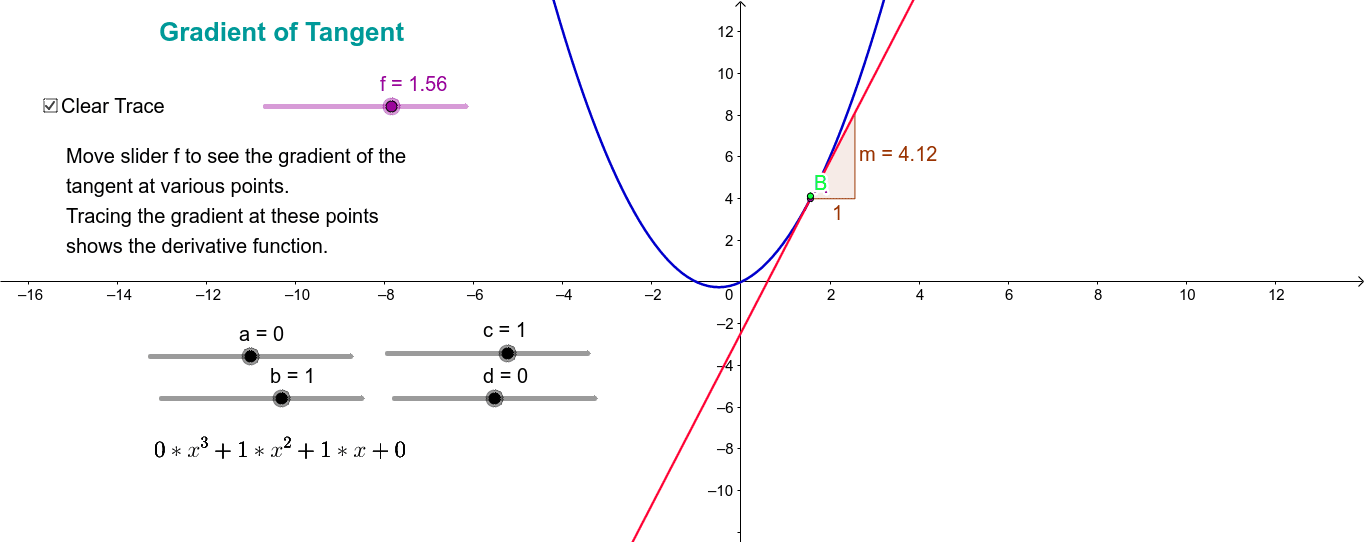
This image shows a curve (in blue) and its tangent line (in red) at point B. The gradient 'm' of this red line is precisely what the derivative of the blue curve calculates at that specific point.
The central idea of this lesson is simple but powerful:
The gradient of the tangent line to a function at the point is equal to the value of the derivative at that point, .
Since a tangent is a straight line, we only need two pieces of information to find its equation:
- A point on the line, .
- The gradient of the line, .
Our process will be to find these two things and then use them to write the equation of the line.
2. The Step-by-Step Method
Let's say we want to find the equation of the tangent to the curve at the point where .
Here is the general recipe:
-
Find the Point: We have the x-coordinate, . To find the y-coordinate, we simply substitute this value into the original function: . This gives us our point .
-
Find the Gradient: We first differentiate the function to find the gradient function, . Then, we substitute our x-coordinate into the derivative to find the specific gradient of the tangent line: .
-
Find the Equation: With a point and a gradient , we can construct the equation of the line. We will look at two common ways to do this.
Let's see this process in action.
Equation of Tangent Calculus Grade 12
This video clearly explains the core process: finding the gradient using the derivative, finding the corresponding y-coordinate, and then using the straight line equation y = mx + c to find the final equation.
Watch from the beginning to 4:23. The first part explains the theory, and the second part works through an example with the function f(x) = x³ - 2x² - 3x + 4 at x = 3.
As the video demonstrates, one way to find the final equation is to use the familiar form . After finding , you substitute the coordinates of your point to solve for the y-intercept, .
The following image provides a static summary of this exact process for a quadratic function.

*This image breaks down the process for the curve y = x² - x + 3 at the point (4, 15).
- Differentiate to find the gradient function:
dy/dx = 2x - 1. - Evaluate at x=4 to find the specific gradient of the tangent:
m = 2(4) - 1 = 7. - Use the point (4, 15) and gradient m=7 in the equation
y = mx + cto solve for the y-intercept,c:15 = 7(4) + c, which givesc = -13. - State the final equation:
y = 7x - 13.*
3. An Alternative: The Point-Gradient Formula
Another, often more direct, way to find the equation of a line is using the point-gradient formula (known as the point-slope formula in the US). If you have a point and a gradient , the equation is given by:
This formula is very convenient because you can simply plug in your values for , , and directly. Let's watch an example that uses this formula and also incorporates the quotient rule, which you've mastered in previous lessons.
How to Find the Equation of a Tangent Line with Derivatives (NancyPi)
This video demonstrates the point-gradient method. It also shows how to handle a more complex rational function that requires the quotient rule. Note that the presenter uses the American term 'slope' for gradient.
Watch the second example from 5:46 to 11:35. Pay attention to how the presenter first finds the derivative using the quotient rule, then finds the y-coordinate, and finally plugs everything into the y - y₁ = m(x - x₁) formula.
Both methods, y = mx + c and y - y_1 = m(x - x_1), will give you the same final answer. You can use whichever you find more comfortable.
Test your understanding!
Find the equation of the tangent line to the curve at the point where .
Show answer
-
Find the point: When , . So the point is .
-
Find the gradient: First, find the derivative: .
Now, evaluate the derivative at : . -
Find the equation: Using the point-gradient formula, :
This is the equation of the tangent line.
4. Working Backwards: Finding the Point from the Gradient
So far, we've started with a point and found the tangent. We can also solve the reverse problem: if we are given a desired gradient, we can find the point(s) on the curve that have a tangent with that gradient.
Equation of a tangent - Differentiation - BBC
This text from BBC Bitesize walks through exactly this scenario: starting with a known gradient and finding the point of contact on the curve.
Read 'Example 2' on the page. The problem is to find the point of contact for the curve y = 5x² - 2x + 3 when the gradient is 4/3. Notice how the process is reversed: you set the derivative equal to the known gradient and solve for x.
The process, as shown in the example, is:
- Find the derivative of the function, .
- Set this derivative equal to the known gradient, .
- Solve the equation for . There might be more than one solution.
- For each value of you find, substitute it back into the original function to find the corresponding y-coordinate.
This technique is useful for problems like "find where the tangent line is horizontal" (which means the gradient is 0) or "find where the tangent is parallel to the line " (which means the gradient is 5).
Conclusion
Congratulations on mastering your first major application of differentiation! You can now connect the abstract idea of a derivative to the concrete, geometric concept of a tangent line.
Key Takeaways:
- The derivative of a function at a point gives the gradient of the tangent line at that same point.
- To find the equation of a tangent line, you need to find a point on the line and its gradient.
- The process is:
- Find the y-coordinate using the original function .
- Find the gradient using the derivative .
- Combine them to form the line equation using either or .
- You can also work backwards, setting the derivative equal to a known gradient to find the point of tangency.
In our next lesson, we will continue to explore what the derivative tells us about the shape of a graph. We'll see how the sign of the derivative (positive or negative) tells us whether the function is increasing or decreasing.