Hello! Welcome to your next lesson on differentiation.
In all our work so far, from the power rule to the derivatives of trigonometric and exponential functions, we have dealt with explicit functions. These are functions written in the form , where the dependent variable is explicitly isolated on one side of the equation.
However, many important relationships in mathematics and science are not written this way. Consider the equation of a circle, . Here, and are interwoven. While you could solve for to get , this is cumbersome and splits the single, simple curve into two separate functions. These types of equations are called implicit relations.
Today, you will learn a powerful technique called implicit differentiation, which allows us to find the derivative directly from an implicit equation, without needing to solve for first.
1. Why We Need Implicit Differentiation
Let's start with the "why." Why can't we just use our existing rules? And what does it even mean to find a derivative when isn't a straightforward function of ? The following video provides a brilliant intuition for this.
Implicit differentiation, what's going on here? | Chapter 6, Essence of calculus
This video from 3Blue1Brown uses the example of a circle to explore the conceptual challenge of finding the gradient (slope) of an implicit curve and provides a beautiful way to think about what we're actually doing.
Please watch the following two segments: From the start (0:10) to 3:09, which sets up the problem. From 8:01 to 10:45, which explains the core idea of keeping the value of an expression constant. Focus on the idea that for a tiny step to stay on the curve, the change in the value of the expression x^2 + y^2 must be zero.
The key insight is that when we have an implicit equation like , we are interested in points that satisfy this condition. If we move a tiny amount along the curve, the values of and change, but they must change in such a way that the equation remains true. Implicit differentiation is the tool that captures this relationship between their rates of change.

2. The Mechanics of Implicit Differentiation
The intuitive idea of dx and dy from the video is formalised by applying our existing differentiation rules, with one crucial addition based on the Chain Rule.
The core principle is: Differentiate both sides of the equation with respect to .
- Terms with only : Differentiate as usual (e.g., ).
- Constant terms: Differentiate to zero (e.g., ).
- Terms with : This is the key step. Since we assume is some function of , we must use the Chain Rule.
To understand this, let's briefly revisit the chain rule.
This short text from mathcentre.ac.uk provides a clear and direct explanation of how the Chain Rule is the foundation for differentiating a function of y with respect to x.
Please read section 2, 'Revision of the chain rule'. Pay close attention to the example z = y^2 and the resulting 'Key Point' at the end of the section.
As the text explains, the rule is:
In simple terms: you differentiate the expression as if it were the variable, and then you multiply the result by .
- Example:
- Example:
The Step-by-Step Process
The entire process can be summarised in a few steps.
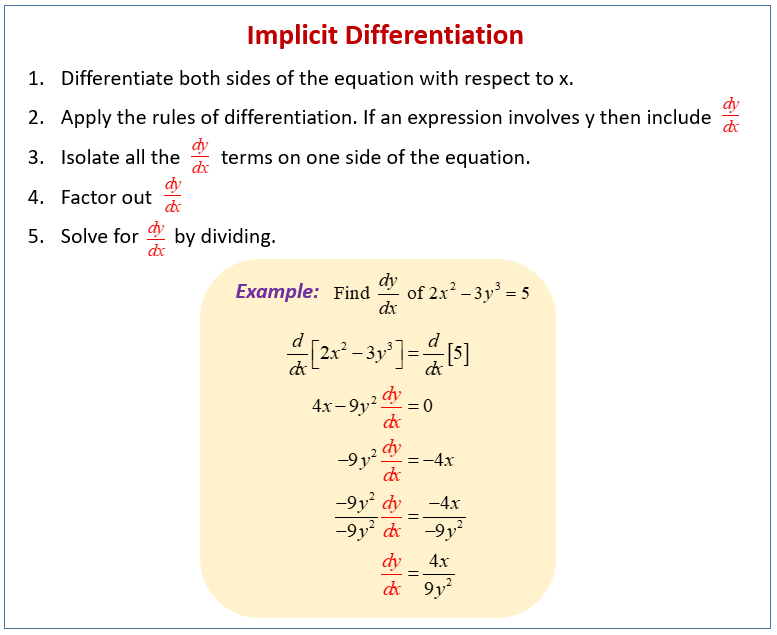
Here are the steps written out:
- Differentiate both sides of the equation with respect to .
- Apply all necessary rules (Power, Product, Quotient, etc.).
- For every term involving , apply the Chain Rule: differentiate with respect to and multiply by .
- Get all terms with on one side of the equation and all other terms on the other side.
- Factorise (factor) out .
- Solve for by dividing.
3. Worked Example
Let's see this process in action. The following video provides a clear, step-by-step walkthrough of a typical problem, making sure to explain the role of the Chain Rule.
Differentiation : Implicit Equations : ExamSolutions
This video from ExamSolutions demonstrates the mechanical process of implicit differentiation. The presenter uses British terminology, which you are familiar with.
Please watch from 1:11 to 9:11. The first part explains the theory of why we multiply by dy/dx, and the second part shows the algebraic rearrangement to find the final answer.
Let's work through one more example that involves the Product Rule. Find for the equation .
-
Differentiate both sides with respect to :
-
Apply the rules:
- The term is a product, so we use the product rule: . Here and .
- The term is standard: .
- The term requires the chain rule: .
- The term is a product, so we use the product rule: . Here and .
-
Combine everything:
-
Isolate terms:
-
Factorise out :
-
Solve for :
Notice that the final expression for the gradient depends on both and . This is typical for implicit differentiation. To find the numerical gradient at a specific point, you need both the x- and y-coordinates of that point.
Test your understanding!
Find for the equation .
Show answer
- Differentiate w.r.t. :
- Apply rules:
- Isolate term:
- Solve:
4. An Elegant Application: Deriving Other Derivative Rules
Implicit differentiation is not just for oddly shaped curves. It's a powerful theoretical tool that can be used to find the derivatives of inverse functions. In the last lesson, you learned that the derivative of is . We can prove this very elegantly using implicit differentiation.
Let's see how. We start with .
Implicit differentiation, what's going on here? | Chapter 6, Essence of calculus
To tie this back to our previous lesson, let's watch one more short clip from the 3Blue1Brown video. It demonstrates how to use implicit differentiation to derive the rule for the derivative of the natural logarithm, ln(x).
Watch from 12:33 to 14:24. Notice how rewriting y = ln(x) into its exponential form e^y = x is the key first step.
This method is a fantastic example of the interconnectedness of mathematical concepts. The same technique is used to find the derivatives of inverse trigonometric functions like and .
Conclusion
You have now added another major technique to your differentiation toolkit. Implicit differentiation frees you from the constraint of only working with explicit functions of the form .
Key Takeaways:
- Implicit functions are equations where is not explicitly isolated.
- To differentiate implicitly, you differentiate both sides with respect to .
- The crucial step is applying the Chain Rule to any term containing : .
- After differentiating, you rearrange the equation algebraically to solve for .
- The resulting expression for the gradient often depends on both and .
In our next lesson, we will begin exploring the many applications of the derivative. Our first application will be a natural follow-on from this topic: using the derivative to find the equation of the tangent line to a curve at a specific point.