Hello! Welcome back to our exploration of new function families.
In our last lesson, we introduced exponential functions of the form . We saw how these functions model rapid growth or decay and are defined by their base a and the variable x being in the index (exponent).
A natural question arises from this: If we have an equation like , we are asking, "To what power must we raise the base 2 to get 16?" You can probably work out that . But what if the equation was ? The answer for x is not a simple whole number. We need a new tool to solve for an unknown index.
Today's lesson addresses this exact problem. Our learning outcome is to define the logarithm as the inverse of an exponential function and convert between logarithmic and exponential forms. This new concept, the logarithm, is the key to "unlocking" the variable from the index.
1. What is a Logarithm? An Intuitive Introduction
Before we dive into formal definitions, let's build an intuition for what a logarithm is. At its heart, a logarithm is simply another way of thinking about indices (powers).
Introduction to Logarithms (1 of 2: Definition)
The video 'Introduction to Logarithms (1 of 2: Definition)' by Eddie Woo provides an excellent way to think about this. He frames the components of an exponential expression in terms of a 'growth rate' (the base), 'time' (the index), and the 'final result'. A logarithm simply rearranges the question to solve for the 'time'.
Watch from the beginning to 07:52. Pay close attention to how he rephrases the exponential relationship base^time = result into the logarithmic question: 'If you know the growth rate and the final result, how much time did it take?' This is the core idea of a logarithm.
As Eddie Woo explained, the logarithm is the index. The two statements below are equivalent ways of expressing the same relationship between the numbers 2, 5, and 32:
- Exponential Form: ("2 raised to the power of 5 equals 32")
- Logarithmic Form: ("The logarithm to base 2 of 32 equals 5")
The logarithm answers the question: "What index do I need to put on the base to get the result?"
2. The Formal Definition and Conversion
Let's formalise this relationship. This is one of the most important definitions in this part of the course, as everything else about logarithms builds on it.
The document 'Logarithms' from mathcentre.ac.uk provides a concise and clear definition. We will focus on the first page which lays out the key point.
Please read the section '3. What is a logarithm?' on page 2. Focus on the 'Key Point' box that shows the general equivalence. Notice how the base of the power becomes the base of the logarithm.
To summarise the key definition from the resource:
If , then equivalently
Here's a breakdown of the terminology:
ais the base.nis the index (or power, or exponent).xis the result, which in the context of logarithms is often called the argument.
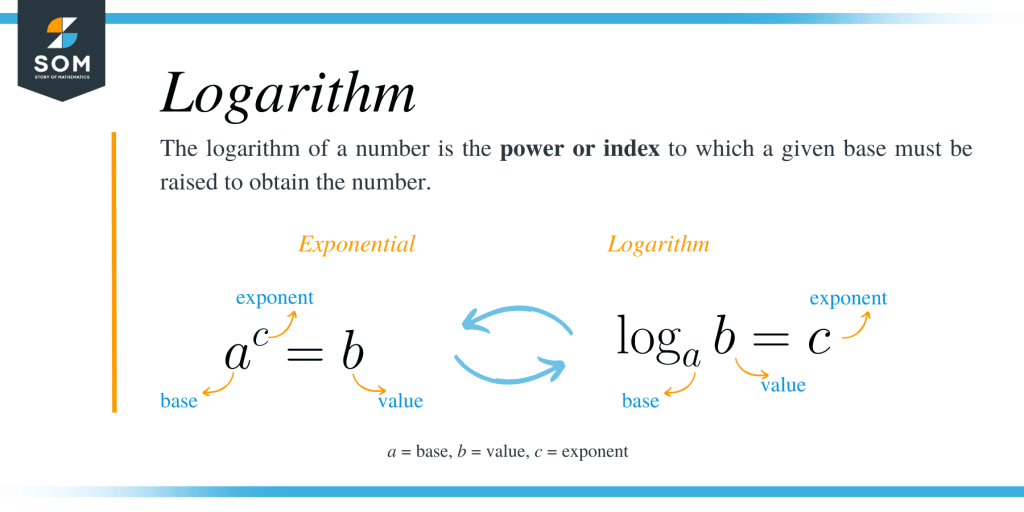
Let's practice converting between these two forms.
From Exponential to Logarithmic:
- Identify the base, index, and result. In , the base is 5, the index is 3, and the result is 125.
- Write the logarithm. The logarithm is the index, so we write
= 3. - Add the base and argument. The base of the power (5) becomes the subscript base of the log. The result (125) becomes the argument.
From Logarithmic to Exponential:
- Identify the base, index, and result. In , the base is 7, the argument is 49, and the value of the log (the index) is 2.
- Write the exponential equation. Start with the base (7), raise it to the index (2), and set it equal to the argument (49).
Test your understanding!
- Convert the equation into logarithmic form.
- Convert the equation into logarithmic form.
- Convert the equation into exponential form.
- Convert the equation into exponential form.
Show answer
- (Remember that an index of 1/2 means the square root)
3. Logarithms as Inverse Functions
In Module 3, we learned that an inverse function "undoes" the original function. To find an inverse algebraically, we swap the x and y variables and solve for the new y. Let's see what happens when we try this with an exponential function, .
- Start with the function:
- Swap
xandy: - Now, try to solve for
y. How do we getyout of the index?
This is precisely where our new notation comes in. The statement is equivalent to . So, the inverse of the exponential function is the logarithmic function .
This inverse relationship is also clear graphically. The graph of an inverse function is a reflection of the original function's graph across the line .
6) Inverse of exponential | Part 1
This video, 'Inverse of exponential | Part 1' from Kevinmathscience, demonstrates this inverse relationship visually.
Watch from 02:29 to 04:22. He takes the coordinates of an exponential graph, swaps them to plot the inverse, and then shows how the equation of this new graph is found using logarithmic notation.
The following image provides a fantastic summary of this inverse relationship, showing how the coordinates, domain, and range are swapped between an exponential function and its logarithmic inverse.

Because they are inverses, applying an exponential function and then a logarithm with the same base (or vice-versa) brings you back to where you started.
Let's return to the 'Logarithms' PDF and read the section that formalises this inverse property.
Please read section '13. Inverse operations' on page 9. This section demonstrates how raising a base to a power and taking a logarithm to that same base are operations that cancel each other out.
This gives us the following crucial identities:
4. Common and Natural Logarithms
While a logarithm can have any valid base, two bases are so frequently used that they have special names and notation.
Introduction to indices and logs
This document, 'Introduction to indices and logs', explains these two special bases. We are interested in the section discussing base 10 and base e.
On page 13, please read the subsection 'IV b) More about base 10 and base e'. This will introduce you to the notation for 'common log' and 'natural log'.
-
Common Logarithm (Base 10): Logarithms with base 10 are called common logarithms. They are often written without the base:
Your calculator'sLOGbutton is the common logarithm. -
Natural Logarithm (Base
e): In the last lesson, we met the special number . Logarithms with baseeare called natural logarithms and are written withln:
The natural logarithm is the inverse of the natural exponential function, . Your calculator'sLNbutton is the natural logarithm.
Conclusion
In this lesson, we have demystified the concept of the logarithm. By understanding it as the inverse of an exponential function, we have unlocked a powerful new tool.
Key Takeaways:
- A logarithm is an index. The expression asks, "What power do I raise
ato in order to getx?" - The statement is equivalent to the exponential statement . Being able to convert between these forms is essential.
- The logarithmic function is the inverse of the exponential function .
- Common Logarithm:
- Natural Logarithm:
Preview of the Next Lesson:
Now that we can define logarithms and switch between forms, we are ready to start working with them. In the next lesson, we will focus on how to evaluate logarithmic functions and analyse their graphs and properties, building directly on the inverse relationship we established today.