Hello! Welcome back to our second lesson.
In our last session, we established the fundamental "grammar" of mathematics: the order of operations, or BODMAS. You learned that these rules ensure everyone arrives at the same answer for any given calculation. Today, we'll build directly on that foundation by exploring arithmetic operations with a type of number that requires careful handling: fractions.
The learning outcome for this lesson is to be able to perform arithmetic operations with fractions, including finding the least common denominator (LCD). This is a crucial skill, and I recall from our initial conversation that finding the LCD was an area you wanted to refresh. We'll tackle multiplication, division, addition, and subtraction, paying special attention to the methods for finding that common denominator, which is the key to addition and subtraction.
1. Multiplication and Division of Fractions
Let's start with multiplication and division. These are generally more straightforward than addition and subtraction because they do not require a common denominator.
Multiplication
To multiply fractions, you simply multiply the numerators together and multiply the denominators together.
A very useful technique is to simplify before you multiply. If a numerator and a denominator share a common factor, you can "cancel" them out. This is especially helpful with larger numbers.
Division
To divide by a fraction, you multiply by its reciprocal. The reciprocal is just the fraction flipped upside down. This is often remembered by the phrase "Keep, Change, Flip":
- Keep the first fraction.
- Change the division sign to multiplication.
- Flip the second fraction to get its reciprocal.
To see these two operations explained with clear examples, please watch the following video.
Fractions Basic Introduction - Adding, Subtracting, Multiplying & Dividing Fractions
This video from The Organic Chemistry Tutor provides a fast and clear guide to both multiplying and dividing fractions. Pay close attention to the example where large numbers are simplified before multiplying.
Watch the segment on multiplication from 06:27 to 08:47, and the segment on division from 08:47 to 12:19. Focus on the 'cancel a number on top with one on the bottom' strategy for multiplication and the 'Keep, Change, Flip' method for division.
Test your understanding!
Calculate the following:
Show answer
-
Multiplication: .
We can simplify first. 5 and 10 have a common factor of 5. 3 and 6 have a common factor of 3.
Alternatively, multiplying first gives , which simplifies to . -
Division: .
Keep, Change, Flip: .
Now simplify before multiplying. 7 and 21 have a common factor of 7. 8 and 16 have a common factor of 8.
.
2. Addition and Subtraction: The Need for a Common Denominator
Unlike multiplication and division, you cannot add or subtract fractions directly unless they have the same denominator.
Think of it this way: the denominator tells you the size of the pieces (e.g., quarters, thirds), and the numerator tells you how many of those pieces you have. You can't add 3 quarters and 2 thirds and get 5 of anything meaningful. You must first convert them into a common unit. This common unit is the Least Common Denominator (LCD).
Once fractions have a common denominator, the process is simple:
- Add or subtract the numerators.
- Keep the denominator the same.
- Simplify the result if necessary.
Example: , which simplifies to .
The main task, then, is finding the LCD and converting the fractions.
3. Finding the Least Common Denominator (LCD)
The LCD is the smallest number that is a multiple of all the denominators. It's the same as the Least Common Multiple (LCM) of the denominators. There are two common methods to find it.
Method 1: Listing Multiples
This is the most intuitive method, especially for smaller numbers.
- List the multiples of each denominator.
- Find the smallest number that appears in all lists.
For example, to find the LCD for and :
- Multiples of 6: 6, 12, 18, 24, 30, ...
- Multiples of 8: 8, 16, 24, 32, ...
The LCD is 24.
This next video provides a very clear, step-by-step guide to finding the LCD by listing multiples.
Adding and Subtracting Fractions with Unlike Denominators | Math with Mr. J
This video from Math with Mr. J is excellent for building a solid understanding of how to find the LCD by listing multiples. It's paced carefully to ensure you grasp the concept before moving on.
Watch from 00:39 to 03:27. The video focuses on adding 4/9 and 1/3. Pay close attention to how the lists of multiples for 9 and 3 are created to find the LCD.
Method 2: Prime Factorisation
This method is more systematic and particularly powerful for larger or more numerous denominators. Your IT background might make you appreciate this more algorithmic approach.
- Find the prime factorisation of each denominator.
- For each prime factor, take the one with the highest power (index).
- Multiply these together to get the LCD.
Let's use this method for the denominators 14, 21, and 6.
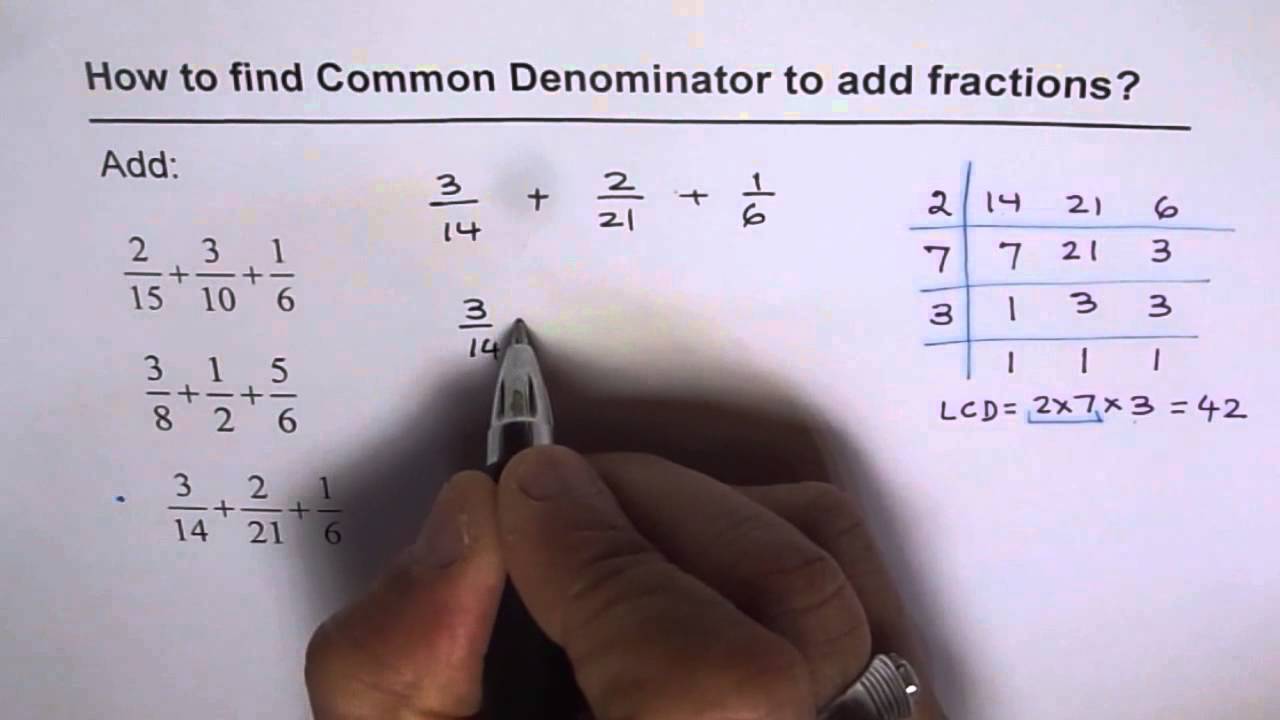
As shown in the image:
The unique prime factors are 2, 3, and 7. The highest power for each is just one (e.g., ).
So, the LCD = .
4. Putting It All Together
Now we combine finding the LCD with the final steps of addition and subtraction.
The full process is:
- Find the LCD of the denominators.
- Convert each fraction to an equivalent fraction with the new denominator. To do this, determine what you multiplied the old denominator by to get the new one, and then multiply the numerator by the same number.
- Add or subtract the numerators of the new fractions.
- Keep the LCD as the denominator.
- Simplify the final answer if possible.
The following resource is a fantastic visual summary of all four operations.

Let's watch a final video that walks through the complete process for both addition and subtraction.
Adding and Subtracting Fractions with Unlike Denominators | Math with Mr. J
Let's return to the video from Math with Mr. J. It demonstrates the full process of converting fractions to use the LCD and then completing the calculation.
Please watch the following segments: from 02:13 to 06:58 for addition examples, and from 08:03 to 14:55 for subtraction examples. Focus on how the original fractions are rewritten as equivalent fractions before the numerators are added or subtracted.
Final Check!
Perform the following calculation, showing your steps: .
Show answer
-
Find the LCD of 6 and 4.
- Multiples of 6: 6, 12, 18...
- Multiples of 4: 4, 8, 12...
- The LCD is 12.
-
Convert to equivalent fractions.
- For : To get a denominator of 12, we multiply 6 by 2. So we must also multiply the numerator by 2. .
- For : To get a denominator of 12, we multiply 4 by 3. So we must also multiply the numerator by 3. .
-
Subtract the new fractions.
- .
-
Simplify.
- The fraction is already in its simplest form.
The final answer is .
Conclusion
Great work today! You've successfully navigated the rules for all four arithmetic operations with fractions. This is a topic that trips up many people, but by focusing on the underlying logic—especially the why behind the common denominator—you've built a strong and reliable skill.
Here are the key takeaways:
- Multiplication and Division are direct. For multiplication, multiply straight across. For division, "Keep, Change, Flip" and then multiply. Remember to simplify by cancelling common factors first where possible.
- Addition and Subtraction require a common "unit size," the Least Common Denominator (LCD).
- You can find the LCD by listing multiples (intuitive) or by using prime factorisation (algorithmic and powerful).
- The full process for addition/subtraction is: Find LCD → Convert Fractions → Perform Operation → Simplify.
In our next lesson, we will begin our transition from pure arithmetic to algebra. The learning outcome will be to simplify algebraic expressions by combining like terms and applying the distributive property. You'll see how the rules of arithmetic we've covered, like BODMAS and fraction operations, apply just as well when we start working with variables.