Hello! Welcome to the third lesson in our journey through mathematics.
In our first two lessons, we established the universal rules of calculation with BODMAS and mastered arithmetic with fractions. We were working purely with numbers. Today, we take a significant and exciting step into the world of algebra, where letters, or variables, join the numbers.
The learning outcome for this lesson is to simplify algebraic expressions by combining like terms and applying the distributive property. Think of this as learning to tidy up and organise mathematical sentences to make them much easier to read and, as we'll see later, to solve. We'll be using the rules of arithmetic you've already learned, but now applying them to expressions that include variables.
1. What are "Like Terms"?
In algebra, an expression is made up of terms. A term can be a number on its own (a constant), a variable (like ), or a combination of numbers and variables multiplied together (like or ). The number part of a term is called the coefficient.
The first key to simplifying expressions is to identify like terms. These are terms that have the exact same variable part, including any powers (or indices).
- and are like terms (the variable part is ).
- and are like terms (the variable part is ).
- and are like terms (they are both constants).
- and are not like terms (different variables).
- and are not like terms (different powers/indices).
You can think of this like organising an inventory. You can add your gold coins together and you can add your silver coins together, but you can't combine 5 gold coins and 3 silver coins to get 8 of a single type of coin. They are different "terms".
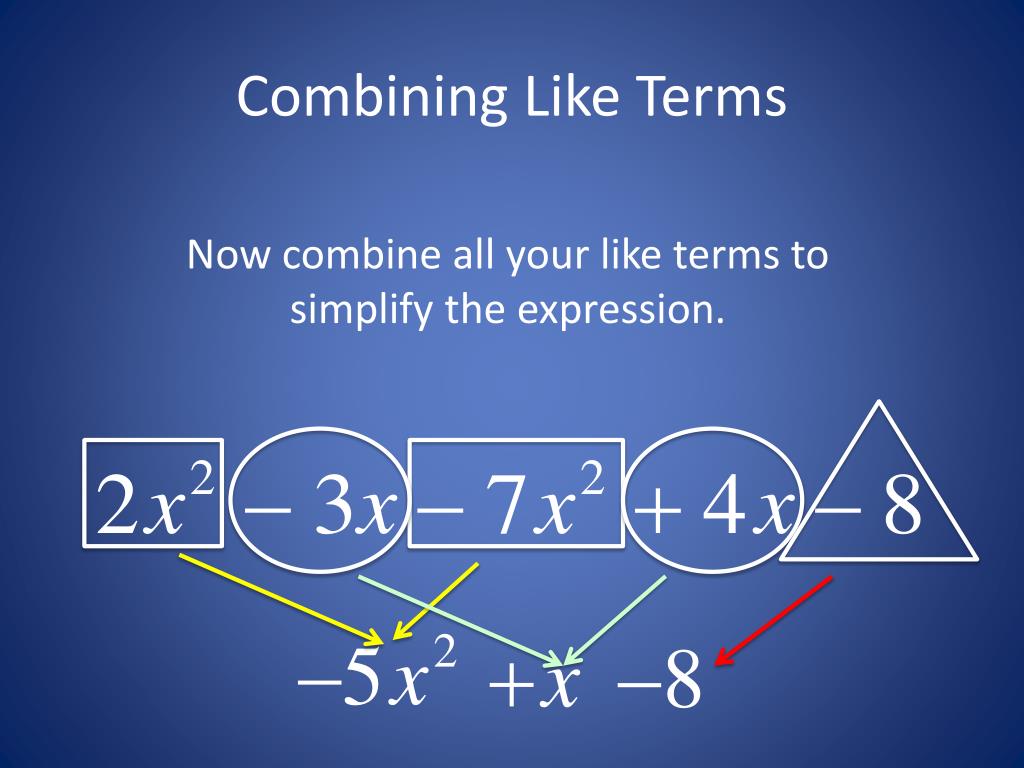
To start, let's get a formal definition and see some clear examples of identifying and combining like terms.
Combining Like Terms - Math Steps, Examples & Questions
The following article, "Combining Like Terms", clearly defines what a term is and how to group similar parts of an expression.
Please read the first two sections of this article: 'What is combining like terms?' and 'How to combine like terms'. Focus on the definition of a term and the visual explanation of why you can combine some terms but not others.
Once you've identified like terms, you combine them by adding or subtracting their coefficients. The variable part stays the same.
For example, in , we add the coefficients: .
In , we subtract the coefficients: .
Let's watch a video that walks through this process. It uses the British terminology you're familiar with.
C1 Simplifying Expressions - Corbettmaths
This video from Corbettmaths demonstrates how to simplify expressions by identifying and combining various types of like terms.
Watch the first two examples, from the beginning to 02:04. Notice how the presenter uses colours to group the different types of like terms before combining them.
Test your understanding!
Simplify the following expression by combining like terms:
Show answer
-
Group like terms:
- The 'a' terms are and .
- The 'b' terms are and .
- The constant term is .
- Grouped expression:
-
Combine coefficients:
-
Final simplified expression:
2. The Distributive Property: Expanding Brackets
What happens when we have an expression like ?
According to BODMAS, we should deal with the Brackets (parentheses) first. However, we can't add and because they aren't like terms. To handle this, we use the distributive property. This property lets us "distribute" the number outside the bracket to each term inside the bracket through multiplication. This process is commonly called expanding the brackets.
The rule is:
So, for , we multiply the 5 by the and then by the 3:
This is a crucial tool for rewriting expressions to make them simpler. Let's read a short guide on this.
Expanding brackets - Algebraic expressions - AQA
This guide from BBC Bitesize explains the process of expanding brackets clearly, using British terminology.
Please read the section titled 'Expanding brackets'. It provides a concise definition and a few clear examples, including one with a variable outside the bracket.
A very important point is to be careful with negative signs. When you distribute a negative number, the sign of each term inside the bracket will flip.
For example: .
3. Putting It All Together: Expand and Simplify
Now we'll combine both skills. Often, you will need to first expand brackets and then combine the resulting like terms. This follows the order of operations: multiplication (from expanding) happens before addition and subtraction (from combining like terms).
Example: Simplify
-
Expand the bracket:
The expression becomes: -
Identify and combine like terms:
The like terms are and .
The expression becomes:
Since and are not like terms, this is our final, simplified answer.

Let's watch a few videos that show this two-step process in full.
C1 Simplifying Expressions - Corbettmaths
First, let's finish the Corbettmaths video, which shows an example of expanding and then simplifying.
Watch the final example in the video, from 02:04 to the end. Note how the negative sign is handled when expanding the second bracket.
Simplifying Algebraic Expressions | Distributive Property & Combining Like Terms | Math with Mr. J
For a more detailed walkthrough with different types of problems, this video from Math with Mr. J is very helpful. It uses American terminology ('parentheses', 'distributive property') but the process is identical.
Watch from 00:14 to 10:11. This covers four distinct examples, starting with a basic one and progressing to more complex cases involving multiple brackets and negative signs. Pay special attention to Example 4, which demonstrates how to distribute a negative term.
Test your understanding!
Simplify the following expression completely:
Show answer
-
Expand both brackets:
- (Remember: a negative times a negative is a positive)
- The expression becomes:
-
Group like terms:
- The 'y' terms are , , and .
- The constant terms are and .
- Grouped expression:
-
Combine coefficients and constants:
-
Final simplified expression:
Conclusion
Excellent work today. You have successfully learned one of the most fundamental skills in all of algebra: simplifying expressions. This process of expanding and combining makes complex expressions manageable, which is essential for the topics that lie ahead.
Here are the key takeaways from this lesson:
- Like terms have the exact same variable part (e.g., and ). You simplify by adding or subtracting their coefficients.
- The distributive property is used to expand brackets (parentheses) when you can't simplify what's inside them. You multiply the term outside by every term inside.
- The standard procedure for simplifying is a two-step process: 1. Expand any brackets first, then 2. Combine any like terms.
In our next lesson, we will use this new skill to solve linear equations in one variable. You will see that the expressions we simplified today often appear on one side of an equation, and simplifying them is the critical first step toward finding the value of the unknown variable.