Hello! Welcome to the first lesson in your journey to explore the vast and fascinating world of mathematics. I'm excited to guide you through this process, starting from the ground up to build a solid and lasting foundation.
This first module, "Arithmetic and Algebra Fundamentals," is all about establishing the core rules and techniques that underpin almost everything else in mathematics. Today, we'll begin with the most fundamental rule of all: the order of operations.
Our goal for this lesson is to learn how to apply the order of operations, BODMAS (PEMDAS), to evaluate numerical expressions. This ensures that everyone, no matter where they are, can look at the same mathematical problem and arrive at the same, correct answer. Think of it as the grammar of mathematics. In your IT work, you know that a programming language must interpret commands in a strict and consistent order to function correctly; mathematics is no different.
1. Why Order Matters
Imagine you're faced with this calculation: 3 + 5 × 2.
If you simply work from left to right, you'd get 3 + 5 = 8, and then 8 × 2 = 16.
But what if you did the multiplication first? You'd have 5 × 2 = 10, and then 3 + 10 = 13.
Two different answers from the same expression! To prevent this ambiguity, mathematicians have agreed on a standard order. This standard is often remembered using a mnemonic. Since you're familiar with British schooling, we'll use BODMAS. I'll also provide the common American equivalent, PEMDAS, for your reference.

2. Understanding BODMAS
BODMAS tells you the hierarchy of operations, from most to least important.
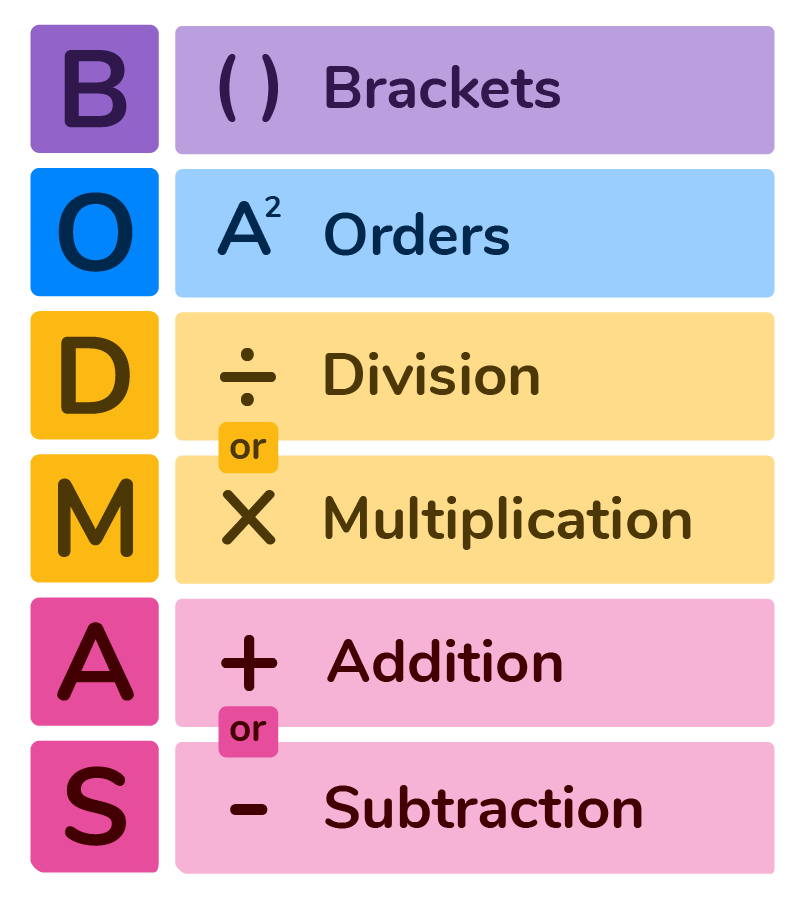
The hierarchy is as follows:
- Brackets: Always calculate what's inside brackets first. If there are brackets inside other brackets, work from the innermost set outwards. (American term: Parentheses).
- Orders: Next, deal with any powers or square roots. This is also known as indices. (American term: Exponents).
- Division and Multiplication: These two have equal importance. You don't always do division first; you simply work from left to right, completing any division or multiplication as you find it.
- Addition and Subtraction: These two also have equal importance. Just like with multiplication and division, you work from left to right.
The "left-to-right" rule for pairs of operations is the most common source of confusion, so it's worth paying special attention to.
To see a clear introduction to these rules, please watch the first part of the following video.
How to use BODMAS (Order of Operations)
This video from the Cognito channel provides a concise and clear explanation of what BODMAS stands for and, crucially, introduces the left-to-right rule for equally-ranked operations.
Watch the video from the beginning up to the timestamp 01:46. Focus on the meaning of each letter in BODMAS and the explanation of how to handle expressions containing both division and multiplication, or both addition and subtraction.
3. Putting It All Together: Worked Examples
Now that we have the rules, let's apply them. The best way to get comfortable with BODMAS is to see it in action and then try it yourself.
Let's work through an example together: 5 × (4 + 2) + 3²
-
Brackets: The expression inside the brackets is
4 + 2.4 + 2 = 6- Our expression becomes:
5 × 6 + 3²
-
Orders: We have a power,
3².3² = 3 × 3 = 9- Our expression becomes:
5 × 6 + 9
-
Division and Multiplication: We have a multiplication,
5 × 6.5 × 6 = 30- Our expression becomes:
30 + 9
-
Addition and Subtraction: Only addition is left.
30 + 9 = 39- The final answer is 39.
Notice how we rewrote the expression at each step. This is an excellent habit that makes it easier to track your work and avoid mistakes.
Now, let's watch some more complex examples being solved.
How to use BODMAS (Order of Operations)
Let's continue with the Cognito video to see how these rules are applied to more complex problems, including those with multiple brackets and operations.
Watch from 01:46 to 05:37. Pay attention to how the problems are broken down one step at a time. Notice in the second example how the operations inside the brackets must also follow BODMAS.
Test your understanding!
Use the BODMAS rules to evaluate the following expression: (10 - 5) × 3 + 8 ÷ 2
Show answer
- Brackets:
(10 - 5) = 5. The expression becomes5 × 3 + 8 ÷ 2. - Orders: There are no orders.
- Division and Multiplication (from left to right):
- First, the multiplication:
5 × 3 = 15. The expression becomes15 + 8 ÷ 2. - Next, the division:
8 ÷ 2 = 4. The expression becomes15 + 4.
- First, the multiplication:
- Addition and Subtraction:
15 + 4 = 19.
The final answer is 19.
For a comprehensive text-based review with more examples, the following resource is very helpful.
The website 'Maths is Fun' provides a great textual summary of the order of operations. It includes simple 'right vs. wrong' examples that really clarify why the order is so important.
Please read the entire page, from the top down to the final worked example that begins '7 + (6 × 5² + 3)'. Focus on the tables that show the wrong answer next to the right one, and the clear explanation of the left-to-right rule.
4. The Left-to-Right Rule in Focus
Let's reinforce the crucial left-to-right rule for Addition/Subtraction, as this is where many errors happen.
Consider 20 - 7 + 3.
-
Correct approach (left-to-right):
20 - 7 = 1313 + 3 = 16
- The correct answer is 16.
-
Incorrect approach (doing addition before subtraction):
7 + 3 = 1020 - 10 = 10
- This gives an incorrect answer of 10.
The same principle applies to Division/Multiplication. In the expression 12 ÷ 6 × 3, you perform the division first because it comes first when reading from left to right.
Final Check!
Evaluate the expression 7 + 3 × (10 ÷ 2) - 4. Show each step of your calculation.
Show answer
- Brackets:
(10 ÷ 2) = 5. The expression is now7 + 3 × 5 - 4. - Orders: None.
- Division and Multiplication:
3 × 5 = 15. The expression is now7 + 15 - 4. - Addition and Subtraction (left-to-right):
7 + 15 = 22.22 - 4 = 18.
The final answer is 18.
Conclusion
Congratulations on completing your first lesson! You've established the foundational rule that governs all mathematical calculations. Without it, our results would be inconsistent and unreliable.
Here are the key takeaways from today's lesson:
- BODMAS provides the standard order for performing operations in any numerical expression.
- The hierarchy is: Brackets, then Orders, then Division/Multiplication, and finally Addition/Subtraction.
- Operations of equal priority (D/M and A/S) are handled by working from left to right as they appear in the expression.
In our next lesson, we will move on to working with a specific type of number that often appears in calculations: fractions. We'll cover how to add, subtract, multiply, and divide them, skills that will integrate directly with the order of operations you've learned today.